
Momentum and impulse explain what happens when things crash, bounce, catch or explode. This guide covers the formulas, the force-time graph, conservation of momentum, collisions and recoil, with three worked examples and the mistakes that cost marks.
Key takeaways
- Momentum is mass times velocity: p = mv. It is a vector, measured in kg m/s.
- Impulse is force times time: J = FΔt. Impulse equals the change in momentum.
- The area under a force-time graph is the impulse.
- In a closed system, total momentum before an event equals total momentum after it.
- Momentum is conserved in every collision. Kinetic energy is conserved only in elastic ones.
What are momentum and impulse?
Quick answer: Momentum is how much "motion" an object carries: its mass times its velocity (p = mv), measured in kg m/s. Impulse is the push that changes momentum: average force times the time it acts (J = FΔt). The impulse-momentum theorem says impulse equals change in momentum, so FΔt = mv − mu.
Both come from Newton's second law (see Newton's three laws).
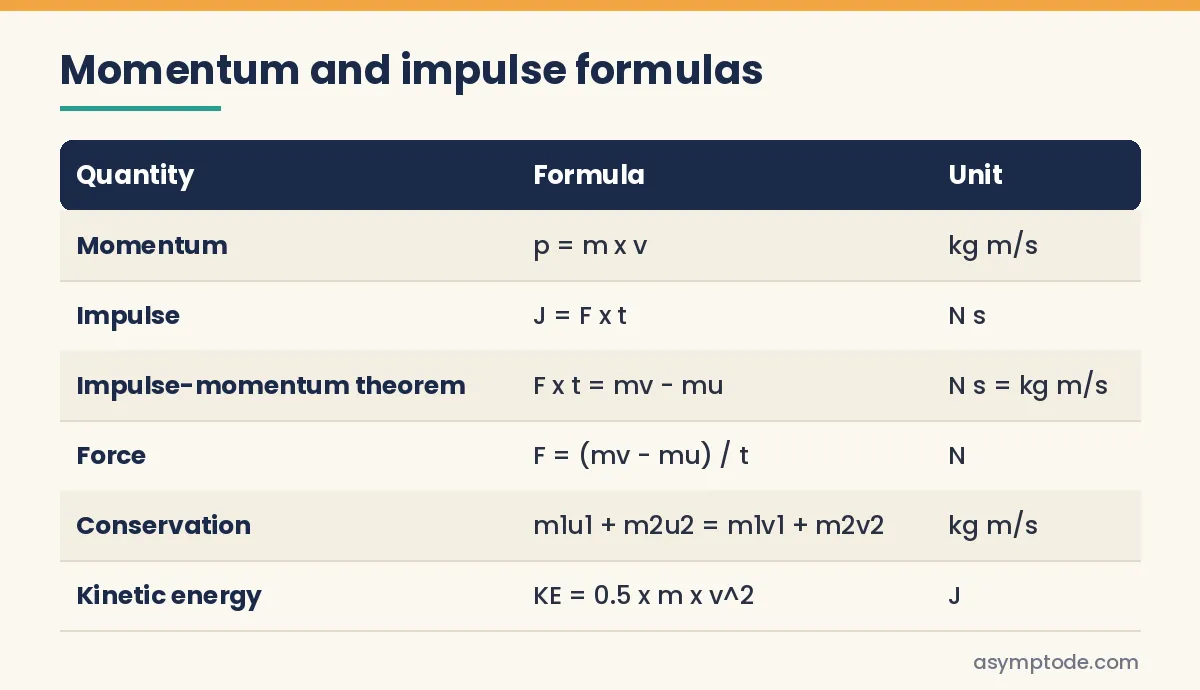 The six formulas you need for momentum and impulse.
Momentum: p = m × v, in kg m/s. Impulse: J = F × t, in N s. Impulse-momentum theorem: F × t = mv − mu. Force: F = (mv − mu) / t, in newtons. Conservation: m₁u₁ + m₂u₂ = m₁v₁ + m₂v₂. Kinetic energy: KE = ½mv², in joules.
What is momentum in physics?
p = mv, where p is momentum (kg m/s), m is mass (kg) and v is velocity (m/s).
Velocity has a direction, so momentum is a vector. A 1,000 kg car moving east at 20 m/s has 20,000 kg m/s of momentum east. Moving west, it has 20,000 kg m/s west. In one-dimensional problems, show this with a sign: east +, west −.
What is impulse, and how does it change momentum?
Impulse is average force times the time it acts: J = FΔt. Its unit is the newton second (N s), which equals one kg m/s.
Start from F = ma, write a as (v − u)/Δt, and multiply by Δt. You get the impulse-momentum theorem:
FΔt = mv − mu = Δp
So a force acting for longer gives a bigger change in momentum, and force is the rate of change of momentum: F = Δp/Δt. Impulse is a vector, pointing the same way as the net force.
How do you find impulse from a force-time graph?
When a foot kicks a ball, the force rises and then falls. The impulse is the area under the force-time graph.
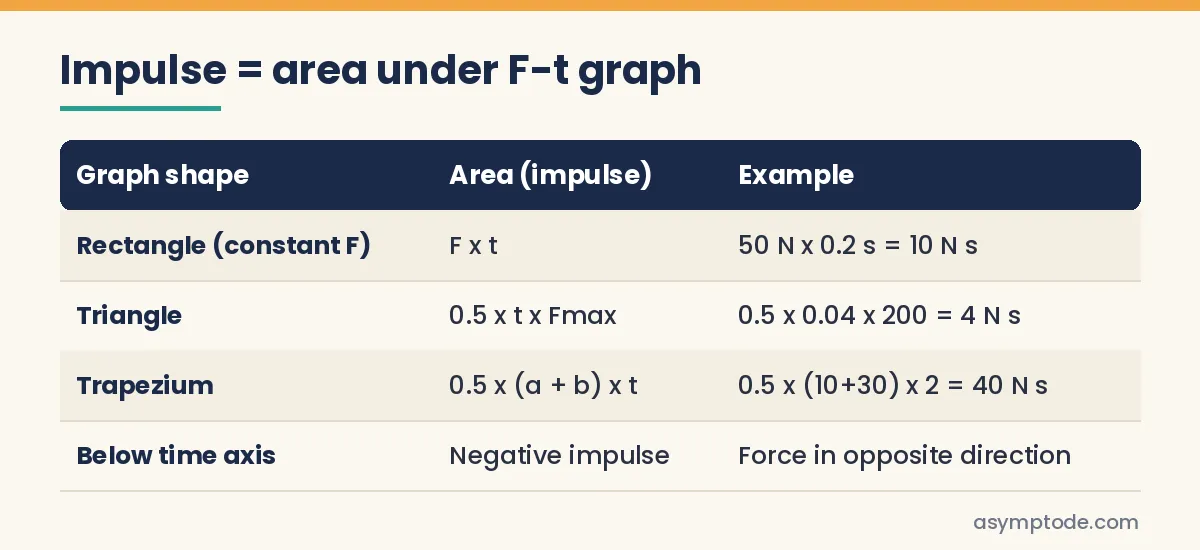 Impulse is the area between the force-time line and the time axis.
- Rectangle (constant force): area = F × t. Example: 50 N × 0.2 s = 10 N s.
- Triangle (force rises then falls): area = ½ × t × Fmax. Example: ½ × 0.04 × 200 = 4 N s.
- Trapezium (force changes steadily from a to b): area = ½ × (a + b) × t. Example: ½ × (10 + 30) × 2 = 40 N s.
- Area below the time axis is negative impulse (force in the opposite direction).
The reverse also works. On a momentum-time graph, the slope is the net force.
What is the law of conservation of momentum?
In a closed system (no net external force), total momentum before an event equals total momentum after it. For two objects:
m₁u₁ + m₂u₂ = m₁v₁ + m₂v₂
Here u is velocity before and v is velocity after. By Newton's third law, each object pushes the other with an equal and opposite force for the same time. So one object gains exactly the momentum the other loses.
What is the difference between elastic and inelastic collisions?
| Collision type | Momentum conserved? | Kinetic energy conserved? | Example |
|---|---|---|---|
| Elastic | Yes | Yes | Gas molecules, near-ideal snooker balls |
| Inelastic | Yes | No, some KE is lost | A car crash where cars bounce apart |
| Perfectly inelastic | Yes | No, the most KE is lost | Objects stick and move together |
To check, add up KE = ½mv² before and after. Equal totals mean elastic; a drop means inelastic. The "lost" energy goes into heat, sound and changing the objects' shape. Our work-energy theorem guide covers the energy side.
Worked example 1: what force does a bat apply?
A 0.15 kg ball moves toward a bat at 20 m/s. The bat sends it straight back at 30 m/s. Contact lasts 0.010 s. Find the average force.
- Take the ball's first direction as positive: u = +20 m/s, v = −30 m/s.
- Change in momentum: Δp = m(v − u) = 0.15 × (−30 − 20) = 0.15 × (−50) = −7.5 kg m/s.
- Average force: F = Δp/Δt = −7.5 ÷ 0.010 = −750 N.
- Answer: the bat pushes with 750 N, opposite to the ball's original direction.
Worked example 2: two carts that stick together
A 2 kg cart at 3 m/s hits a 1 kg cart at rest. They stick together.
 Momentum stays at 6 kg m/s, but 3 J of kinetic energy is lost.
- Momentum before: (2 × 3) + (1 × 0) = 6 kg m/s.
- They stick, so the total mass after is 2 + 1 = 3 kg.
- Momentum after = momentum before: 3 × v = 6, so v = 2 m/s.
- KE before: ½ × 2 × 3² = 9 J. KE after: ½ × 3 × 2² = 6 J.
- 3 J of kinetic energy was lost, so this is a perfectly inelastic collision.
Worked example 3: recoil of a rifle (an explosion)
An explosion is a collision in reverse. Everything starts at rest, so total momentum is zero before and after.
A 4.0 kg rifle fires a 0.010 kg bullet at 400 m/s. Find the rifle's recoil velocity.
- Momentum before = 0.
- Bullet momentum after: 0.010 × 400 = 4.0 kg m/s.
- Total must stay 0, so the rifle has −4.0 kg m/s.
- Rifle velocity: −4.0 ÷ 4.0 = −1.0 m/s, so it recoils at 1.0 m/s, opposite to the bullet.
Kinetic energy increases in an explosion, because chemical energy turns into motion. Momentum is still conserved.
Book a free demo class to practise momentum problems with a mentor, or see plans and fees.
Why do airbags and bent knees reduce the force?
The change in momentum is fixed by your starting speed. Since F = Δp/Δt, a longer Δt means a smaller force.
 Same change in momentum, ten times the stopping time, one tenth of the force.
A 60 kg jumper lands at 5 m/s, so the change in momentum is 60 × 5 = 300 kg m/s. Stiff legs stop the body in 0.05 s: average force = 300 ÷ 0.05 = 6,000 N. Bent knees stop it in 0.5 s: average force = 300 ÷ 0.5 = 600 N, ten times less. (Average net forces; we ignore the jumper's weight.)
Airbags, seat belts, crumple zones, crash mats, cycle helmets and soft playground surfaces all increase stopping time, which lowers the rate of change of momentum and the force.
What are the most common mistakes with momentum and impulse?
- Ignoring direction. Pick a positive direction and stick to it. A ball that bounces back has a negative final velocity.
- Adding speeds, not vectors. Carts moving toward each other have momenta of opposite signs. In two dimensions, treat x and y separately, as in projectile motion.
- Mixing units. 10 g is 0.010 kg; 10 ms is 0.010 s.
- Assuming KE is conserved. Only do this if the collision is elastic.
- Forgetting the combined mass when objects stick.
- Using peak force, not area. Impulse is the area under the force-time graph.
Where do momentum and impulse appear in your syllabus?
| Course | Where it sits | What is covered |
|---|---|---|
| AP Physics 1 | Unit 4: Linear Momentum (10–15% of the multiple-choice section) | Impulse, conservation, collisions |
| AQA GCSE Physics (8463) | 4.5.7 Momentum, Higher Tier only | p = mv, conservation; changes in momentum (physics only) |
| AQA A-level Physics (7408) | 3.4.1.6 Momentum | Impulse, force-time graphs, collisions, explosions (1D) |
| JEE Main 2027 | Physics Unit 3 (Laws of Motion) and Unit 4 (Work, Energy and Power) | Impulse, conservation, collisions in 1D and 2D |
- AP Physics 1: Unit 4 topics are 4.1 Linear Momentum, 4.2 Change in Momentum and Impulse, 4.3 Conservation of Linear Momentum and 4.4 Elastic and Inelastic Collisions (official Course and Exam Description; our AP Physics 1 exam guide).
- AQA GCSE: the 8463 forces content asks you to explain air bags, seat belts, crash mats, cycle helmets and cushioned playgrounds. See our GCSE Physics guide.
- AQA A-level: the 7408 mechanics content links impact force to contact time (footballs, crumple zones, packaging). See our A-level Physics guide.
- JEE Main 2027: see the NTA JEE (Main) 2027 syllabus and our JEE Main 2027 guide.
- IB, NEET and others: check your official syllabus.
How 1-on-1 tutoring helps with momentum and impulse
- One dedicated mentor, live online 1-on-1, following your own syllabus and exam dates: AP, GCSE, A-level or JEE.
- Method first. Your mentor watches each step of your working, so sign errors and unit slips get caught early.
- Personalised homework with feedback on collision, recoil and force-time graph questions.
- Every class recorded, short parent updates, and a free demo class to start.
Facts checked against official sources on 7 November 2026.
FAQ
Is momentum a vector or a scalar?
A vector. It points the same way as the velocity. In one-dimensional problems, show direction with a + or − sign.
What is the unit of impulse?
Newton seconds (N s). This equals kg m/s, the unit of momentum, because impulse is a change in momentum.
Is momentum conserved in an inelastic collision?
Yes. Momentum is conserved in every collision in a closed system. Only the kinetic energy goes down.
What is the difference between momentum and kinetic energy?
Momentum (mv) is a vector and is conserved in every collision. Kinetic energy (½mv²) is a scalar and is conserved only in elastic collisions.
Why does a longer contact time reduce the force?
The change in momentum is fixed by the start and end velocities. Force is change in momentum divided by time, so a longer time means a smaller force. That is how airbags and crash mats protect you.
Is momentum on the AQA GCSE Foundation paper?
No. In AQA GCSE Physics (8463), section 4.5.7 Momentum is marked Higher Tier only. Check the AQA specification for details.
Ready to start? Book a free demo class and advisor call, or see our plans and fees.