
The AP Calculus BC exam is on Monday, May 10, 2027, in the morning session, and it now runs 3 hours 10 minutes in a new, shorter format. This guide explains what changed, what each of the 10 units is worth, how the AB subscore works, and how to handle the BC-only topics: parametric and polar curves, and series. It is written for US and Canadian students and parents planning from now until May.
Key takeaways
- The AP Calculus BC exam is on Monday, May 10, 2027, Session 1 (8 a.m. local time at most US schools).
- The 2027 exam has 42 multiple-choice questions (down from 45) and 6 free-response questions, in 3 hours 10 minutes.
- Units 9 and 10 (parametric, polar, vectors, and series) are BC only and together carry 25-35% of the exam.
- Every BC student also gets a Calculus AB subscore from 1 to 5.
- The on-time order deadline (Nov 13, 2026) has passed; orders from Nov 14, 2026 to Mar 12, 2027 carry a $40 late fee per exam.
What is on the AP Calculus BC exam in 2027?
Quick answer: The AP Calculus BC exam tests all of AP Calculus AB plus extra topics: parametric equations, polar coordinates, vector-valued functions, and infinite series. It has 42 multiple-choice questions in 1 hour 40 minutes and 6 free-response questions in 1 hour 30 minutes. Each section counts for 50% of the score.
BC covers everything in AB and goes further. A student cannot take both the AB and BC exams in the same year; both are set for the same slot. If you are still choosing, read our AP Calculus AB vs BC guide.
Who should take AP Calculus BC?
BC suits students who are strong in algebra and trigonometry. The College Board recommends algebra, geometry, trigonometry, analytic geometry, and elementary functions, plus some familiarity with sequences, series, and polar equations.
If you took AP Precalculus, our AP Precalculus exam guide shows which skills carry over. Three skills matter most:
- Logarithms, used in integrals, logistic models, and series: logarithms explained.
- Trig identities, needed for polar areas and integrals: trigonometric identities explained.
- Radians, used in all calculus with trig: radians and the unit circle explained.
What is the AP Calc BC format in 2027?
The exam is hybrid digital. You answer multiple-choice questions in the Bluebook app. You read the free-response questions in Bluebook but write your answers by hand in a paper booklet.
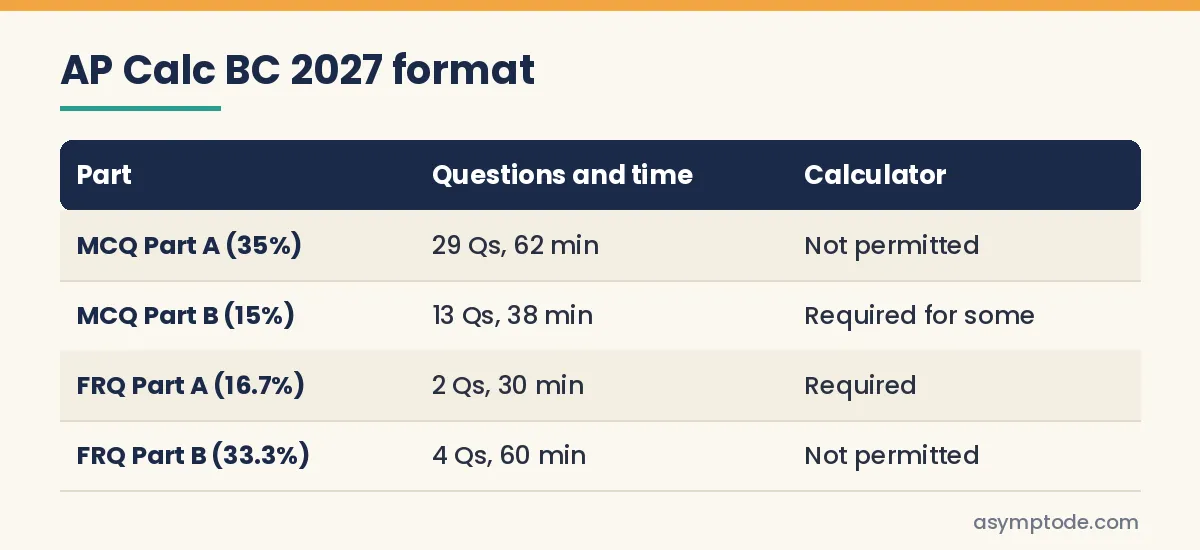 The four parts of the 2027 AP Calculus BC exam.
Multiple-choice Part A has 29 questions in 62 minutes with no calculator (35%). Multiple-choice Part B has 13 questions in 38 minutes, with a graphing calculator required for some questions (15%). Free-response Part A has 2 questions in 30 minutes with a graphing calculator required (16.7%). Free-response Part B has 4 questions in 60 minutes with no calculator (33.3%).
How is the new format different from the old one?
The change is in the multiple-choice section only. It takes effect from fall 2026, so it applies to the May 2027 exam.
| Part | Old format | New format (May 2027) |
|---|---|---|
| MCQ Part A (no calculator) | 30 questions, 60 min | 29 questions, 62 min |
| MCQ Part B (calculator) | 15 questions, 45 min | 13 questions, 38 min |
| MCQ total | 45 questions, 1 h 45 min | 42 questions, 1 h 40 min |
| FRQ Part A (calculator) | 2 questions, 30 min | 2 questions, 30 min |
| FRQ Part B (no calculator) | 4 questions, 60 min | 4 questions, 60 min |
| Whole exam | 3 h 15 min | 3 h 10 min |
Older practice sets still teach the right skills, but time yourself with the new numbers: about 2 minutes 8 seconds per question in Part A, and just under 3 minutes per question in Part B. The same document also clarifies two statements (on the Extreme Value Theorem and on differential equations having infinitely many solutions). No topics were added or removed. See the official clarifications PDF.
Which calculator can I use?
You can use the Desmos graphing calculator built into Bluebook. You can also bring up to two approved handheld graphing calculators. Desmos appears only in the calculator parts (MCQ Part B and FRQ Part A). Calculators with QWERTY keyboards or wireless features are not allowed, and you cannot share. The list is marked 2026-27 and can change, so check the official calculator policy before exam day.
What are the AP Calc BC units and their weights?
There are 10 units. Units 1-8 are shared with AB, and Units 9 and 10 are BC only. These weights are for the BC exam, from the College Board course page.
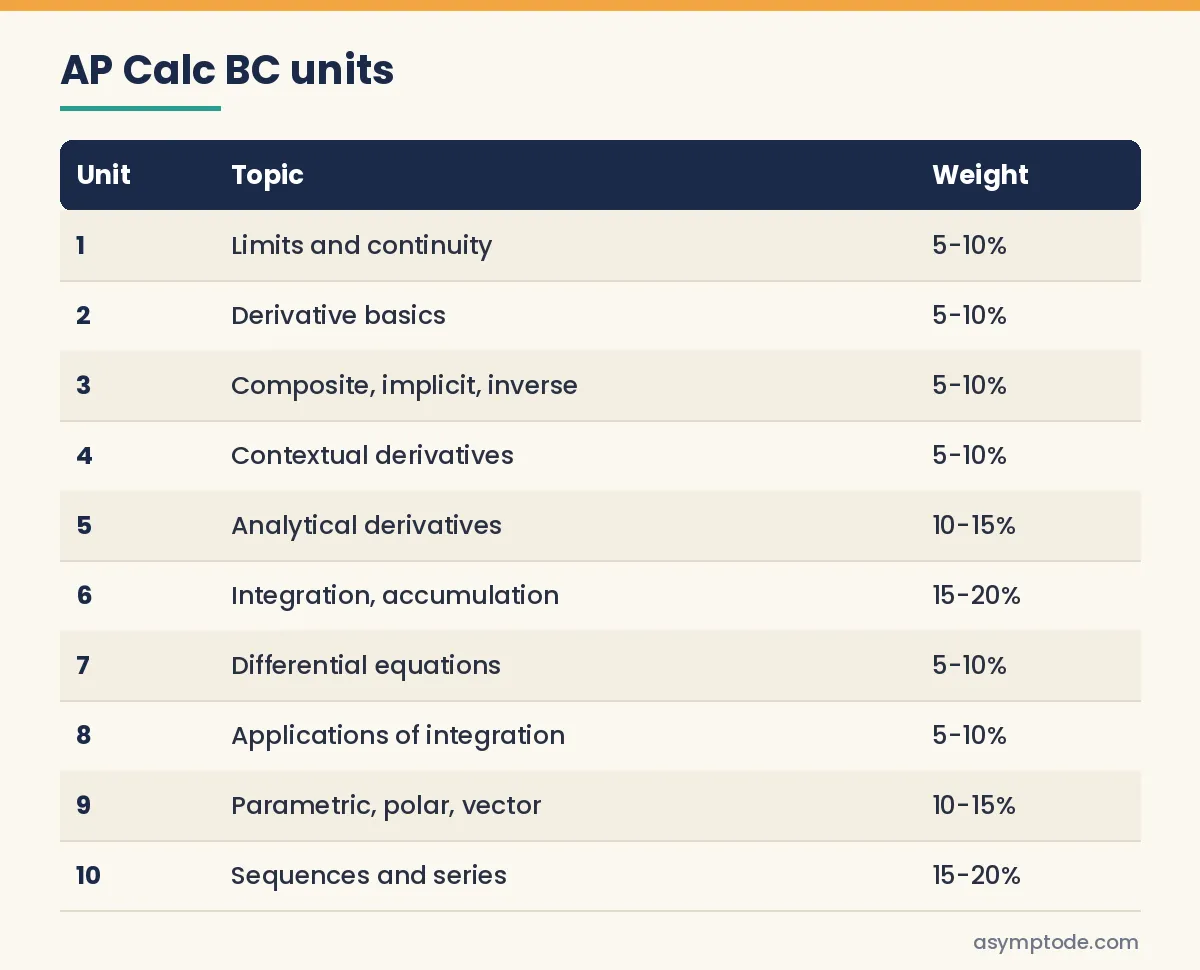 All 10 AP Calculus BC units with official exam weights.
| Unit | Topic | BC exam weight |
|---|---|---|
| 1 | Limits and Continuity | 5-10% |
| 2 | Differentiation: Definition and Fundamental Properties | 5-10% |
| 3 | Differentiation: Composite, Implicit, and Inverse Functions | 5-10% |
| 4 | Contextual Applications of Differentiation | 5-10% |
| 5 | Analytical Applications of Differentiation | 10-15% |
| 6 | Integration and Accumulation of Change | 15-20% |
| 7 | Differential Equations | 5-10% |
| 8 | Applications of Integration | 5-10% |
| 9 | Parametric Equations, Polar Coordinates, and Vector-Valued Functions (BC only) | 10-15% |
| 10 | Infinite Sequences and Series (BC only) | 15-20% |
Units 6 and 10 are the biggest, at 15-20% each. Units 5 and 9 are 10-15%. Every other unit is 5-10%. For a refresher on Units 2-3, see differentiation explained.
Which BC-only topics hide inside Units 6, 7 and 8?
These are easy to miss if you study from AB-only materials.
- Unit 6: integration by parts, linear partial fractions, and improper integrals.
- Unit 7: Euler's method and logistic models with differential equations.
- Unit 8: arc length of a smooth curve and distance traveled.
What is in Units 9 and 10?
Unit 9 covers parametric and vector derivatives, arc length, particle motion in a plane, polar derivatives, and polar area.
Unit 10 covers convergence tests, error bounds, radius and interval of convergence, and Taylor and Maclaurin series.
What is the AB subscore?
Every BC student gets two scores: the BC score and a Calculus AB subscore, both from 1 to 5. The subscore is based on the AB part of the exam, which is about 60% of it. The College Board recommends that colleges treat the AB subscore the same way as an AP Calculus AB score. Each college sets its own credit and placement policy, so check the college's own page. Details are on the College Board subscore page.
How did students score on AP Calculus BC in 2025?
These are the official global numbers for May 2025, from the College Board score distribution PDF. 160,954 students took the exam, and the mean score was 3.82.
| Score | BC score (2025) | AB subscore (2025) |
|---|---|---|
| 5 | 43.9% | 47.7% |
| 4 | 21.8% | 30.5% |
| 3 | 12.8% | 9.8% |
| 2 | 15.2% | 9.0% |
| 1 | 6.2% | 3.0% |
The AB subscore numbers come from the official AB subscore PDF (mean 4.11). Past results do not predict any one student's score.
Which BC series test should I use?
The key to series is choosing a test quickly. Look at the shape of the terms first.
| Test | Use when | Example |
|---|---|---|
| nth-term (divergence) test | Terms do not go to 0 | sum of n/(n+1) diverges |
| Geometric series | Each term is the last times r | sum of (2/3)^n converges, since abs(r) < 1 |
| p-series | Terms look like 1/n^p | sum of 1/n^2 converges (p = 2 > 1) |
| Integral test | Terms are positive, decreasing, easy to integrate | sum of 1/n diverges |
| Direct or limit comparison | Terms look like a known series | sum of 1/(n^2 + 1), compare with 1/n^2 |
| Alternating series test | Signs alternate and terms shrink to 0 | sum of (-1)^n/n converges |
| Ratio test | Factorials or powers like 3^n | sum of n/3^n converges |
The nth-term test can only show divergence. If the terms go to 0, it tells you nothing.
Three worked BC examples
All numbers below were checked with a calculation.
Example 1: Does the sum of n/3^n converge?
- The terms have a power, 3^n, so use the ratio test.
- a(n+1)/a(n) = [(n+1)/3^(n+1)] / [n/3^n] = (n+1)/(3n).
- As n grows, (n+1)/(3n) goes to 1/3.
- Since 1/3 < 1, the series converges by the ratio test.
On an FRQ, show the limit, compare it to 1, and name the test.
Example 2: A parametric derivative
A particle moves with x = t^2 and y = t^3 - 3t. Find dy/dx at t = 2.
- dx/dt = 2t = 4 at t = 2.
- dy/dt = 3t^2 - 3 = 9 at t = 2.
- dy/dx = (dy/dt)/(dx/dt) = 9/4.
- The point is (4, 2), so the tangent line is y - 2 = (9/4)(x - 4).
For polar curves, write x = r cos(theta) and y = r sin(theta), then do the same.
Example 3: A Taylor polynomial and its error
Estimate sin(0.1) with the third-degree Maclaurin polynomial.
 Third-degree Maclaurin polynomial for sin x, evaluated at 0.1.
The series is sin x = x - x^3/3! + x^5/5! - ... So P3(x) = x - x^3/3! = x - x^3/6. Then P3(0.1) = 0.1 - 0.001/6, which is about 0.0998333. The series alternates and the terms shrink, so the error is at most the next term: (0.1)^5/5!, which is about 0.0000000833. The true value of sin(0.1) is about 0.0998334, so the estimate is inside the bound.
On the exam, say why the bound works: the terms alternate, decrease, and go to 0. Some questions ask for the Lagrange error bound instead.
How do I score points on BC free-response questions?
The free-response section is half the exam, and your written reasoning earns the points. Use the official past exam questions. AP Central has BC free-response questions from 2023 to 2026. The 2023-2025 sets include scoring guidelines, sample responses, and chief reader reports. The 2026 set has questions and scoring guidelines.
- Name the test and check its conditions. "Converges by the alternating series test" needs all three conditions shown.
- Show the limit for the ratio test. Write the limit and compare it to 1.
- State the error bound you use. Say "alternating series error bound" or "Lagrange error bound", and show the term or the max value you used.
- Write units. Context questions want units like meters per second.
- Show the setup on calculator questions. Write the integral, then the answer from your calculator.
What are the most common BC mistakes?
- Using the nth-term test to "prove" a series converges.
- Forgetting to check the endpoints of an interval of convergence.
- Mixing up speed and velocity in parametric motion. Speed is the square root of (dx/dt)^2 + (dy/dt)^2.
- Missing the 1/2 in the polar area formula, which is (1/2) times the integral of r^2.
- Using degrees instead of radians on the calculator.
What is a good study plan from November to May?
Schools set their own pace for BC, so match this plan to your class.
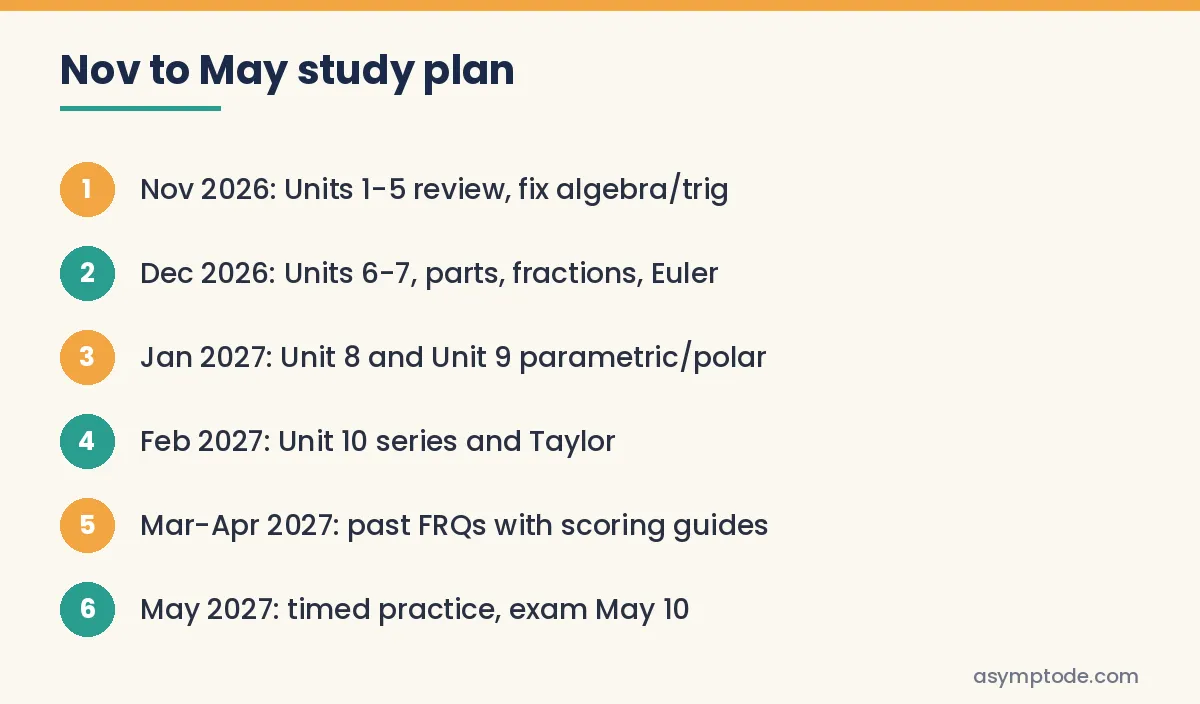 A month-by-month AP Calculus BC study plan.
- November 2026: review limits and derivatives (Units 1-5) and fix algebra and trig gaps.
- December 2026: Units 6-7, including integration by parts, partial fractions, and Euler's method.
- January 2027: Unit 8 and Unit 9 (parametric, polar, and vector functions).
- February 2027: Unit 10, series tests and Taylor polynomials.
- March-April 2027: past free-response questions, checked against the scoring guidelines.
- May 2027: timed practice with the new format, then the exam on May 10.
Your teacher may also assign practice in AP Classroom, the College Board's online resource for AP courses. For all AP dates in one place, see our AP exam dates 2027 guide.
How much does the AP Calculus BC exam cost?
The 2026-27 fee is $99 per exam at schools in the US, US territories, Canada, and DoDEA schools. It is $129 at schools elsewhere. The on-time order deadline was November 13, 2026. Orders placed from November 14, 2026 to March 12, 2027 have a $40 late fee per exam. March 12, 2027 is also the deadline for courses that start after November 13. Eligible students can get a $37 fee reduction per exam. See the official exam fees page.
The Calculus late-testing slot is Thursday, May 20, 2027, in the afternoon session; your AP coordinator arranges it. Parents can learn more in our AP guide for parents.
Want help with series or polar curves? Book a free demo class with an Asymptode mentor, or see our plans and fees.
How Asymptode Can Help You Prepare for the AP Calculus BC Exam
At Asymptode, an experienced calculus mentor teaches your child one-to-one, live online. It is never a batch class. The mentor follows the student's own school AP Calculus BC course and plans toward the May 10, 2027 exam date. That includes the BC-only parts: parametric and polar curves, vector-valued functions, and series.
The mentor watches each step of the working. So a wrong step, such as a missing condition for the alternating series test or a lost 1/2 in a polar area, is traced back to the idea behind it.
Every class is recorded and searchable by topic. The student can jump back to the exact point where Taylor polynomials or the ratio test was taught.
After class, the student gets practice worksheets on the topics taught, built from what their last attempt showed. These are prepared with AI assistance and sent only after the student's own mentor approves them. AI supports the mentor; it does not teach or mark on its own.
Parents can follow progress in the parent progress view. To start, book a free demo class and advisor call or see our fees.
Related guides
- AP Calculus AB vs BC prep guide
- AP Precalculus exam guide
- AP exam dates 2027
- AP complete guide for parents
Facts checked against official College Board sources on 14 November 2026.
FAQ
When is the AP Calculus BC exam in 2027?
It is on Monday, May 10, 2027, in Session 1, which is usually the morning. At most US schools, Session 1 starts at 8 a.m. local time. Your AP coordinator will confirm the time and room.
How long is the AP Calculus BC exam?
It is 3 hours 10 minutes: 1 hour 40 minutes of multiple choice and 1 hour 30 minutes of free response. The old format was 3 hours 15 minutes.
Can I take both AP Calculus AB and BC?
No, not in the same year. Both exams are in the same slot on May 10, 2027. BC students get an AB subscore instead, which colleges are advised to treat like an AB score.
Is a calculator allowed on the AP Calc BC exam?
Yes, but only in MCQ Part B and FRQ Part A. You can use Desmos inside Bluebook or up to two approved handheld graphing calculators. The other parts are calculator-free.
What are the BC-only units?
Unit 9 (parametric, polar, and vector-valued functions) is worth 10-15%, and Unit 10 (sequences and series) is worth 15-20%. BC also adds topics like integration by parts and Euler's method to shared units.
Is it too late to register for the 2027 exam?
No, but there is a fee. The on-time deadline was November 13, 2026. Orders from November 14, 2026 to March 12, 2027 have a $40 late fee per exam, so talk to your school's AP coordinator soon.
Ready to start? Book a free demo class and advisor call, or see our plans and fees.
Sources
- AP Calculus BC Exam (AP Students)
- AP Calculus BC Exam (AP Central)
- AP Calculus BC course and units
- AP Calculus AB and BC CED clarifications (effective fall 2026)
- 2027 AP Exam Dates
- 2027 AP Exam Late-Testing Dates
- AP Exam Calculator Policy
- Special Score Structure: Calculus BC
- AP Calculus BC 2025 Score Distributions
- AP Calculus BC 2025 AB Subscore Distributions
- AP Calculus BC Past Exam Questions
- AP Exam Fees 2026-27