
If you are wondering how to become a physiotherapist, the short version is this: finish school with strong biology, earn an approved physiotherapy degree, then register with the regulator in the country where you want to work. The details change from country to country. This guide walks parents and students through each step, from Grade 9 subject choices to your first licence, using only official sources.
Key takeaways
- Every route needs an approved or accredited physiotherapy programme, then registration or a licence.
- Biology is the core school subject. PE, chemistry and physics help too.
- In the UK, most undergraduate courses for 2027 entry have a UCAS deadline of 13 January 2027, 18:00 UK time.
- In the USA, you need a Doctor of Physical Therapy (DPT), then the NPTE and a state licence.
- In India, BPT rules are changing under the NCAHP, so check each university's official page.
How to become a physiotherapist: what are the main steps?
Quick answer: To become a physiotherapist, take biology (and ideally PE, chemistry or physics) at school, gain some care or sports work experience, and complete an approved physiotherapy degree or degree apprenticeship. Then register with your country's regulator, such as the HCPC in the UK, before you can practise and use the protected title.
The core path looks the same in most countries. Only the names of the degrees, exams and regulators change.
 The general path to becoming a physiotherapist.
The animation shows five steps. First, pick science subjects at school, with biology at the core. Second, get work experience in care or sport. Third, apply to an approved physiotherapy course. Fourth, complete the degree with clinical placements. Fifth, register or get licensed, then start work.
What does a physiotherapist do?
A physiotherapist helps people move better and recover from injury, illness or surgery. The UK National Careers Service lists the main tasks:
- Assess joint and movement problems.
- Plan treatment using exercises, massage and ultrasound.
- Advise patients on how to reduce the risk of injury.
- Keep accurate records of treatment and progress.
- Work closely with other health professionals.
In the USA, the same job is called a physical therapist. In the UK, both "physiotherapist" and "physical therapist" are protected titles. You must be on the HCPC Register to use them.
After you qualify and gain clinical experience, you can specialise. Sports injuries and rehabilitation is one example the National Careers Service gives.
If your child is also weighing other health careers, compare this guide with how to become a doctor and how to become a pharmacist.
Which school subjects do you need to become a physiotherapist?
Biology matters most. Almost every official source names it.
- England, Wales and Northern Ireland: NHS Health Careers says courses usually ask for two or three A levels, including a biological science and/or PE. They also ask for five GCSEs, including English language, maths and at least one science.
- Scotland: NHS Scotland Careers lists Human Biology, PE, Care, Physics, Chemistry, English and Maths as useful subjects.
- India: the NCAHP physiotherapy curriculum asks for 10+2 with Physics, Chemistry and Biology, with at least 50% marks.
- USA: DPT programmes usually need a bachelor's degree plus prerequisites such as anatomy, chemistry and physics, says the US Bureau of Labor Statistics.
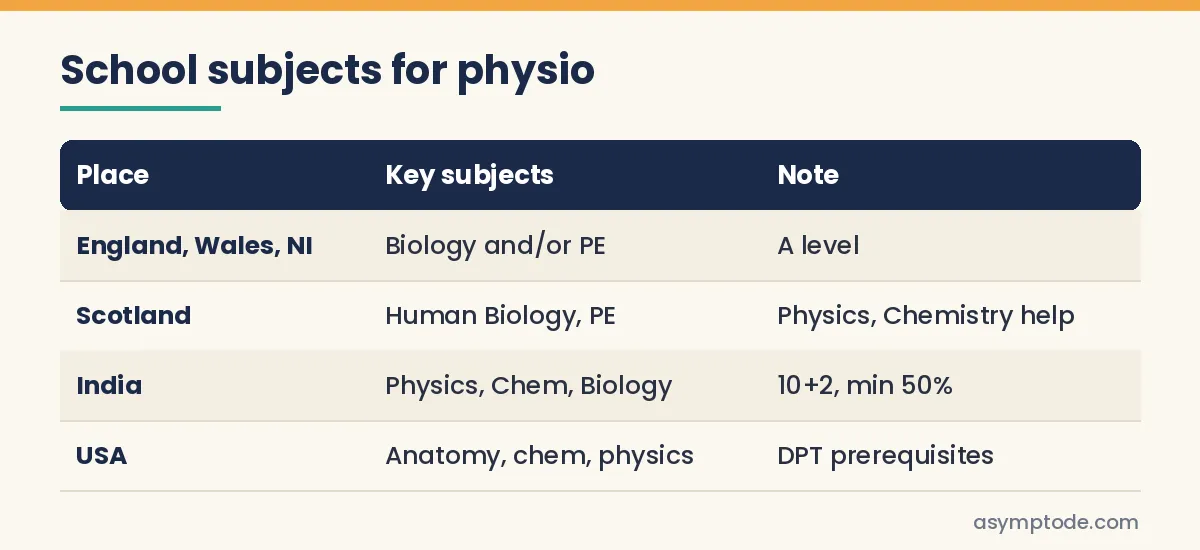 Key school subjects for physiotherapy, by country.
The table lists the subjects by place. In England, Wales and Northern Ireland, it is biology and/or PE at A level. Scotland lists Human Biology, PE, Physics and Chemistry. India needs Physics, Chemistry and Biology at 10+2 with 50%. In the USA, DPT prerequisites include anatomy, chemistry and physics.
Each university sets its own grades and rules, so always check the course page.
Why does chemistry or physics help?
Physiotherapy uses body science every day. Chemistry helps with how drugs, cells and muscles work. Physics helps with forces, levers and movement. Even when a course only asks for biology, a second science makes the first year easier. Our A level chemistry guide and GCSE combined science guide explain those courses step by step.
How do you become a physiotherapist in each country?
The table below sums up the main routes. Details follow in each section.
| Country | Degree | Registration or licence |
|---|---|---|
| UK | HCPC-approved BSc, MSc or degree apprenticeship | HCPC registration |
| USA | Doctor of Physical Therapy (CAPTE-accredited) | Pass the NPTE, then a state licence |
| India | Bachelor of Physiotherapy (BPT) | Under the NCAHP Act 2021 |
| Australia | Board-approved programme of study | Physiotherapy Board of Australia (Ahpra) |
| Canada | PEAC-accredited entry-to-practice programme | CPTE exam, then a provincial regulator |
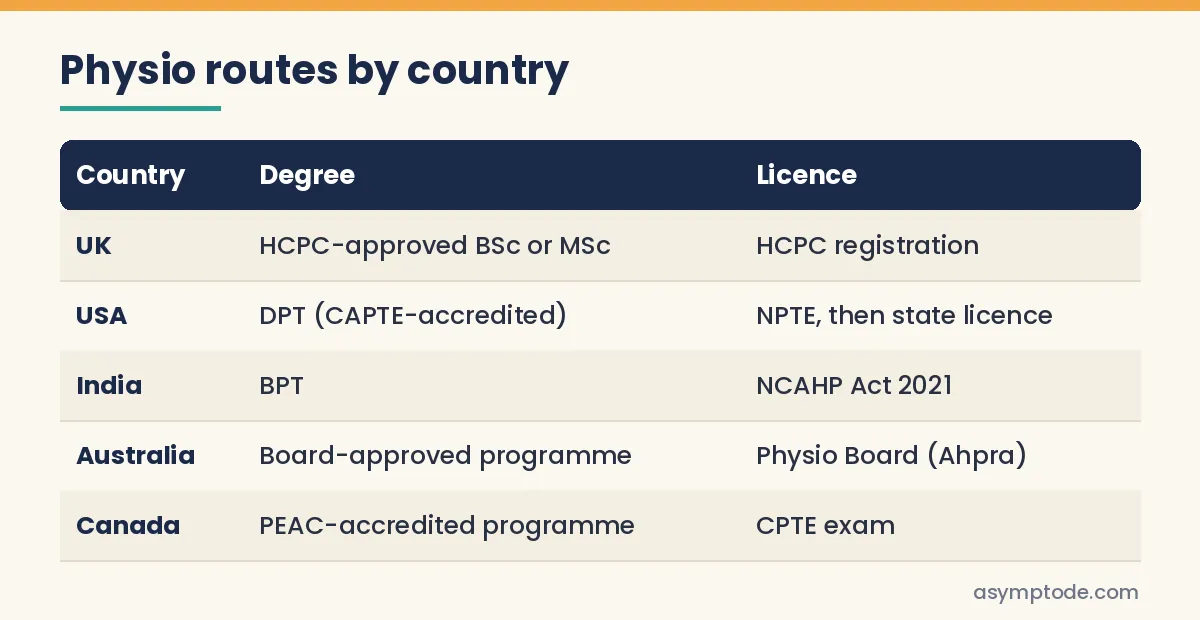 Physiotherapy routes by country: degree and licence.
The image shows the same five countries. The UK needs an HCPC-approved course and HCPC registration. The USA needs a DPT and the NPTE, then a state licence. India uses the BPT under the NCAHP Act. Australia needs Board registration, and Canada uses the CPTE exam.
How do you become a physiotherapist in the UK?
There are four main routes, according to the National Careers Service and NHS Health Careers:
- BSc degree. Full-time takes three years in England (four to six years part-time). In Scotland, pre-registration undergraduate courses take four years full-time.
- Accelerated MSc. A two-year master's for people who already have a relevant degree, such as biological science, health science, or sports and exercise science.
- Degree apprenticeship. The Physiotherapist Level 6 Degree Apprenticeship usually takes four years. You work and study at university at the same time.
- Assistant route. Start as a physiotherapy assistant, for example in the NHS, and study part time.
Whichever route you take, the course must be approved. When you finish an HCPC-approved programme, you can apply to join the HCPC Register. You must be registered to practise, and you pay an annual fee to stay on it. The National Careers Service also suggests joining the Chartered Society of Physiotherapy (CSP) for development and contacts.
 The UK route, from school to the HCPC Register.
The flow has four boxes. It starts with A levels including biology or PE. Next comes a UCAS application, with a 13 January 2027 deadline for most courses. Then you complete an HCPC-approved degree or apprenticeship. Last, you join the HCPC Register.
What are the UCAS deadlines for 2027 entry?
Here are the official UCAS dates for 2027 entry:
| Date (UK time) | What happens |
|---|---|
| 15 October 2026, 18:00 | Deadline for Oxford, Cambridge and most medicine, dentistry and veterinary courses (already passed) |
| 13 January 2027, 18:00 | Equal consideration date for most undergraduate courses |
| 30 June 2027, 18:00 | Later applications go straight into Clearing |
| 2 July 2027 | Clearing opens |
| 23 September 2027, 18:00 | Final date for 2027 entry applications |
Physiotherapy is not one of the course groups UCAS lists for 15 October, so most physio courses fall under the 13 January 2027 deadline. UCAS says to check each course in its search tool to see which deadline applies. Physio courses are popular, so do not leave it to the last week.
How do you become a physical therapist in the USA?
In the USA, the job title is physical therapist. The Bureau of Labor Statistics says you need a Doctor of Physical Therapy (DPT) degree. DPT programmes typically last three years. Most need a bachelor's degree first.
The steps are:
- Earn a bachelor's degree and complete the prerequisites, such as anatomy, chemistry and physics.
- Apply to DPT programmes. Many use PTCAS, which lets you apply to several programmes with one application.
- Choose a CAPTE-accredited programme. CAPTE says graduation from an accredited programme is required to sit the licensing exam and to be licensed in all 50 states.
- Pass the NPTE, the national exam run by the Federation of State Boards of Physical Therapy (FSBPT).
- Get a state licence. Some states add extra steps, such as a jurisprudence exam.
All states require physical therapists to be licensed. Continuing education is usually needed to keep the licence.
How do you become a physiotherapist in India?
In India, the degree is the Bachelor of Physiotherapy (BPT). Physiotherapy is one of the professions covered by the National Commission for Allied and Healthcare Professions (NCAHP) Act, 2021. The Act says a physiotherapist has a minimum qualification of a bachelor's degree.
The rules are changing, so read carefully:
- The NCAHP physiotherapy curriculum handbook says the BPT has so far run for 4.5 years including internship.
- The same handbook sets out a five-year programme: four years of study plus a one-year full-time internship.
- It asks for 10+2 with Physics, Chemistry and Biology (at least 50%) and links admission to having appeared for NEET.
- Some universities already follow this. For example, the NMIMS BPT 2026 handout lists five years and needs NEET.
News reports say the national NEET rule for BPT starts from 2027-28. That is not yet confirmed on an official page we could check, so check the official page of each university and state counselling body before you apply. If NEET applies to your child, our NEET UG 2027 guide explains the exam.
How do you become a physiotherapist in Australia?
You must be registered with the Physiotherapy Board of Australia to practise. The Board works with Ahpra.
The Australian Physiotherapy Council accredits physiotherapy courses for the Board. Ahpra keeps a list of Board-approved programmes of study. Pick a course from that list, finish it, then apply for registration.
How do you become a physiotherapist in Canada?
In Canada, physiotherapy is regulated by each province. The national exam is run by the Canadian Alliance of Physiotherapy Regulators (CAPR).
From January 2026, CAPR launched the Canadian Physiotherapy Examination (CPTE). It combines the old written and clinical parts of the Physiotherapy Competency Examination (PCE) into one exam. Regulators across Canada, except Quebec, agreed in principle to use it as the licensure exam.
To sit the CPTE, Canadian-educated students must be enrolled in, or have graduated from, a PEAC-accredited programme. Then you apply to your provincial regulator.
What is the pay and job outlook for physiotherapists?
We only share official figures here.
| Place | Official figure | Source |
|---|---|---|
| UK (National Careers Service) | £32,000 starter to £48,000 experienced per year | National Careers Service |
| USA median pay | $102,760 per year (May 2025) | BLS |
| USA job growth | 12% from 2025 to 2035 | BLS |
| USA openings | About 13,400 a year | BLS |
The BLS calls this growth "much faster than the average for all occupations". There were 283,700 physical therapist jobs in the USA in 2025. UK physios usually work 35 to 40 hours a week. For India, Australia and Canada, check the official pages, as we could not verify current pay figures.
How should you plan from Grade 9 or 10?
Start early. Physiotherapy is a popular course, and good planning takes pressure off Year 13 or Grade 12.
- Grade 9 or 10 (Year 10 or 11): Keep biology strong. Do well in English, maths and science GCSEs or board exams, as many courses check these.
- Pick the right next-stage subjects: Biology first. Add PE, chemistry or physics. In India, keep Physics, Chemistry and Biology together.
- Find work experience: The National Careers Service suggests NHS volunteering. For sports physio, help at an amateur sports team or club. Care homes and community groups also count.
- Read about the job: Talk to a physio if you can. Note what you saw. You will use this in your personal statement and interview.
- Shortlist approved courses: Check the HCPC, CAPTE, Ahpra or PEAC list for your country.
- Apply on time: In the UK, aim well before 13 January 2027 for 2027 entry. Elsewhere, follow each university's official dates.
- Prepare for interviews: Many UK courses interview applicants, says NHS Health Careers. Practise talking about teamwork, care and why you want this job.
What are the most common mistakes?
- Dropping biology. It is the subject most courses ask for.
- Choosing a course that is not approved. Without an approved course, you cannot register in the UK or get licensed in the USA.
- Leaving work experience too late. Start in Grade 10 or Year 11 if you can.
- Missing the deadline. Check the UCAS deadline for each physio course, not just one.
- Trusting old rules in India. BPT length and NEET rules are changing. Check the latest official notice.
- Thinking physio is "just sport". Physios also work with older people, people after surgery, and people with long-term conditions.
If animals interest your child more than people, see how to become a veterinarian.
Want a mentor to plan the science side with your child? Book a free demo class and see our plans and fees.
How Asymptode helps you with becoming a physiotherapist
Physiotherapy entry rests on biology, with chemistry, physics and maths close behind. At Asymptode, a qualified mentor teaches your child one-to-one, live online. Lessons follow the exact syllabus your child needs for physio: GCSE and A level biology, chemistry or physics, Scottish Highers, Indian Class 11-12 PCB, or US pre-DPT science. The mentor plans around real dates, such as the UCAS 13 January 2027 deadline or your NEET year.
Between classes, your child gets practice built just for them. It is a worksheet made from what their own last attempt showed they had not understood, at their level, never generic. This is Asymptode's AI-assisted practice. It is written to the mentor's brief and sent only after the mentor approves it.
The mentor marks the work. You see what your child understood and what to practise next, so preparation keeps correcting itself toward a physiotherapy place. For personal statements and interviews, the mentor helps with planning, method and practice review.
Book a free demo class or see plans and fees.
Facts checked against official sources on 12 November 2026.
FAQ
How long does it take to become a physiotherapist?
In England, a full-time BSc takes three years, and in Scotland four years. A degree apprenticeship usually takes four years. In the USA, a DPT typically takes three years after a bachelor's degree. In India, the BPT has been 4.5 years including internship, and the new NCAHP curriculum sets five years.
Can I become a physiotherapist without A levels?
Some UK courses accept other qualifications, says NHS Health Careers. You can also start as a physiotherapy assistant and study part time for a degree or apprenticeship. Each university sets its own rules, so check the course page.
Is biology compulsory for physiotherapy?
Biology is the subject most official sources name. UK degrees usually ask for A level biology, and some accept PE as the biological subject. In India, the NCAHP curriculum asks for Physics, Chemistry and Biology at 10+2.
What is the UCAS deadline for physiotherapy in 2027?
For most undergraduate courses, it is 13 January 2027 at 18:00 UK time. The 15 October 2026 deadline was for Oxford, Cambridge and most medicine, dentistry and veterinary courses. Check each physio course in the UCAS search tool to confirm.
Do I need NEET for BPT in India?
The NCAHP curriculum links BPT admission to NEET, and some universities already need it. News reports say the national rule starts in 2027-28, but this is not confirmed on an official page we could check. Check the official page of your chosen university and state counselling body.
Is a physiotherapist the same as a physical therapist?
Yes. "Physical therapist" is the US name for the same job. In the UK, both titles are protected, and you must be on the HCPC Register to use either one.
Ready to start? Book a free demo class and advisor call, or see our plans and fees.
Sources
- National Careers Service: Physiotherapist
- NHS Health Careers: Physiotherapist entry requirements and training
- NHS Scotland Careers: Physiotherapist
- HCPC: Professions and protected titles
- UCAS: Dates and deadlines for uni applications
- US BLS Occupational Outlook Handbook: Physical Therapists
- CAPTE: Importance of accreditation
- FSBPT: National Physical Therapy Examination
- APTA: Centralized Application Services (PTCAS)
- National Commission for Allied and Healthcare Professions Act, 2021
- Physiotherapy Board of Australia: Registration
- CAPR: CPTE transition information