
The GAMSAT is the admissions test you sit if you want to study graduate-entry medicine in Australia, the UK or Ireland. If you are planning for GAMSAT 2027, this guide explains the test format, fees, dates, scoring and how universities use your score. It also gives you a simple study plan and a worked science example.
Key takeaways
- GAMSAT is run by ACER. It has three sections: Written Communication, Humanities and Social Sciences, and Biological and Physical Sciences.
- Section 3 (Biological and Physical Sciences) counts double in your Overall Score.
- The 2026 fee is AUD$568 in Australia, €378 in Ireland and £296 in the UK.
- ACER says registrations for March 2027 open in November 2026. Exact March 2027 dates were not yet published on 12 November 2026.
- Australian results can be used for up to four years. UK and Ireland results can be used for two years.
What is the GAMSAT and who needs it?
Quick answer: The GAMSAT (Graduate Medical School Admissions Test) is a computer-based test made by ACER with GEMPASS Australia. You need it to apply to graduate-entry medicine and some health courses in Australia, the UK and Ireland. It tests reasoning, writing and science problem solving. It runs twice a year, in March and September.
GAMSAT is for people who have a degree, or are studying for one. School leavers usually need the UCAT instead. Read our UCAT 2027 guide for that route. If you are aiming at US medical schools, see our MCAT 2027 guide.
You can read the official overview on the ACER GAMSAT website.
Which universities use GAMSAT?
In Australia, ACER lists 4-year graduate-entry medical degrees that need GAMSAT at ANU, Deakin, Flinders, Griffith, Macquarie, Melbourne, Notre Dame (Fremantle and Sydney), Queensland, Sydney, Western Australia and Wollongong.
ACER says the other Australian medical schools run 5 or 6 year undergraduate programs. For example, UNSW is not on ACER's GAMSAT list. See our guide on how to get into UNSW for that path.
Some dentistry, optometry and pharmacy programs also use GAMSAT. Check the ACER Australia admission page.
In the UK, ACER lists graduate-entry courses through UCAS at places such as Exeter, Liverpool, Plymouth, St Andrews/Dundee, Swansea and Ulster. In Ireland, the CAO handles graduate-entry medicine at RCSI, University College Cork, University College Dublin and the University of Limerick.
Am I eligible to sit GAMSAT?
ACER says you can sit GAMSAT if you have finished, or are currently enrolled in, a bachelor or undergraduate honours degree. You can also sit if you meet the entry rules of the university you are applying to. You must be a genuine applicant to a course that needs GAMSAT.
You do not need a science degree, and there is no limit on how many times you can sit. Exeter and Plymouth have a special rule; check the ACER home page.
To apply through GEMSAS in Australia, you must have finished, or be in the final year of, a three-year full-time bachelor or honours degree in any discipline. See GEMSAS eligibility.
What is the GAMSAT test format?
GAMSAT has three sections. You sit them in two parts. Written Communication is done online with a remote proctor. The other two sections are done at a test centre, about three weeks later.
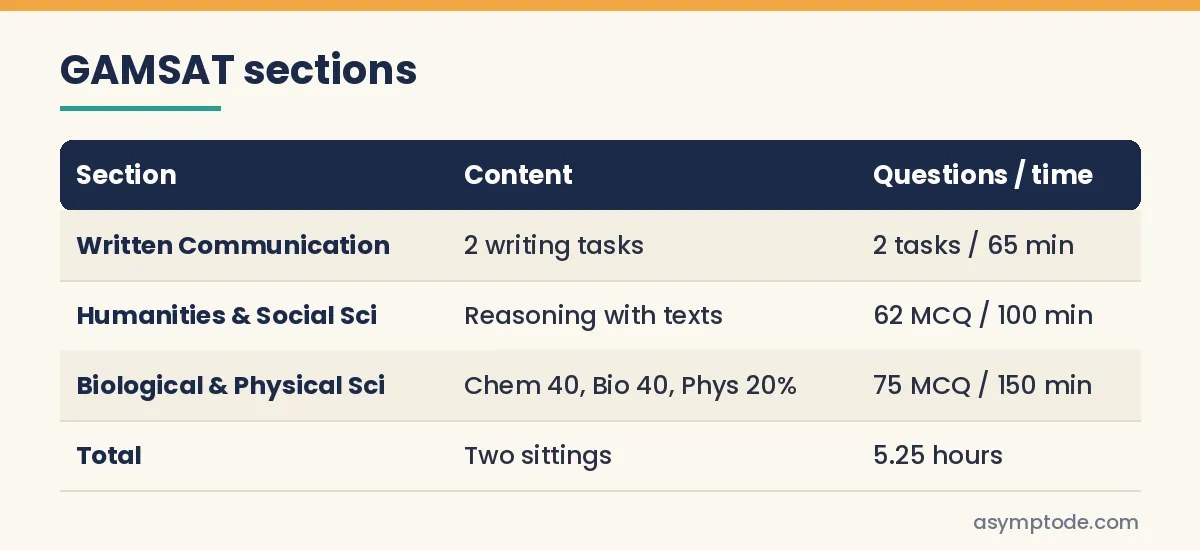 The three GAMSAT sections at a glance.
Written Communication has 2 writing tasks in 65 minutes. Humanities and Social Sciences has 62 multiple-choice questions in 100 minutes. Biological and Physical Sciences has 75 multiple-choice questions in 150 minutes. It is 40% chemistry, 40% biology and 20% physics. Total test time is 5.25 hours over two sittings.
Source: ACER GAMSAT Information Booklet 2026 and ACER preparation page.
What is in each GAMSAT section?
Written Communication. You write two essays, each in 30 minutes. Each task gives four statements on one theme. The first task is about socio-cultural issues. The second is about personal and social issues. Markers look at your thinking and how well you organise and express it. Each essay is scored independently three times. Spelling and punctuation errors do not affect your score. ACER checks every essay for plagiarism, including AI use. Memorised essays generally score poorly.
Humanities and Social Sciences. You read different kinds of writing, such as personal, imaginative and argument texts. Some units use visuals or tables. Then you answer questions about meaning, argument and reasoning. Each question has four options.
Biological and Physical Sciences. ACER says the level is first-year university biology and chemistry, and Year 12 (or A-level) physics. But the focus is problem solving, not memory. You will read data, graphs and diagrams and apply ideas to new situations.
Can I use a calculator in GAMSAT?
No. ACER lists calculators as a prohibited item. You get a whiteboard and marker, or pens and paper. So you must be fast with mental maths, fractions and powers of ten.
Is there negative marking?
No. ACER says no marks are taken off for wrong answers. Every question has the same value. So always answer every question, even if you have to guess.
Can I sit GAMSAT from home?
Only Written Communication is remote for everyone. Humanities and Biological Sciences are at a test centre. ACER allows remote sitting for those sections only if you live more than three hours' drive from a centre, or in a country with no centre. Test centres run in Australia, Ireland, the UK, New Zealand and Singapore. See the ACER remote proctoring page for the technical rules.
When are the GAMSAT 2027 dates?
ACER's registration page says September 2026 registrations are closed, and March 2027 registrations open in November 2026. On 12 November 2026, the exact March 2027 deadlines and test days were not yet published. Check the ACER registration page often.
Here are the official 2026 dates to help you plan. Do not assume 2027 will match.
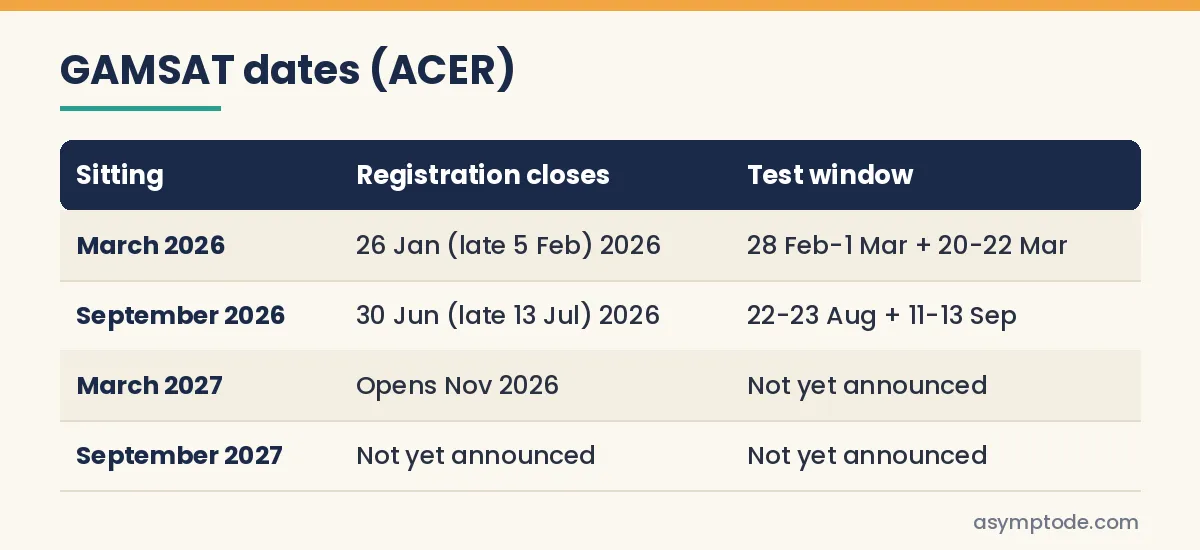 Official GAMSAT dates published by ACER, and what is still to come.
For March 2026, standard registration closed on 26 January 2026 and late registration on 5 February 2026. Testing was 28 February to 1 March, then 20 to 22 March 2026. For September 2026, standard registration closed on 30 June 2026 and late registration on 13 July 2026. Testing was 22 to 23 August, then 11 to 13 September 2026. For March 2027, registration opens in November 2026. Exact dates are not yet announced. September 2027 dates are also not yet announced.
| Sitting | Standard registration closes | Late registration closes | Written Communication | Humanities and Biological Sciences | Results |
|---|---|---|---|---|---|
| March 2026 | 26 January 2026 | 5 February 2026 | 28 Feb - 1 Mar 2026 | 20-22 March 2026 | Late May 2026 |
| September 2026 | 30 June 2026 | 13 July 2026 | 22-23 August 2026 | 11-13 September 2026 | Mid November 2026 |
| March 2027 | Not yet announced | - | - | - | - |
Source: ACER GAMSAT Information Booklet 2026.
If you sat in September 2026, ACER says results are released in mid November 2026. You get an email when they are ready.
How much does GAMSAT cost?
These are ACER's 2026 fees. Check the ACER registration page for 2027 fees before you pay.
| Fee | Australia | Ireland | UK |
|---|---|---|---|
| Registration | AUD$568 (incl. GST) | €378 | £296 |
| Late registration or late changes | AUD$114 | €83 | £71 |
| Overseas levy (centre outside Australia, Ireland or UK, e.g. Singapore) | AUD$208 | - | - |
The registration fee includes the Practice Test A e-book. You pay online by Mastercard or Visa. ACER's booklet says you can get a full refund within 14 days of registering.
How is the GAMSAT scored?
You get a score for each section and an Overall Score. Each score is on a scale of 0 to 100. These are not percentages. ACER scales scores so that different test versions can be compared fairly.
ACER gives this formula on its results page:
Overall Score = (Humanities and Social Sciences + Written Communication + 2 x Biological and Physical Sciences) / 4
This means Section 3 counts for half of your Overall Score.
 An example only. These section scores are made up to show the formula.
Example only: Humanities 60, Written Communication 62, Biological and Physical Sciences 65. Double the science score: 2 x 65 = 130. Add them up: 60 + 62 + 130 = 252. Divide by 4: 252 / 4 = 63. So the example Overall Score is 63.
ACER works out the real Overall Score before rounding the section scores. So your own sum may differ slightly from your Statement of Results.
Your results come with a percentile chart, but universities use your scores, not your percentile. Universities set their own cut-offs each year. You cannot ask for a re-mark.
How long are GAMSAT scores valid?
ACER says results can be used for up to four consecutive years in Australia, and two consecutive years in the UK and Ireland. Ulster University accepts four years.
There is one trap in Australia. GEMSAS says results from the September sitting in your year of application cannot be used for that intake. For example, September 2026 results cannot be used for the 2027 intake. But September 2026 and March 2027 results can be used for the 2028 intake. See the GEMSAS GAMSAT page.
How do universities combine GPA, GAMSAT and interview?
In Australia, ACER says students are chosen on three things: a bachelor degree, a GAMSAT score and an interview. Each university weights these differently.
 The usual path to graduate-entry medicine in Australia.
First, finish your bachelor degree, or be in its final year. Next, sit GAMSAT in March or September. Then apply through GEMSAS (or directly to some universities) with your GPA and GAMSAT. Last, if you are invited, attend an interview before place offers are made.
- Degree and GPA. GEMSAS calculates your GPA from your key degree. Schools can apply their own rules, so you may have more than one GPA. See GEMSAS GPA calculations.
- GAMSAT. Schools may set a minimum score. For example, GEMSAS lists ANU's minimum for the 2027 intake as an Overall Score of 50 and at least 50 in each section.
- Interview ranking. Schools rank applicants for interview using GAMSAT, GPA and sometimes Casper or extra requirements. ANU combines standardised GAMSAT and standardised GPA. Griffith uses a 50/50 mix of GPA and overall GAMSAT. See GEMSAS interviews.
- Interview. You interview at one medical school only. Only interviewed applicants can get an offer.
- Offers. In the last cycle, GEMSAS released place offers at the end of October or early November 2026.
Not every school uses GEMSAS. ACER says the University of Sydney and Flinders University process their own medicine applications. Read our guides on how to get into the University of Melbourne, the University of Sydney and ANU for school-level detail.
What were the last GEMSAS dates?
For the 2027 intake, GEMSAS applications opened on 1 May 2026 and closed at 5pm AEST on 29 May 2026. Interview offers came in early September 2026. Dates for the 2028 intake are not yet announced. Check GEMSAS key dates.
How does it work in the UK and Ireland?
In the UK, you apply through UCAS. For 2027 entry, the UCAS closing date was 15 October 2026. ACER says you need at least an upper second class honours degree (or a predicted one), and most courses take home students only. In Ireland, you apply through the CAO. Check the ACER UK page and ACER Ireland page for each school's rules.
How do I prepare for GAMSAT?
ACER says last-minute cramming does not help much. If you are not from a science background, ACER strongly recommends learning basic science to first-year university level. It also says to read widely and practise critical thinking.
There is no official number of study hours, so use these plans as a guide.
If you have 6 months or more
- Do one official ACER practice test under timed conditions. Find your weakest section.
- Rebuild your science base: chemistry and biology to first-year university level, physics to Year 12.
- Read one long opinion piece or essay each day. Write a short summary.
- Write one timed essay each week.
If you have about 3 months
- Do Practice Test A (it comes with your registration).
- Focus on Section 3, since it counts double.
- Practise maths without a calculator every day.
- Write two timed essays each week. Plan for a few minutes, then write.
If you have 4 to 6 weeks
- Do full timed practice sections and review every mistake.
- Guess on every question you cannot finish. There is no negative marking.
- Check your test day rules, ID and remote proctoring set-up.
Worked example: a Section 3 chemistry calculation
This is a practice-style example we wrote. It is not a real GAMSAT question.
Question: How many moles of water are in 9.0 g of water? (H = 1, O = 16)
- Find the molar mass of water, H2O: 2 x 1 + 16 = 18 g/mol.
- Use moles = mass / molar mass.
- Moles = 9.0 / 18 = 0.50 mol.
Answer: 0.50 mol.
You need to do steps like this in your head or on a whiteboard, with no calculator. If moles feel shaky, read our mole concept explained guide.
What are common GAMSAT mistakes?
- Ignoring Section 3. It counts double. A small gain here helps a lot.
- Memorising essays. ACER checks for plagiarism and says memorised essays generally score poorly.
- Relying on a calculator. You cannot use one, so practise mental maths early.
- Leaving blanks. Wrong answers cost nothing.
- Missing deadlines. Late registration costs extra, and after it closes you cannot register.
Want help building your plan? Book a free demo class with a mentor, or see our plans and fees.
For the wider journey, from degree to specialist training, read how to become a doctor.
How Asymptode helps you with GAMSAT preparation for graduate-entry medicine
At Asymptode, a qualified mentor teaches you one-to-one, live online. Your classes follow the GAMSAT structure: the chemistry, biology and physics reasoning of Section 3, and the data and graph skills it needs. Lessons are planned around the real ACER sitting you are aiming for and the GEMSAS, UCAS or CAO dates that follow.
Between classes, you get practice built for you. After each attempt, your mentor sees what you had not understood. Then you get a worksheet made from those gaps, at your level, never generic. This is Asymptode's AI-assisted practice. It is written to your mentor's brief and only sent after your mentor approves it.
Your mentor marks the work. You and your parent can see what you understood and what to practise next. So your preparation keeps correcting itself toward your GAMSAT sitting.
For Humanities and Written Communication, your mentor helps with planning, method and reviewing your practice.
Book a free demo class or see our fees.
Facts checked against official sources on 12 November 2026.
FAQ
When can I register for GAMSAT March 2027?
ACER says registrations for March 2027 open in November 2026. The exact closing dates and test days were not yet published on 12 November 2026. Check the ACER registration page and register early, as late registration costs extra.
How much does GAMSAT cost in 2026?
The 2026 registration fee is AUD$568 in Australia, €378 in Ireland and £296 in the UK. A late fee of AUD$114, €83 or £71 applies in the late period. Check ACER for 2027 fees before you pay.
How is the GAMSAT Overall Score calculated?
ACER adds Humanities, Written Communication and twice the Biological and Physical Sciences score, then divides by 4. Each score is on a 0 to 100 scale. They are not percentages.
Do I need a science degree to sit GAMSAT?
No. Graduates from any field can sit GAMSAT and apply. But ACER says success is unlikely without knowledge of biology, chemistry and physics. Non-science graduates should study basic science first.
How many times can I sit GAMSAT?
There is no limit. You can sit in March, September or both. If you have more than one valid score, your best score set is used unless you choose otherwise.
Can I use my September 2026 GAMSAT score for the 2027 intake in Australia?
No. GEMSAS says September results in your year of application cannot be used for that intake. Your September 2026 results can be used for the 2028 intake and later, while they are still valid.
Ready to start? Book a free demo class and advisor call, or see our plans and fees.
Sources
- ACER GAMSAT official website
- ACER GAMSAT Registration (dates and fees)
- ACER GAMSAT Information Booklet 2026
- ACER GAMSAT Results and scores
- ACER GAMSAT Preparation
- ACER GAMSAT Test day
- ACER GAMSAT Remote proctoring
- ACER University admission - Australia
- ACER University admission - UK
- ACER University admission - Ireland
- GEMSAS GAMSAT
- GEMSAS Academic Eligibility Requirements
- GEMSAS Key Dates
- GEMSAS Interviews
- GEMSAS GPA Calculations