ESAT vs TMUA is a choice many UK maths, science and engineering applicants face, but usually your course makes it for you. The ESAT is the science and engineering test. The TMUA is the maths, computer science and economics test. This guide compares format, timing, scores, dates, fees and courses.
Key takeaways
- ESAT = science and engineering. TMUA = maths, computer science and economics.
- ESAT: Maths 1 plus (for most courses) two more modules, 27 questions in 40 minutes each.
- TMUA: two papers, 20 questions in 75 minutes each, with Paper 2 testing logic and proof.
- Both cost £78 in the UK and Ireland (£133 elsewhere), use no calculator and have no negative marking.
- January 2027 sitting: 4-8 January. Booking closes 21 December 2026 at 6pm GMT.
ESAT vs TMUA: which test do you need?
Quick answer: You need the test your course lists. Engineering, physics, natural sciences, life sciences and veterinary medicine courses use the ESAT. Maths, computer science and economics courses use the TMUA. Check the official UAT-UK course list and each university's course page before you book, because one wrong test can make an application invalid.
Both tests are run by UAT-UK, a partnership between Imperial and Cambridge, and taken on computer at Pearson test centres. For full detail on each test, read our ESAT guide and our TMUA guide.
How are the ESAT and TMUA formats different?
The ESAT is built from modules. The TMUA is built from two fixed papers.
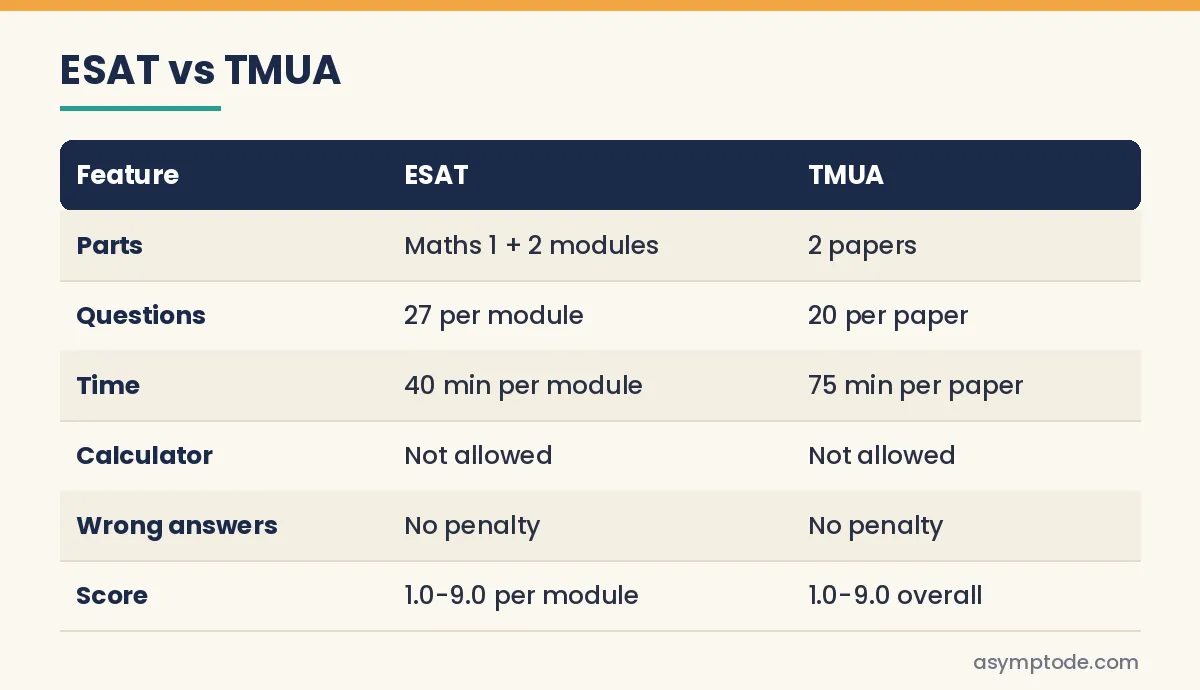 ESAT and TMUA compared feature by feature.
The ESAT has five modules, and most students sit three: Maths 1 plus two more. Each module has 27 questions in 40 minutes. The TMUA has two papers of 20 questions, and each paper lasts 75 minutes. Neither allows a calculator or takes marks off for wrong answers, and both score from 1.0 to 9.0.
| Feature | ESAT | TMUA |
|---|---|---|
| Parts | 5 modules; most sit Maths 1 + 2 more | 2 papers, both compulsory |
| Questions | 27 per module | 20 per paper |
| Time | 40 min per module (120 min for most) | 75 min per paper (2 h 30 min) |
| Calculator | Not allowed | Not allowed |
| Wrong answers | No penalty | No penalty |
| Score | 1.0-9.0 per module | One overall score, 1.0-9.0 |
Source: the official ESAT page and TMUA page.
On test day, the parts run back to back with no automatic break. Once you end a module or paper, you cannot go back, and spare time does not carry over.
What is in each test?
What does the ESAT cover?
The ESAT tests how you apply school science and maths across five modules: Mathematics 1, Mathematics 2, Physics, Chemistry and Biology. Every module assumes Maths 1 content, and Maths 2 adds harder maths. The official ESAT specification lists every topic.
What does the TMUA cover?
The TMUA uses Higher Level GCSE and AS maths. Paper 1 (Applications of Mathematical Knowledge) applies maths in new situations. Paper 2 (Mathematical Reasoning) tests mathematical arguments and simple logic. There is no formulae booklet. The TMUA specification and the free "Notes on Logic and Proof" explain Paper 2. If your AS maths is shaky, start with our A-level maths guide.
How much time do you get per question?
You get far less time per question in the ESAT.
 Minutes per question: ESAT against TMUA.
ESAT: 40 ÷ 27 = about 1.48 minutes (roughly 89 seconds) per question, or 81 questions in 120 minutes over three modules. TMUA: 75 ÷ 20 = 3.75 minutes (3 minutes 45 seconds) per question, or 40 questions in 150 minutes. So a TMUA question gives you about two and a half times as long.
ESAT practice is about speed and recall. TMUA practice is about staying calm on longer, trickier questions.
Which universities and courses need the ESAT or the TMUA?
Seven UK universities use one or more UAT-UK tests. The table below comes from the official Course List 2027 Entry.
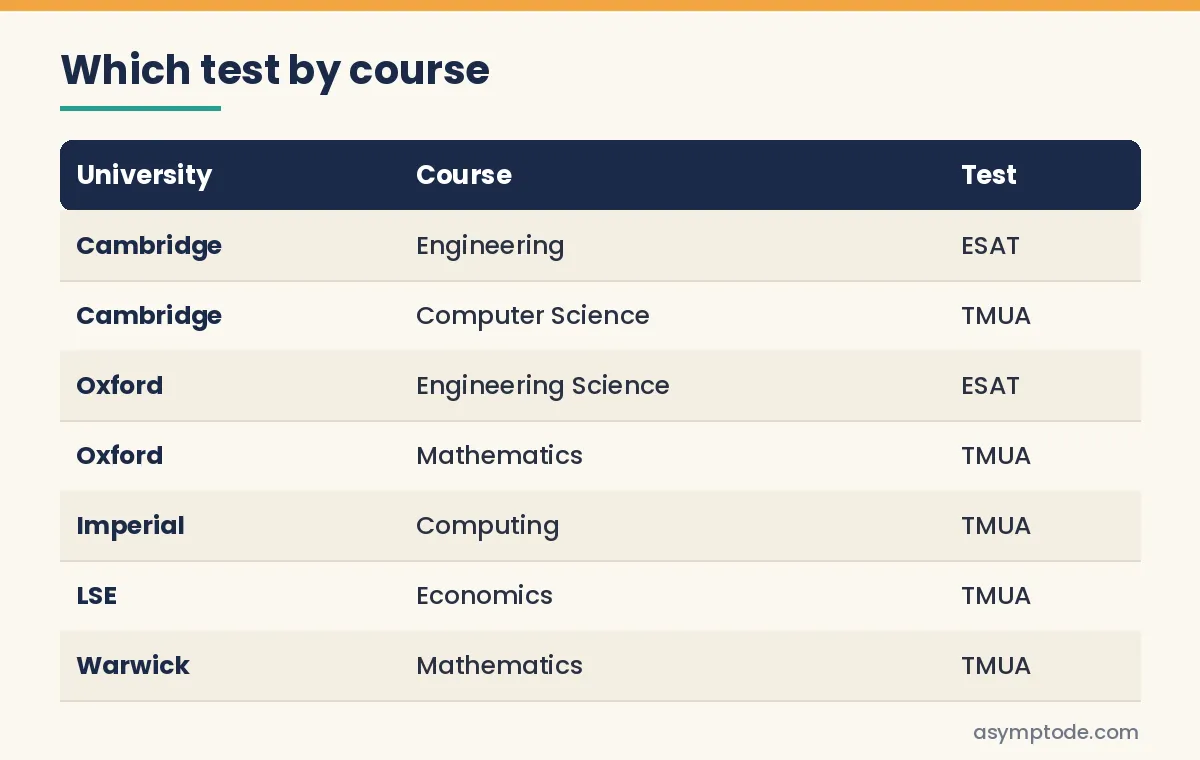 Which test, by university and course, for 2027 entry.
Cambridge Engineering and Natural Sciences use the ESAT. Cambridge Maths, Computer Science and Economics use the TMUA. Oxford and Imperial follow the same split: ESAT for engineering and physics, TMUA for maths and computing. LSE Economics and Warwick Maths and Computer Science use the TMUA.
| University | ESAT courses (examples) | TMUA courses (examples) |
|---|---|---|
| Cambridge | Engineering; Natural Sciences; Chemical Engineering and Biotechnology; Veterinary Medicine | Mathematics; Computer Science; Economics |
| Oxford | Engineering Science; Physics; Physics and Philosophy; Biomedical Sciences | Mathematics; Computer Science; Maths and Philosophy |
| Imperial | Engineering courses; Physics; Biological Sciences; Biochemistry | Computing; Mathematics; Economics, Finance and Data Science |
| LSE | None | Economics and Econometrics (compulsory); others recommended |
| Warwick | None | Maths, Computer Science, Discrete Maths (compulsory); Economics recommended |
| UCL | Electronic and Electrical Engineering | Economics |
| Durham | None | Mathematics; Maths and Statistics (recommended) |
Two details matter. First, ESAT modules differ by course: Cambridge and Oxford Engineering need Maths 1, Maths 2 and Physics, while Imperial life sciences need Maths 1, Chemistry and Biology. Second, "recommended" is not "compulsory": at Durham, some LSE courses and some Warwick courses the TMUA is only recommended.
For each university, see our guides on getting into Cambridge, getting into Oxford, getting into Imperial, getting into LSE and getting into Warwick.
Do any courses need both tests, or neither?
No single course on the 2027 list needs both. But you may need both if your five UCAS choices mix subjects, for example Engineering at one university and Computing at another.
Some need neither. UCL Computer Science and Oxford Economics and Management use the TARA, a different UAT-UK test. Imperial Chemistry and Materials use no admissions test.
Which test should I choose? A simple flow
 A four-step way to choose the right test.
List every course on your UCAS form and look each one up in the official course list. Then book the ESAT (with the right modules), the TMUA, or both, and confirm on each course page.
Can you sit both the ESAT and the TMUA?
Yes. The Candidate Handbook says you can sit two tests in the same sitting, or one in October and one in January (Cambridge and Oxford rules still apply). Each test is sat once per cycle and paid for separately.
When are the ESAT and TMUA in 2026-27?
The October 2026 sitting is over. Results for it come out on Monday 16 November 2026, mid-afternoon GMT, through your UAT-UK account.
The next sitting is 4-8 January 2027. Key dates from the official deadlines page:
| Date | What happens |
|---|---|
| 28 October 2026 | January booking opened |
| 7 December 2026, 6pm GMT | Deadline to request access arrangements |
| 14 December 2026, 6pm GMT | Deadline to request a bursary |
| 21 December 2026, 6pm GMT | January booking closes |
| 4-8 January 2027 | Test window |
| 8 February 2027 | January results released |
The January sitting is not for most Cambridge or Oxford applicants; it only covers Cambridge mature colleges with a January deadline and Oxford's Astrophoria Foundation Year. For other universities, there is no advantage to either sitting.
How much do the ESAT and TMUA cost?
Each test costs £78 at a test centre in the UK or Republic of Ireland, and £133 elsewhere. Eligible UK students can get a bursary covering the full fee, but must apply before booking. See the register page. You can reschedule or cancel free of charge until 48 hours before your test.
How are ESAT and TMUA scores reported?
Both use a 1.0 to 9.0 scale, to one decimal place. The ESAT scores each module separately; the TMUA gives one overall score. The median is fixed at 4.5, there is no pass mark and no appeals. Scores go automatically to universities on your UCAS form, for courses that list the test. More detail is on the test results page.
Need a hand planning? Book a free demo class with a mentor, or check our plans and fees.
How should you prepare for each test?
ESAT prep plan
- Tick off specification topics for your three modules.
- Make Maths 1 rock solid, because every module assumes it.
- Drill timed sets at about 90 seconds a question, with no calculator.
- Sit the specimen and practice tests under timed conditions.
TMUA prep plan
- Read the specification and the "Notes on Logic and Proof".
- Review GCSE Higher and AS maths, and learn formulae by heart.
- Practise Paper 2 logic: necessary and sufficient conditions and flawed proofs.
- Do timed past papers at about 3 minutes 45 seconds per question.
All of these materials are free on the UAT-UK prepare page.
What are the most common mistakes?
- Booking the wrong ESAT modules. You cannot change modules after booking. You must cancel and rebook.
- Leaving questions blank. There is no penalty for wrong answers, so answer every question.
- Ignoring Paper 2. Many TMUA students only practise Paper 1-style maths.
- Getting stuck in the ESAT. At about 89 seconds per question, one stuck question costs a lot.
How Asymptode helps you with the ESAT and TMUA
At Asymptode, a qualified mentor teaches your child one-to-one, live online, following the actual ESAT modules or TMUA papers their courses need. Lessons work back from real dates, such as the 21 December 2026 booking deadline and the 4-8 January 2027 sitting.
Between classes, your child gets practice built for them. If their last attempt showed a gap, such as TMUA Paper 2 logic or an ESAT Maths 2 topic, the next worksheet targets it at their level, never a generic sheet. This is Asymptode's AI-assisted practice. The AI writes it to the mentor's brief, and it is sent only after the mentor approves it.
The mentor marks each worksheet. You, the parent, see what was understood and what to practise next. That way, ESAT or TMUA preparation keeps correcting itself toward the right test, the right modules and the right timing.
To start, book a free demo class or see our plans and fees.
Facts checked against official sources on 12 November 2026.
FAQ
Is the TMUA harder than the ESAT?
They are hard in different ways. The ESAT gives about 1.48 minutes per question, so speed matters. The TMUA gives 3.75 minutes, but questions need deeper reasoning, including logic and proof.
Can I use a calculator in the ESAT or TMUA?
No. Neither test allows a calculator or a dictionary. You get a whiteboard or laminated sheet and a marker pen for working.
Is there negative marking in the ESAT or TMUA?
No. Scores are based on correct answers, and you do not lose marks for wrong ones. So answer every question.
Does Cambridge Computer Science use the ESAT or the TMUA?
Cambridge Computer Science uses the TMUA for 2027 entry. Cambridge says Peterhouse and Trinity applicants also take the CSAT. Always check the Cambridge admission tests page for the latest rules.
Can I take the ESAT or TMUA again if I do badly?
Not in the same cycle. You can only sit each test once within an admissions cycle. If you apply again in a later year, you sit it again then.
When will I get my October 2026 results?
They are due on Monday 16 November 2026, mid-afternoon GMT, in your UAT-UK account. January 2027 results are due on 8 February 2027.
Ready to start? Book a free demo class and advisor call, or see our plans and fees.
Sources
- UAT-UK: ESAT
- UAT-UK: TMUA
- UAT-UK: Key dates and deadlines
- UAT-UK: Register
- UAT-UK: Test results
- UAT-UK: Prepare
- UAT-UK Course List 2027 Entry (PDF)
- UAT-UK Candidate Handbook 2027 Entry (PDF)
- ESAT Content Specification (PDF)
- TMUA Content Specification (PDF)
- University of Cambridge: Admission tests
- Imperial College London: Admissions tests