
The ESAT exam is the Engineering and Science Admissions Test, a computer-based test that top UK universities use for engineering, physics, natural sciences and some life science courses. For 2027 entry, the October sitting is over, and January 2027 is your last chance. This guide covers who needs it, scoring, key dates and how to prepare.
Key takeaways
- The ESAT has five modules. Everyone sits Mathematics 1, and most people sit two more modules.
- Each module has 27 multiple-choice questions in 40 minutes. You cannot use a calculator.
- Each module gets its own score from 1.0 to 9.0. There is no pass mark.
- The January 2027 sitting runs from 4 to 8 January. Booking closes at 6pm (UK time) on 21 December 2026.
- Most Cambridge and Oxford applicants had to sit in October. Other universities accept either sitting.
What is the ESAT exam?
Quick answer: The ESAT exam is an admissions test run by UAT-UK, a partnership between Imperial College London and the University of Cambridge. You sit it on a computer at a Pearson VUE test centre. It checks how well you use school maths and science. Imperial, Cambridge, Oxford and UCL use it for chosen courses.
The test is set by UAT-UK. Pearson runs it at over 5,000 test centres in more than 180 countries, not at schools. It uses maths and science you have likely met at school. What makes it hard is the speed, the style and the lack of a calculator.
There is a sister test called the TMUA, used for maths, computer science and economics. If you are not sure which one you need, read our TMUA guide as well.
Which universities and courses need the ESAT?
Four universities use the ESAT: Imperial College London, the University of Cambridge, the University of Oxford and UCL. Each course chooses which modules you must take. The official source is the UAT-UK Course List 2027 Entry (PDF). Always check your course page too.
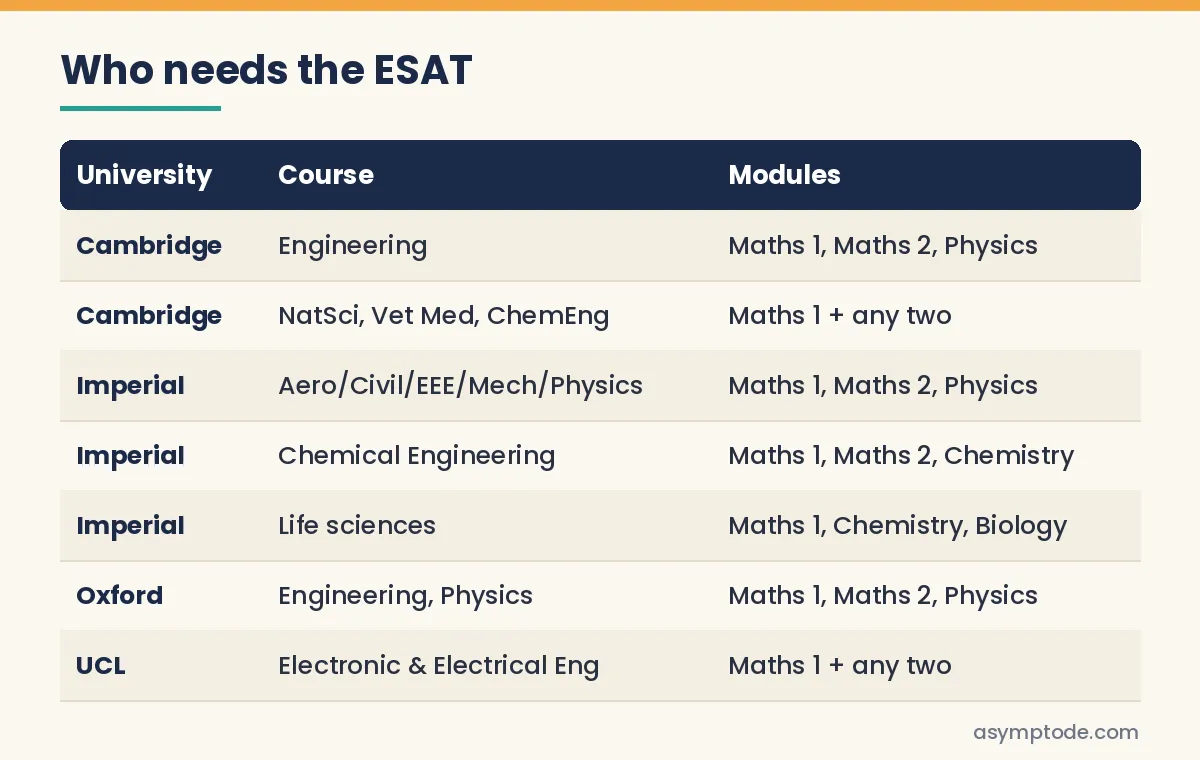 Who needs the ESAT for 2027 entry, and which modules.
Cambridge Engineering needs Maths 1, Maths 2 and Physics. Cambridge Natural Sciences, Veterinary Medicine and Chemical Engineering and Biotechnology need Maths 1 plus any two modules. Most Imperial engineering courses and Physics need Maths 1, Maths 2 and Physics. Imperial Chemical Engineering needs Maths 1, Maths 2 and Chemistry, and Imperial life sciences need Maths 1, Chemistry and Biology. Oxford Engineering and Physics need Maths 1, Maths 2 and Physics. UCL Electronic and Electrical Engineering needs Maths 1 plus any two modules.
Full detail from the official course list:
| University | Courses (examples) | Modules required |
|---|---|---|
| Cambridge | Engineering | Maths 1, Maths 2, Physics |
| Cambridge | Natural Sciences, Veterinary Medicine, Chemical Engineering and Biotechnology | Maths 1 + any two |
| Imperial | Aeronautical, Civil, Mechanical, Electrical and Electronic, Electronic and Information Engineering; Physics | Maths 1, Maths 2, Physics |
| Imperial | Chemical Engineering | Maths 1, Maths 2, Chemistry |
| Imperial | Design Engineering | Maths 1 and Maths 2 only |
| Imperial | Biochemistry, Biological Sciences, Biotechnology, Microbiology, Ecology and Environmental Biology | Maths 1, Chemistry, Biology |
| Oxford | Engineering Science, Biomedical, Chemical, Civil, Electrical, Information and Mechanical Engineering; Physics; Physics and Philosophy | Maths 1, Maths 2, Physics |
| Oxford | Biomedical Sciences | Maths 1 + any two |
| UCL | Electronic and Electrical Engineering (BEng and MEng) | Maths 1 + any two |
Imperial Design Engineering needs only two modules. Some UCL engineering courses, such as Mechanical Engineering, use the TARA instead.
For more on each university, see our guides to getting into Cambridge, getting into Imperial and getting into UCL.
What if my courses ask for different modules?
If one course lets you choose and another has fixed modules, sit the fixed ones. If two courses have fixed modules that clash, you may need four modules; select all four and UAT-UK reviews it. You cannot change modules after booking without cancelling and rebooking.
What is in each ESAT module?
The ESAT has five modules. Each one is 40 minutes long and has 27 multiple-choice questions. Most students sit three modules, which is 120 minutes in total.
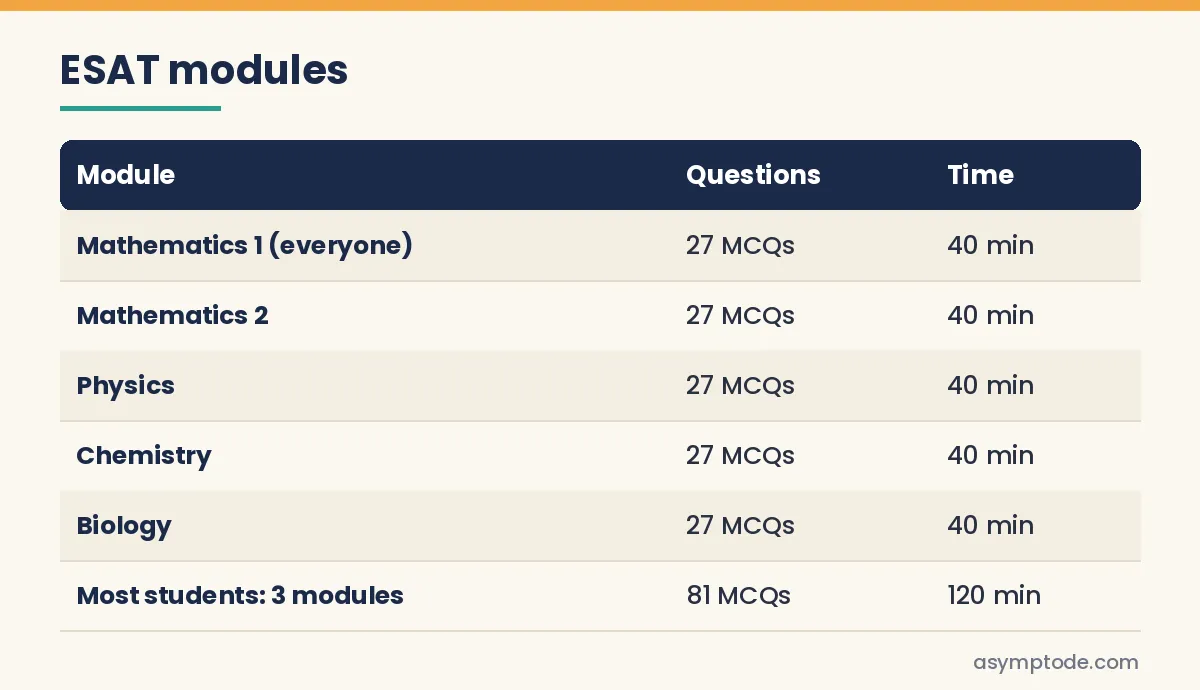 The five ESAT modules and their timing.
The five modules are Mathematics 1, Mathematics 2, Physics, Chemistry and Biology. Each module has 27 multiple-choice questions and lasts 40 minutes. Most students sit three modules: 81 questions in 120 minutes.
That is just under 1.5 minutes per question, so you must learn which questions to skip and come back to.
The full topic list is in the ESAT specification and ESAT Guide. Mark any topic you have not covered in class. For maths and physics revision, our A-Level Maths guide and A-Level Physics guide are useful partners.
Can you use a calculator in the ESAT?
No. UAT-UK says you cannot use a calculator or a dictionary. You get a whiteboard (or laminated sheet) and a marker pen for working. You cannot bring your own pen and paper.
What happens on test day?
The Candidate Handbook sets out these rules:
- Modules run back to back with no breaks, unless approved as an access arrangement.
- Spare time in one module does not carry over to the next.
- The timer keeps running if you leave the room.
- Each module ends with a review screen of flagged and unanswered questions. Once you end a module, you cannot go back.
How is the ESAT scored?
You get a separate score for each module. Scores run from 1.0 (low) to 9.0 (high), to one decimal place. There is no pass or fail mark.
Key points from the UAT-UK results page:
- Your score is based on the number of correct answers.
- You do not lose marks for wrong answers. So answer every question.
- Each module is scaled on its own. The scale is set so that the middle (median) October score is 4.5.
- January scores are put on the same scale as October scores.
- UAT-UK does not publish grade boundaries, and it does not accept appeals.
Universities use your ESAT scores with the rest of your UCAS application. Imperial says a high score does not by itself mean an offer.
When do ESAT results come out?
Results appear in your UAT-UK account about four weeks after the test. For 2027 entry:
- October 2026 sitting: results on Monday 16 November 2026 (mid-afternoon GMT).
- January 2027 sitting: results on 8 February 2027 (mid-afternoon GMT).
Your scores go to universities automatically. They only go to a university if your UCAS course there uses the test. You cannot choose who sees them.
What are the ESAT dates for 2026-27?
The October 2026 sitting (12 to 16 October) has finished. The January 2027 sitting is your next and only other chance. All dates below come from the official UAT-UK key dates page.
 Key ESAT dates for the rest of the 2027 entry cycle.
October results arrive on 16 November 2026. Ask for access arrangements by 7 December 2026 and for a bursary by 14 December 2026. Booking for January closes at 6pm on 21 December 2026. The January test runs from 4 to 8 January 2027, and results arrive on 8 February 2027.
| Date | What happens |
|---|---|
| 16 November 2026 | October 2026 results released |
| 7 December 2026, 6pm GMT | Deadline to request access arrangements for January |
| 14 December 2026, 6pm GMT | Deadline to request a bursary for January |
| 21 December 2026, 6pm GMT | January booking closes |
| 4 to 8 January 2027 | January test window |
| 8 February 2027 | January results released |
If you sit in China, Hong Kong or Macau, the January ESAT runs on 6 January 2027 only.
Should I sit the ESAT in October or January?
For most Cambridge and Oxford applicants, there was no choice: you had to sit in October. The exceptions are mature applicants applying to a Cambridge mature college with a January deadline, and applicants to Oxford's Astrophoria Foundation Year.
For every other university that uses the ESAT, you can sit in October or January. UAT-UK says there is no advantage either way.
Remember: you can sit the ESAT only once in each admissions cycle. You cannot use an old score if you apply again next year.
How much does the ESAT cost, and how do you register?
The ESAT costs £78 if you sit it in the UK or the Republic of Ireland, and £133 elsewhere. The fee depends on where the test centre is, not on your nationality. UK students in financial need can apply for a bursary, which covers the full fee.
Follow these steps, based on the UAT-UK registration page:
- Create a UAT-UK account. Use your full name exactly as it appears on your photo ID. Use the same details as on UCAS.
- Apply for a bursary or access arrangements first, if you need them. You must do this before you select a test. A bursary review can take up to five working days. Access arrangements can take up to ten working days.
- Add a test card. Choose the ESAT and pick your modules. Check them against the course list and your course pages.
- Book and pay in the Pearson system. Pick a test centre and a time slot. Book early, as popular centres fill up.
Your school cannot book or pay for you. You can cancel for a full refund, or move your slot, up to 48 hours before your test.
Need help planning the next eight weeks? Book a free demo class with an Asymptode mentor, or see our plans and fees.
How do you prepare for the ESAT? (with worked examples)
UAT-UK gives free materials: the ESAT specification, the ESAT Guide for each module, specimen and practice tests in the Pearson test player, and old ENGAA and NSAA papers from 2016 to 2023. UAT-UK marks old questions that fall outside the ESAT specification. Find them on the ESAT preparation materials page.
The key skill is fast, clean working without a calculator. Here are two original practice questions in ESAT style.
Worked example 1: a physics question
A car of mass 1200 kg speeds up from rest to 20 m/s in 8 s on a flat road. Ignore friction and air resistance. What is the average power?
A) 3 kW B) 15 kW C) 30 kW D) 60 kW E) 120 kW F) 240 kW
 Solving the car power question step by step, with no calculator.
The car has a mass of 1200 kg and goes from 0 to 20 m/s in 8 s. Kinetic energy is KE = 1/2 x m x v^2, so KE = 0.5 x 1200 x 400 = 240000 J. Power is energy divided by time: P = 240000 / 8 = 30000 W. The answer is 30 kW, option C.
Why the wrong options are there:
- F (240 kW): you found the energy, 240000 J, but forgot to divide by the time.
- D (60 kW): you forgot the half in KE = 1/2 x m x v^2.
- B (15 kW): you used the half twice.
Wrong options are built from common slips, so a match is not proof you are right.
Worked example 2: a maths question
Solve 2^(x + 1) = 8^(x - 1).
A) x = 0 B) x = 1 C) x = 2 D) x = 3 E) x = 4
- Write 8 as a power of 2: 8 = 2^3.
- So 8^(x - 1) = 2^(3x - 3).
- The bases match, so the powers are equal: x + 1 = 3x - 3.
- Rearrange: 4 = 2x, so x = 2.
- Quick check: 2^3 = 8 and 8^1 = 8. Correct. The answer is C.
A five-second check catches most slips.
An 8-week ESAT plan for the January sitting
You have about eight weeks before 4 January 2027. Here is a simple plan.
- Week 1: Book and diagnose. Book before 21 December. Sit one specimen test per module, untimed, and list weak topics.
- Weeks 2 to 3: Fill gaps using the ESAT Guide for each module.
- Weeks 4 to 5: Speed work. Do sets of 9 questions in 13 minutes, the real pace.
- Week 6: Full mocks. Sit timed modules back to back on a mini whiteboard.
- Week 7: Review errors. Redo every wrong answer without the solution.
- Week 8: Light practice and test day planning: ID and route.
Our A-Level exam dates 2027 page helps you plan around school mocks.
What are the most common ESAT mistakes?
- Booking the wrong modules. You cannot change them later without cancelling and rebooking.
- Leaving the bursary or access request too late. These must be done before you book, and they take days to review.
- Leaving blanks. There is no penalty for wrong answers, so never leave a question blank.
- Spending too long on one question. Flag it, move on, and use the review screen.
- Practising with a calculator. You will not have one. Train your mental arithmetic now.
- Ending a module by mistake. Once you confirm the end of a module, you cannot go back.
If you are aiming at engineering, our guide on how to become an engineer explains the routes after your degree.
How Asymptode helps you with the ESAT exam
At Asymptode, a qualified mentor teaches you one-to-one, live online, using the official ESAT specification and the modules your own courses require. Your plan is built around the real 2027 entry dates: booking closes on 21 December 2026, and the test runs from 4 to 8 January 2027.
Between classes, you get practice made for you. After each attempt, your mentor sees what you have not yet understood, for example kinetic energy errors in Physics or index rules in Maths 1. Asymptode's AI-assisted practice then builds a worksheet on exactly those gaps, at your level, never a generic sheet. It is written to your mentor's brief and sent to you only after your mentor approves it.
Your mentor marks your work. Your parent sees what you understood and what to practise next. So each week, your ESAT preparation corrects itself towards the modules and timing you will face in January.
Want to see how it works? Book a free demo class, or see our plans and fees.
Facts checked against official sources on 11 November 2026.
FAQ
Is the ESAT the same as the ENGAA and NSAA?
No. The ESAT is its own test with its own specification. But UAT-UK shares old ENGAA and NSAA papers because they contain questions of the type found in the ESAT. It marks the questions that are not in the ESAT specification.
How many questions are in the ESAT?
Each module has 27 multiple-choice questions and lasts 40 minutes. Most students sit three modules, so that is 81 questions in 120 minutes. Imperial Design Engineering needs only two modules.
What is a good ESAT score?
UAT-UK does not publish a pass mark or grade boundaries. Each module is scored 1.0 to 9.0, with the middle October score set at 4.5. Universities judge it alongside the rest of your application.
Can I retake the ESAT?
You can sit the ESAT only once in each admissions cycle, in October or January. If you apply again in a later year, you must sit it again. Old scores are not passed on.
Can I still take the ESAT for 2027 entry?
Yes, if your course accepts the January sitting. The January window is 4 to 8 January 2027 and booking closes at 6pm (UK time) on 21 December 2026. Most Cambridge and Oxford applicants needed to sit in October, so check the exceptions on the official site.
How much does the ESAT cost?
The ESAT costs £78 in the UK and Republic of Ireland and £133 elsewhere. UK students in financial need can apply for a full-fee bursary before booking, by 14 December 2026 for January.
Ready to start? Book a free demo class and advisor call, or see our plans and fees.
Sources
- UAT-UK: ESAT test overview
- UAT-UK: Key dates and deadlines
- UAT-UK: Register for a test
- UAT-UK: Test results
- UAT-UK: FAQ
- UAT-UK: Course List 2027 Entry (PDF)
- UAT-UK: Candidate Handbook 2027 Entry (PDF)
- UAT-UK: ESAT preparation materials
- University of Cambridge: ESAT
- Imperial College London: Admissions tests
- UCL: Tests, tasks and interviews