

If you have ever typed "SAT practice questions" into a search bar, you already know the problem. There are thousands of them: free official tests, video lessons, question banks, paid courses, apps, and a confident promise on every page. For parents, the hard part is not finding material. It is knowing what to do with it, and whether the time and money are going to produce real results.
Here is how we help families cut through that noise, and how you can apply the same thinking at home.
Start with diagnosis, not a package of lessons
The biggest mistake we see is starting with resources instead of the student. A bundle of lessons or a stack of practice tests tells you nothing about why your child is losing marks.
We begin by looking at current performance, but also at how the student approaches problems: where they hesitate, which mistakes repeat, which concepts are missing, and whether the real barrier is knowledge, reasoning, time management, or confidence. A wrong answer caused by a missing concept needs a very different fix from one caused by rushing.
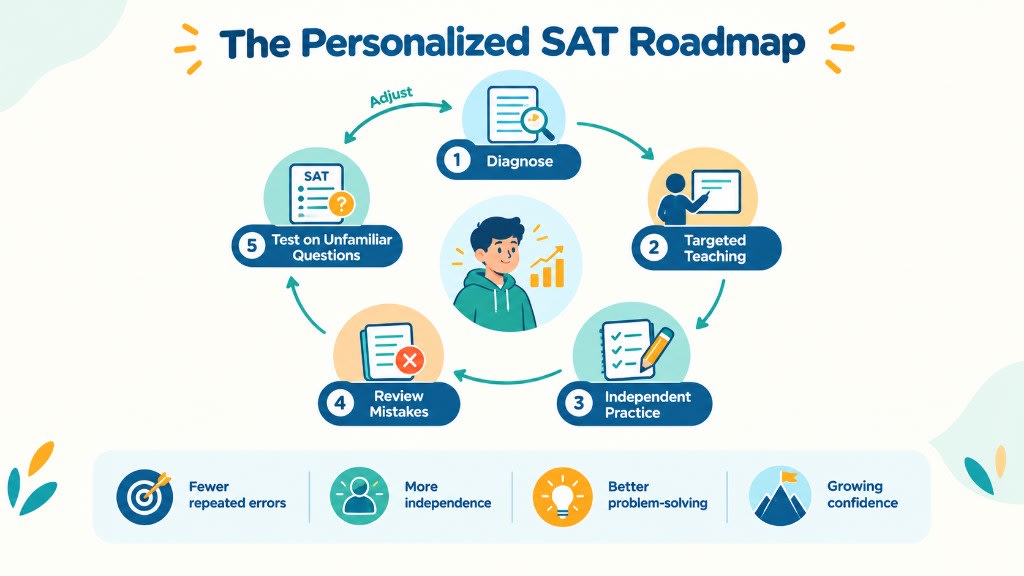
From that diagnosis we build a focused roadmap:
- Identify the highest-impact gaps
- Address the underlying concepts
- Practise deliberately
- Test understanding on unfamiliar questions
- Reassess and adjust
The roadmap should evolve with the student. It should never lock them into a fixed amount of content or practice.
How will you know it's working?
Parents deserve a clear answer to three questions: What are we working on, why are we working on it, and how will we know it's helping?
A score is only one signal, and it moves slowly. We also look for:
- Fewer repeated errors
- Greater independence
- Better problem-solving
- Stronger performance on unfamiliar questions
- Growing confidence
If you can see these changes week to week, the score tends to follow.
Tricks can raise a score. Understanding keeps it raised.
Many programs promise quick boosts through shortcuts or sheer volume of practice. A superficial gain usually comes from pattern recognition: spot the question type, apply a familiar shortcut, move on. That works until the wording, numbers, or context changes, and then it falls apart.
Deep understanding is different. The student knows why a method works, when to use it, and how to adapt it.
Here is an example from physics, but the same pattern shows up in SAT maths constantly. Imagine a student who repeatedly struggled with equations-of-motion problems. They had memorized several formulas, yet picked the wrong one whenever a problem looked unfamiliar. More formula practice would have made the memorizing stronger, not the thinking.
So in 1:1 sessions, the tutor did something else. The student had to describe what was physically happening, draw the situation, list the known and unknown quantities, and predict what should happen before choosing an equation.
The breakthrough came when the student said, "I know what is happening physically, so now I know which relationship I need." Unfamiliar problems stopped being intimidating. The change was not another formula. It was a reasoning process that works on problems they have never seen.
That is the difference between preparing for a test and learning to think through a problem.
Give every resource a job
Free official resources are excellent. College Board practice and Khan Academy are genuinely good for repetition, independent practice, and getting used to SAT-style questions. You do not need to replace them with something paid.
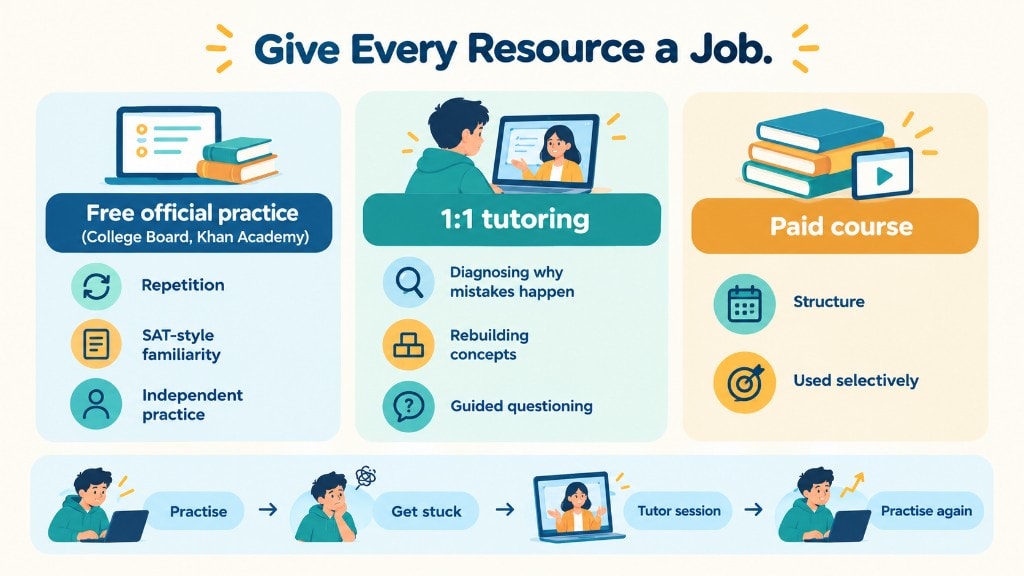
What matters is that each resource has a specific role:
- Free official practice: independent practice, repetition, and familiarity with the format
- 1:1 tutoring: the moments where practice alone is not enough, such as when the same mistake keeps coming back, when the student cannot see why an answer is wrong, or when a concept needs to be rebuilt
- Paid courses: structure, used selectively, so your child is not made to complete content they already know
The cycle looks like this: diagnose, teach the gap, practise independently, review mistakes, test on new questions, adjust. Independent time goes to practising what the student already understands. Tutor time goes to what needs expert diagnosis and explanation. The goal is not to use more resources. It is to make every resource serve a clear learning purpose.
When your child feels defeated by tests
If your child has struggled with standardized tests before, the most commonly missed ingredient is a sense of control. After enough bad experiences, every wrong answer starts to feel like proof of being "bad at tests." Piling on more practice can reinforce exactly that belief.
What helps instead:
- Pick a few specific, solvable barriers and create early wins. Rather than "you need to improve your SAT maths," try "let's understand why these particular algebra questions are going wrong."
- Work through the reasoning together. Use guided questions rather than handing over answers, then gradually remove the support.
- Track progress beyond scores. Fewer repeated mistakes, more independent attempts, clearer explanations, and a willingness to try unfamiliar questions all count.
The psychological shift we are aiming for is from "I hope I get this right" to "I know what to do when I get stuck." Once a student sees that they can influence their own progress, motivation stops depending on constant encouragement and starts coming from real competence.
What to take away
- Diagnose first. Choose resources second.
- Measure progress in more than one way.
- Aim for understanding that transfers to unfamiliar questions, not shortcuts.
- Assign each resource a clear job.
- Rebuild confidence by giving your child control, one solvable problem at a time.
If you would like help working out where your child is actually losing marks, and what to do about it, Asymptode's 1:1 online tutors can start with a diagnostic session and build a plan around what they find.