

As parents, we want our children to do well, to feel confident, and to genuinely understand what they're learning. Yet with a high-stakes exam like the SAT, practice tests often become a source of stress rather than a pathway to progress. You may worry that your child is falling behind, that their confidence is taking a hit, or that they're learning "tricks" instead of real understanding.
Practice tests can be something better. Used well, they become a tool for building lasting confidence and a deeper grasp of math and science. It's not just about the score. It's about the journey your child takes to get there.
From Verdict to Diagnosis: Changing What a Practice Test Means
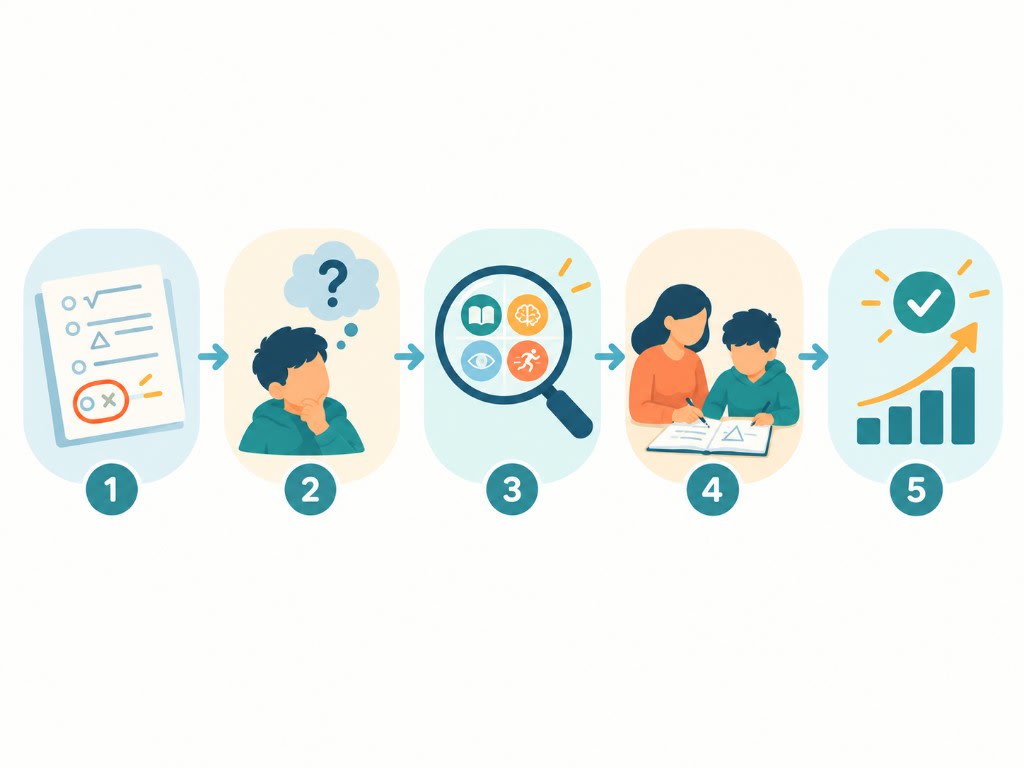
Many students treat a practice test as a final judgment. A low score feels like proof: "I'm not good at this." That mindset is a real barrier to learning.
Consider a student who saw every practice test this way. Instead of immediately assigning more tests, the tutor changed what the test meant. After each one, they reviewed only a few important mistakes and asked, "What happened in your thinking here?" Together, they spotted patterns: rushing through unfamiliar wording, or choosing a formula before understanding the problem.
Over time, practice tests became diagnostic tools rather than verdicts. The student could see specific progress: fewer repeated mistakes, better pacing, and more willingness to attempt difficult questions. The tutor also had the student predict which areas they'd struggle with before testing, then compare those predictions with the results. That made the process active and far less threatening.
The mindset gradually shifted from "I hope I get a good score" to "This test is going to show me what I can improve next." That shift is what makes practice testing confidence-building rather than anxiety-inducing.
Ask "What Did Your Thinking Do?" Not "What Did You Get Wrong?"
Most practice-test advice stops at identifying weak areas. That's a start, but it isn't enough. To build resilience, students need to see mistakes as information, not failure.
After a practice test, resist the urge to show the correct solution right away. Ask your child to reconstruct their thinking:
- What did you notice first?
- What were you trying to find?
- Why did you choose that approach?
- Where did you become unsure?
This helps separate a knowledge gap from a reasoning error, a misreading, rushing, or plain uncertainty.
For example, if a student picks the wrong equation on an SAT Math question, a tutor might say: "This isn't evidence that you can't do algebra. It tells us we need to get better at translating the words into the mathematical relationship before choosing an equation." They then solve a similar problem together, the student explains the reasoning in their own words, and finally tries a slightly different version independently.
Every mistake should end with an actionable next step. The student learns that a wrong answer isn't a verdict on their ability. It's information about what to work on next, and eventually they start saying, "I know why I got this wrong, and I know what I'll try differently next time."
Why 1:1 Tutoring Makes Practice Tests More Powerful
Official SAT practice tests are widely available, but they don't come with coaching or emotional support. The real difference is what happens between the questions and the next attempt.
A practice test tells us what the student answered. 1:1 tutoring helps uncover why. A tutor can slow down when a student is overwhelmed, revisit a missing foundation, or change the explanation when the student is stuck. Instead of "You missed five algebra questions," the tutor might find that the real issue is translating word problems, then practise that skill at the right level before returning to SAT-style questions.
How Parents Can Help
Parents play an important role in making practice tests feel like feedback, not judgment.
- Change the after-test question. Instead of "What did you score?", try "What felt easier this time?", "Where did you feel stuck?" or "What did you learn from this test?"
- Skip the comparisons. Avoid comparing scores with other students or jumping straight to the errors.
- Celebrate independence. Notice when your child attempts a difficult question, corrects an error, or tries a new strategy.
The goal is for your child to think, "A practice test doesn't tell me how capable I am. It tells me what I can work on next." Precise 1:1 feedback combined with calm parental support turns testing from a judgment experience into a learning process.
Quality Over Quantity: The Counter-Intuitive Path to Confidence

A common belief is that more practice tests automatically mean more confidence. In reality, taking test after test without understanding the mistakes can become repeated evidence of what the student already finds difficult. Confidence can actually drop, and burnout can follow.
Our advice: take fewer full-length tests, but study each one much more deeply. After a test, spend time on a small number of high-impact mistakes: what the student thought, where the reasoning broke down, and what strategy could change the outcome. Then practise that specific skill before taking another full test.
For example, instead of "Your score hasn't improved, so let's take another test," try: "Let's not take another test yet. Let's make sure you can solve these three types of problems independently first." The next test then becomes a chance to show growth rather than another stressful measurement.
The goal isn't to get better at taking practice tests. It's to get better at the thinking the SAT requires: critical reasoning, problem-solving, and solid foundations.
Key Takeaways for Confident SAT Prep
- Shift perspective: treat practice tests as diagnostic tools for growth, not judgments of ability.
- Analyze thinking, not just answers: find the root cause of each mistake and end with a clear next step.
- Embrace 1:1 support: personalized tutoring turns generic practice into a tailored confidence-building journey.
- Choose quality over quantity: fewer tests with deeper review beat endless testing.
- Support at home: ask about learning, not just scores.
At Asymptode, we partner with parents to help their children prepare for the SAT by understanding the concepts underneath, building confidence that lasts well beyond test day. Our 1:1 online math and science tutoring is paced to your child's stage. Book a free consultation to see how it works.