

As a parent, you want your child to genuinely understand maths and science, not just memorize for a test. You picture them tackling challenges with confidence and building a strong foundation for their future. Yet the SAT looms, and with it an endless stream of practice questions. Many resources offer "detailed answer explanations," but are they enough to build the deep, lasting understanding your child needs?
This article explains why personalized, human-driven feedback is what turns SAT practice into real learning, and what it looks like in a 1:1 session.
The Critical Difference: Generic Explanations vs. Personalized Feedback
Popular SAT prep resources, such as those from Kaplan and The Princeton Review, provide thorough answer explanations. They are good at showing how a question should be solved. But a generic explanation tells the student how the question should be solved, while personalized feedback identifies why this particular student couldn't solve it.
An explanation can lay out the correct algebraic steps, but it can't tell whether the student misunderstood the question, missed a prerequisite concept, chose the wrong strategy, or simply rushed.
Imagine a student gets an SAT word problem wrong. The explanation shows the correct equation and solution. The student may understand it perfectly and still make the same mistake on the next question, because their real problem is translating words into a mathematical relationship.
In 1:1 tutoring, I would ask: "Before you chose that equation, what did you think the question was asking you to find?" If the answer reveals the misconception, we can address that specific reasoning gap, practise a few variations, and then gradually remove the support.
That is the difference between correcting an answer and changing the student's thinking. The goal isn't for your child to understand today's explanation. It's for them to recognize the underlying concept and apply it independently when the next question looks completely different.
Uncovering the Root Cause: Beyond the "What" to the "Why"
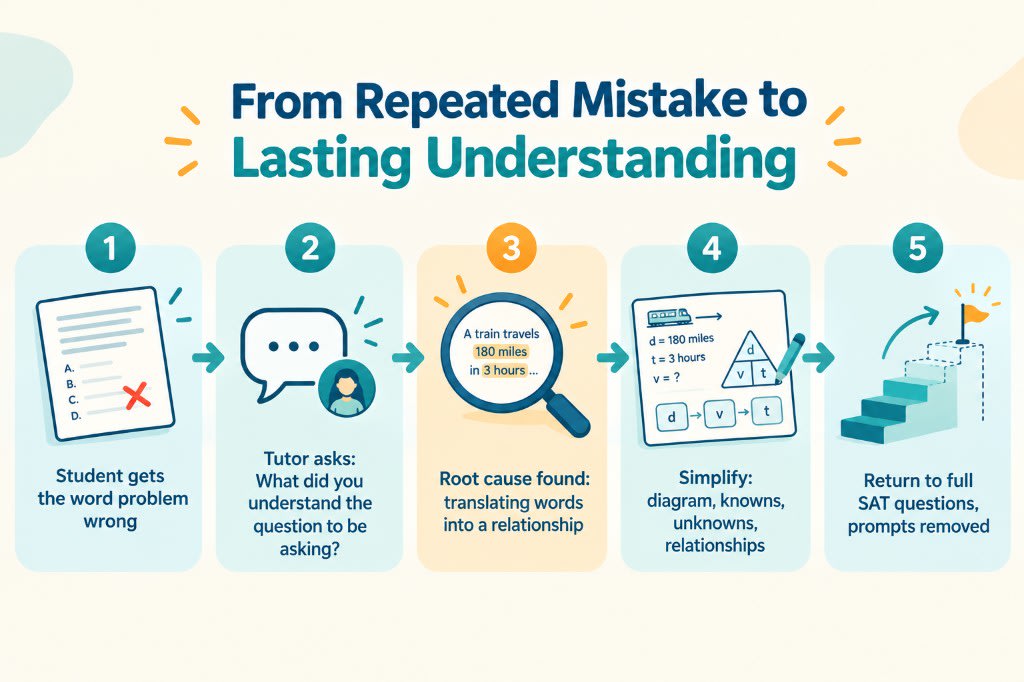
It's frustrating for parents when a child completes many practice questions and still struggles with the same types of problems. A standard resource explains the correct equation each time, yet the student repeats the mistake.
A common example is a student who keeps getting SAT algebra word problems wrong even after dozens of practice sets. In 1:1 tutoring, I would stop adding more questions and examine the student's thinking:
"What did you understand the question to be asking? What information did you use? Why did you choose that equation?"
Often the real issue isn't algebra. The student is trying to identify a formula before translating the words into a mathematical relationship. Once that becomes visible, we step back and use a simple example or diagram. We practise identifying the knowns, unknowns and relationships before writing any equation. Then we gradually return to full SAT questions and remove the prompts.
That's the difference between treating the symptom and finding the cause. Generic feedback says, "Here is the correct solution." Personalized feedback asks, "Why did your thinking lead you here, and what needs to change so you can solve the next one independently?"
Cultivating a Lasting Problem-Solving Mindset
Your child's academic journey is about more than a single score, and individualized feedback builds something that outlasts the test.
Consider a student who approached every difficult SAT question by searching for a familiar formula or waiting for a recognizable pattern. When that failed, they quickly concluded, "I don't know how to do this." Through 1:1 feedback, I focus less on giving solutions and more on making the student's thinking visible:
What do you know? What are you trying to find? What relationships do you see? What could you try first?
Over time, the student begins applying that process independently. They become more comfortable with unfamiliar questions, start checking their own reasoning, and treat mistakes as information rather than proof that they can't do something. Their SAT performance can improve as a result, but the more important change is that they no longer need to know the answer immediately before being willing to attempt the problem.
That is the lasting value of individualized feedback. It can shift a student from "I need someone to show me how" to "I can figure out how to approach this." That mindset carries into future maths, science, university coursework, and any situation where the answer isn't immediately obvious.
The Missing Link: Why Human-Driven Feedback Is Indispensable
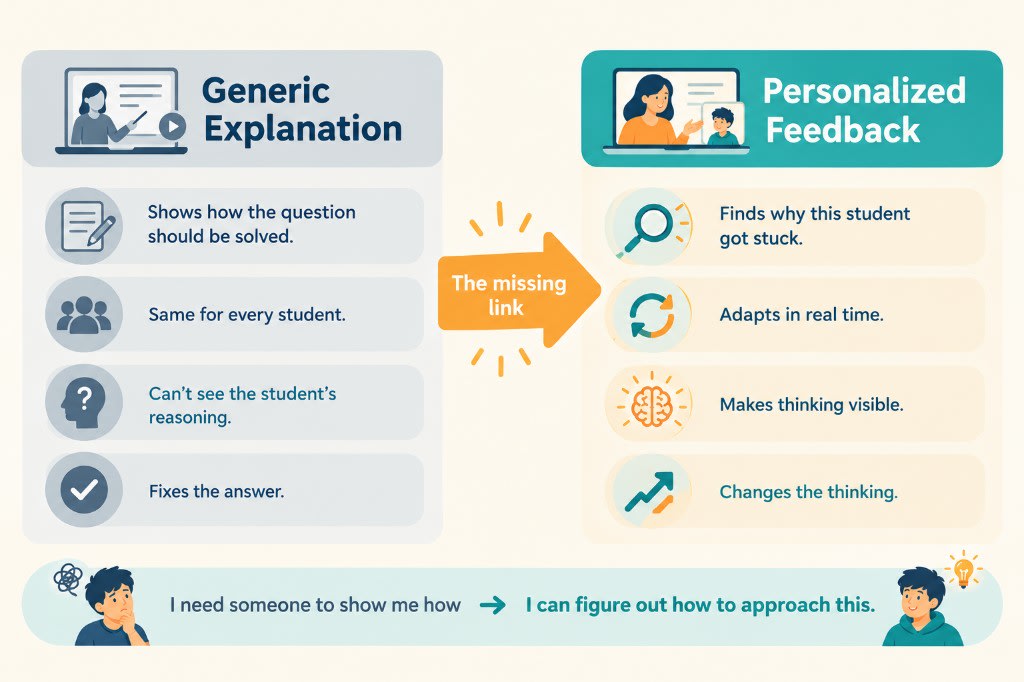
Some argue that with enough practice questions and detailed explanations, students can work things out on their own. Practice and explanations can be powerful, but they assume the student can correctly identify what went wrong in their own thinking. That self-diagnosis is often the hardest part.
A student may read an explanation, understand it, and still not realize that the same underlying misconception caused their original mistake. They fix the answer without fixing the reasoning, and the cycle of repeated errors continues.
A human tutor can interrupt that cycle with targeted questions:
"What made you choose that approach?" "What did you think this sentence meant?" "Where did you become unsure?"
If a student repeatedly chooses the wrong equation, the tutor may discover that the issue is not algebraic skill but translating the wording into a mathematical relationship. The tutor can then change the representation, rebuild the prerequisite concept, practise carefully chosen variations, and gradually remove the support.
The unique value is not simply knowing the correct answer. It is seeing the student's reasoning, diagnosing the specific barrier, and adapting the teaching in real time. Practice gives students opportunities to solve; personalized feedback helps them become better solvers. Over time, "I don't know what I did wrong" becomes "I can recognize my mistake and know what to try next."
Key Takeaways
For concerned parents, SAT prep can feel daunting. Practice questions and explanations are widely available, but lasting mastery and confidence usually need a more tailored approach. Personalized, human-driven feedback turns practice into learning by:
- Diagnosing the "why": moving beyond correct answers to the root cause of a student's errors.
- Building a problem-solving mindset: developing independent thinking rather than rote memorization.
- Adapting in real time: giving targeted support that evolves with your child's needs.
If you're looking for tutoring that adapts to your child's learning style and pace, explore how Asymptode's 1:1 online maths and science tutoring can help at asymptode.com.