
If you want to know how to become an architect, the short version is this: earn an accredited architecture degree, get supervised work experience, pass a professional exam, and register in the country where you want to work. This guide walks students and parents through each step, using only official sources.
Key takeaways
- In most countries the path has three parts: an accredited degree, supervised experience, and an exam or assessment before you can register.
- In the US, you need a degree (often a 5-year NAAB-accredited B.Arch), 3,740 hours of NCARB AXP experience, the six-division ARE 5.0 exam, and a state licence.
- In the UK, "architect" is a protected title: you must be on the ARB register. ARB is replacing the old Part 1, 2 and 3 system with a new framework.
- In India, you need a 5-year B.Arch (entry through NATA or JEE Main Paper 2A) and registration with the Council of Architecture.
- Maths, physics and art all matter. Start a sketchbook and a portfolio early, because many schools ask for one.
How to become an architect: what are the main steps?
Quick answer: To become an architect, you finish school with strong maths, physics and creative work, then complete an accredited architecture degree. Next you gain supervised work experience, usually two to three years. Finally you pass a professional exam or assessment and join your country's official register. Only then can you legally call yourself an architect.
The US Bureau of Labor Statistics (BLS) says there are "typically three main steps": a degree, a paid internship, and passing the Architect Registration Examination. Other countries use different names, but the shape is the same.
 The four-stage path to becoming a licensed architect.
The path has four stages. First, school, where you build maths, physics and art skills. Second, an accredited architecture degree. Third, supervised work experience in a practice. Fourth, an exam or assessment and registration, after which you are a licensed architect.
What does an architect actually do?
According to the BLS Occupational Outlook Handbook, "Architects plan and design houses, factories, office buildings, and other structures." BLS lists these duties:
- Meet clients and give early estimates of cost and construction time.
- Prepare scaled drawings, by computer or by hand.
- Write specifications and contract documents for builders.
- Manage contracts and visit sites to check the work follows the plans.
- Give presentations to win new work.
BLS also lists creativity, communication, technical skill with design software (CADD and BIM), and the ability to "envision how the parts of a structure relate to each other."
BLS notes that "most architects work full time and many work additional hours, especially when facing deadlines."
Which school subjects should you choose to become an architect?
Choose maths, physics and an art or design subject if you can. English and computing help too.
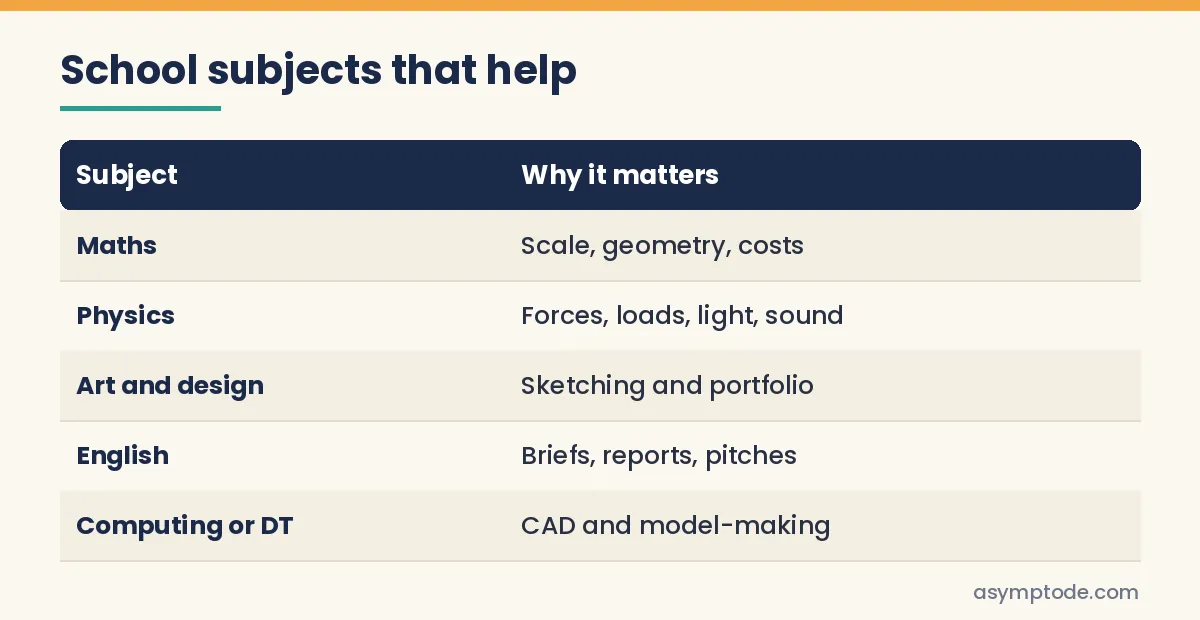 Five school subjects and how each one is used in architecture.
Maths is used for scale, geometry and cost estimates. Physics helps you understand forces, loads, light and sound in buildings. Art and design build your sketching skills and your portfolio. English helps with client briefs, reports and presentations, and computing or design technology helps with CAD and model-making.
What do universities actually require? It varies, so always check each official course page. Here are three real examples:
| University or system | What the official page asks for |
|---|---|
| India, any B.Arch (CoA rules) | Class 12 with Physics and Mathematics compulsory, plus one more listed subject, at least 45% aggregate; or a 10+3 Diploma with Mathematics |
| UCL Architecture BSc (2027 entry) | A levels AAB, no specific subjects; GCSE English Language and Maths at grade C or 4; portfolio on invitation |
| Cornell B.Arch (US) | A portfolio of 15-20 slides and a short video interview |
See the official UCL and Cornell pages. Cornell wants freehand drawings plus media such as painting, photography or woodworking. For admissions advice, see our guides on how to get into UCL and how to get into MIT.
How do maths and physics get used in architecture?
Maths is a daily tool for architects, not just an entry test.
Scale. Every plan is drawn to scale, so you must turn real sizes into paper sizes and back again without errors.
Geometry. Angles, areas, volumes and right-angled triangles appear in roofs, stairs, ramps and site plans. For example, if a roof rises 4 m over a half-span of 3 m, the sloping rafter is the square root of (3 x 3 + 4 x 4) = the square root of 25 = 5 m. That is Pythagoras, used for real.
Structures. Physics explains how loads travel through beams, columns and foundations to the ground. Architects work with structural engineers, so they must understand forces. If you also like the engineering side, read how to become an engineer.
Worked example: reading a 1:50 plan
 A 1:50 scale drawing, worked step by step.
A scale of 1:50 means 1 cm on paper equals 50 cm in real life. The room is 4.5 m by 3.6 m, which is 450 cm by 360 cm. 450 cm divided by 50 is 9 cm, and 360 cm divided by 50 is 7.2 cm, so the room is drawn 9 cm by 7.2 cm. Check: 9 x 50 = 450 and 7.2 x 50 = 360. The real floor area is 4.5 x 3.6 = 16.2 square metres.
One trap: areas scale by 50 x 50 = 2,500. The paper room is 9 x 7.2 = 64.8 square cm, and 64.8 x 2,500 = 162,000 square cm, or 16.2 square metres.
How do you become an architect in different countries?
Each country has its own degree, experience rules and licensing body.
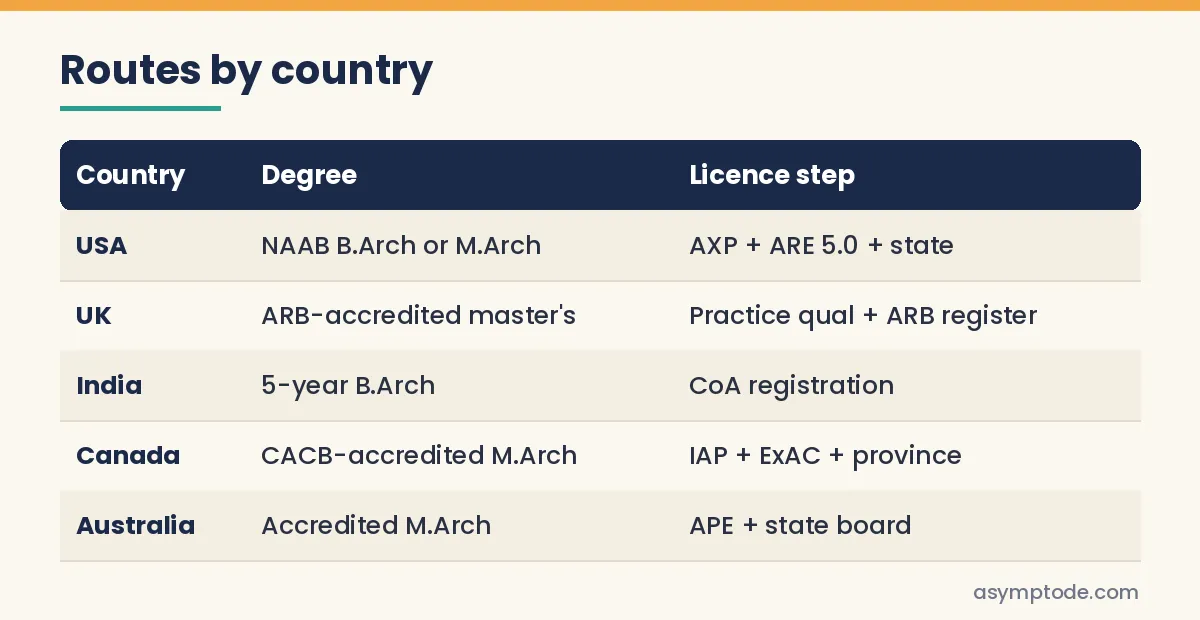 Degree and licence steps in five countries.
USA: a NAAB-accredited B.Arch or M.Arch, then AXP, the ARE 5.0 and a state licence. UK: an ARB-accredited master's level qualification, then a practice qualification and the ARB register. India: a 5-year B.Arch, then registration with the Council of Architecture. Canada: a CACB-accredited M.Arch, then the IAP internship, the ExAC exam and a provincial licence. Australia: an accredited Master of Architecture, then the APE and a state or territory board.
How do you become an architect in the USA?
- Earn an accredited degree. NAAB describes the B.Arch as "a five-year, professional undergraduate degree." An M.Arch usually takes two years after a four-year pre-professional degree (such as a BS in Architecture), or three years after a degree in another field. NAAB says an accredited degree "is accepted by all 55 jurisdictions and required by 37." It lists 180 accredited programs and 10 candidate programs at 152 institutions.
- Complete the AXP. NCARB's Architectural Experience Program requires 3,740 hours across six areas: Practice Management (160), Project Management (360), Programming & Analysis (260), Project Planning & Design (1,080), Project Development & Documentation (1,520) and Construction & Evaluation (360). Since November 2025, experience up to a year old earns full credit and older experience earns 75%.
- Pass the ARE 5.0. It has six divisions with the same six names as the AXP areas. NCARB made small changes to 12 of its 91 objectives on 27 April 2026, but the six-division structure did not change.
- Get your state licence. BLS says "All states and the District of Columbia require architects to be licensed," and most states require continuing education to keep the licence.
NCARB says broader pathway changes would "not be announced until 2027 at the earliest," so check its updates page. US applicants weighing tests should read SAT vs ACT.
How do you become an architect in the UK?
In the UK, "To call yourself an architect in the UK, you must be registered with ARB," the Architects Registration Board.
ARB is moving to a new framework built on Competency Outcomes (Academic Outcomes and Practice Outcomes). Under it, you register with either:
- an accredited master's level qualification covering the Academic Outcomes, plus an accredited practice level qualification covering the Practice Outcomes, or
- one "combined" accredited qualification that covers both.
The old qualifications are still called Part 1, 2 and 3. ARB says it will keep accrediting existing qualifications, including Part 3, until 31 December 2028. On the old route, Part 3 candidates are likely to need 24 months of practical experience, with 12 months in the UK.
UCL's course page says that from 2028 an undergraduate architecture degree "will not be an essential requirement for registration," though you can still take one and move on to an accredited master's. The RIBA also lists Level 6 and Level 7 apprenticeships and its RIBA Studio earn-and-learn route. The rules are in transition, so check ARB every year.
How do you become an architect in India?
- Finish Class 12 with Physics and Mathematics compulsory, plus one more listed subject, and at least 45% aggregate (CoA Regulations 2020).
- Qualify an aptitude test: NATA, run by the Council of Architecture, or JEE Main Paper 2A, run by NTA. See our NATA 2027 guide and JEE Main 2027 guide. JEE Main 2027 Session 1 runs 20-28 January 2027 and Session 2 runs 2-7 April 2027. NATA 2027 dates are not yet announced.
- Complete a 5-year B.Arch.
- Register with the Council of Architecture, set up under the Architects Act, 1972. Using the title "Architect" needs CoA registration.
If you love design but are unsure about architecture, compare the UCEED 2027 guide for design degrees.
How do you become an architect in Canada?
The CACB sets out these steps:
- Complete a CACB-accredited Master of Architecture (M.Arch).
- Your school sends your details to CACB for certification. You do not apply yourself.
- Register for the Internship in Architecture Program (IAP) in your province or territory and log experience.
- Complete the IAP and the Examination for Architects in Canada (ExAC).
- Apply to your provincial or territorial regulator. Once licensed, you may use the title "Architect".
Check your provincial association for hours and exam details.
How do you become an architect in Australia?
The AACA says the most common route is an accredited qualification, then the Architectural Practice Examination (APE). Architects have "5 years professional education," and 22 universities offer the accredited Master of Architecture.
The APE has three parts: a logbook and statement of practical experience, a National Examination Paper, and an Examination by Interview with two practising architects. You need at least 3,300 hours (about two years) of experience, with at least 12 months after your qualification. You then register with one of eight state and territory boards. For 2027, Part 2 papers are set for 13 April and 21 September 2027.
How long does it take to become an architect?
Plan for seven years or more after school. Australia's AACA describes five years of professional education plus at least two years of experience. In the US, BLS says the B.Arch usually takes five years and the internship generally lasts three years. Exam time comes on top.
Is architecture a good career? The honest outlook
Here are the US figures, exactly as the BLS Occupational Outlook Handbook prints them (page last modified 27 August 2026):
| BLS measure (US only) | Figure |
|---|---|
| Median pay (May 2025) | $99,280 per year ($47.73 per hour) |
| Number of jobs (2025) | 124,600 |
| Projected growth (2025-35) | 4%, as fast as average |
| Employment change (2025-35) | 5,300 |
| Openings per year | About 6,900, on average |
Many openings come from replacing architects who change jobs or retire. These are US numbers only.
What can you do in school right now?
You do not need to wait for university. Start these early steps now:
- Keep a sketchbook. Draw buildings, rooms and streets from life. Cornell's B.Arch asks for freehand drawings in the portfolio.
- Build a portfolio. Include drawing, painting, photography, models or woodwork. UCL and Cornell both ask for one.
- Try a summer program. Cornell AAP runs a six-week Introduction to Architecture and Design Precollege Program for high school students, with a design studio and lectures. It ran 22 June to 31 July 2026; 2027 dates are not yet listed.
Book a free demo class to strengthen your maths and physics for architecture entrance tests and Class 11-12 or A level work, or see our plans and fees.
A step-by-step plan from Grade 9 or 10
- Grade 9: Keep maths and science strong. Take art or design. Start a sketchbook.
- Grade 10: Pick the right senior subjects. In India, choose Physics and Mathematics. In the UK, make sure you pass GCSE maths and English. Keep art if you can.
- Grade 11: Research target countries and read official course pages. Start serious portfolio pieces. Look for an official summer program.
- Grade 11-12: Prepare for your entrance route: NATA or JEE Main Paper 2A in India, SAT or ACT if your US schools ask for them, and portfolio deadlines everywhere.
- Grade 12: Apply. Check that each degree is accredited (NAAB, ARB, CoA, CACB or AACA) for the country where you want to work.
- After school: Finish the degree, log your experience from the start, then sit the exam and register.
What are the most common mistakes?
- Choosing a non-accredited degree. A four-year pre-professional degree in the US is not a B.Arch. You may need an M.Arch after it.
- Dropping maths or physics too early. In India, B.Arch admission needs both.
- Leaving the portfolio until Grade 12. Good portfolios take years of steady work.
- Planning for one country, then moving. Pick your target country early.
- Ignoring rule changes. Recheck ARB, NCARB and other official pages every year.
How 1-on-1 tutoring helps with becoming an architect
- Maths and physics for entrance tests: One dedicated Asymptode mentor, live online 1-on-1, follows your own syllabus and exam dates, whether that is Class 12 for NATA and JEE Main Paper 2A, A levels, IB or AP.
- Method-first working: Your mentor watches each step of your geometry, scale and mechanics working, so small errors are caught before exams.
- Personalised homework with feedback, plus every class recorded so you can rewatch tricky topics like trigonometry or forces.
- Planning help and parent updates: For the portfolio and applications, your mentor helps honestly with planning and method, not the art itself. Parents get short updates, and you can start with a free demo class.
Facts checked against official sources on 6 November 2026.
FAQ
Do I need to be good at maths to become an architect?
You need solid maths for scale, geometry, area and cost estimates. In India, B.Arch admission needs Mathematics in Class 12, and JEE Main Paper 2A includes a maths section.
Can I become an architect without a degree?
Usually not. India, Canada and Australia all start with an accredited degree, and BLS says about two-thirds of US states require an accredited architecture degree. In the UK, RIBA lists apprenticeship routes, and ARB's new framework is built on accredited qualifications, so check ARB for the current rules.
Is a B.Arch or an M.Arch better?
Both can lead to a licence if accredited. In the US, NAAB describes the B.Arch as a five-year professional degree, and the M.Arch usually takes two or three years after a first degree. Canada uses the accredited M.Arch, and India uses the 5-year B.Arch.
How much do architects earn?
The US BLS reports median pay of $99,280 per year in May 2025. That is a US figure only. For other countries, check official national sources.
Do I need a portfolio to study architecture?
Many schools ask for one. UCL asks for a portfolio on invitation, and Cornell's B.Arch requires one plus a short video interview. In India, NATA and JEE Main Paper 2A include drawing tests.
Can I study in one country and work in another?
Sometimes, but it takes extra steps. Each national, state or provincial body has its own rules for overseas qualifications. Choose a program accredited for the country where you hope to work.
Ready to start? Book a free demo class and advisor call, or see our plans and fees.
Sources
- BLS Occupational Outlook Handbook: Architects
- NCARB AXP experience requirements
- NCARB Recent AXP and ARE Updates
- NAAB Prospective Students
- ARB information for students and trainees
- ARB transition FAQs and glossary for students
- RIBA: Become an architect
- UCL Architecture BSc
- Cornell AAP undergraduate admissions: Architecture
- Cornell AAP architecture summer programs
- NATA official portal
- Council of Architecture
- CACB: Role of CACB in your pathway to licensure
- AACA Architectural Practice Examination
- AACA: Architecture in Australia