
ATAR explained in one line: the Australian Tertiary Admission Rank is a number from 0.00 to 99.95 that shows where you stand compared with other students your age. It is not a mark out of 100. This guide covers who calculates it in each state, how scaling and adjustments work, the official 2026 release dates and a simple Year 11 and 12 plan.
Key takeaways
- The ATAR is a rank, not a mark. It runs from 0.00 to 99.95 in steps of 0.05.
- Each state has its own admissions centre: UAC, VTAC, QTAC, SATAC, TISC or the University of Tasmania.
- Your subject results are scaled, then your best results are added up and turned into a rank.
- Universities look at your selection rank: your ATAR plus any adjustments. Adjustments never change the ATAR itself.
- 2026 ATARs come out in December: Victoria on 10 December, NSW and ACT on 16 December, Queensland on 18 December.
What is the ATAR? ATAR explained simply
Quick answer: The ATAR (Australian Tertiary Admission Rank) is a rank between 0.00 and 99.95. It shows your position compared with all students in your age group. An ATAR of 75.00 means you did better than about 75% of that group. It is calculated from your scaled Year 12 results and is used for university entry.
UAC puts it simply: "The ATAR is a rank, not a mark." There is no ATAR of 100.
Is the ATAR a percentage?
No. It is a percentile rank. VTAC says an ATAR of 75.00 means you did better than 75% of the Year 12 age group (VTAC).
What does "30 or less" mean?
Low ranks are not shown exactly. Ranks of 30.00 or below appear as "30 or less" in NSW (UAC) and "30.00 or less" in Queensland (QTAC).
Who calculates the ATAR in each state?
Each state has a tertiary admissions centre that runs university applications. Official sources: UAC, VTAC, QTAC, SATAC, TISC.
| State or territory | Who calculates the ATAR |
|---|---|
| NSW | UAC |
| ACT | ACT Board of Senior Secondary Studies, with UAC |
| Victoria | VTAC |
| Queensland | QTAC |
| South Australia and NT | SATAC |
| Western Australia | TISC |
| Tasmania | University of Tasmania |
TASC, the Tasmanian exam body, calls the University of Tasmania "Tasmania's Tertiary Admissions Centre".
How is the ATAR calculated?
The steps are the same everywhere. Only the details change by state.
 From subjects to rank, step by step.
The animation walks through the process. You finish your Year 12 subjects and get your results from your state's exam body. Your results are scaled, then your best scaled results are added up into one total, called an aggregate. That aggregate is compared with everyone else and turned into a rank: your ATAR, from 0.00 to 99.95.
What is scaling, and does it punish hard subjects?
Scaling makes results fair across subjects. VTAC says it adjusts for the fact that a high score is harder to get in some studies, because of how strong that group of students is, not because the subject is "harder" (VTAC). QTAC says scaling means students "are neither advantaged nor disadvantaged based on the subjects they choose" (QTAC).
UAC also explains that scaling does not change the order of students inside a course (UAC fact sheet). If you beat a classmate in a subject, you still beat them after scaling.
So do not pick a subject only because you think it "scales well".
Which results count in each state?
| State | What counts | Key rule |
|---|---|---|
| NSW | Best 2 units of English + best 8 other units | 10 units in total |
| Victoria | Best English-group score + next best 3 ("primary four") | Plus 10% of 5th and 6th scores |
| Queensland | Best 5 inputs (General, Applied or Cert III+ VET) | At least a C in English |
| SA and NT | Best scaled scores from 90 Stage 2 credits | Must qualify for SACE or NTCET |
| WA | Best 4 scaled scores | Plus 10% bonuses for LOTE, Methods, Specialist |
Two extra points: in Victoria, VCE Vocational Major subjects get no study score, so they cannot count. In WA, the maximum TEA (Tertiary Entrance Aggregate) is 430. Sources: UAC, VTAC, QTAC, SATAC, TISC.
If maths is part of your plan, our guides to HSC Maths Advanced, HSC Maths Extension 1 and VCE Maths Methods explain how those courses work.
Who is eligible for an ATAR?
You must meet your state's rules, or you will not get an ATAR.
- NSW: at least 10 units of Board Developed courses, including 2 units of English, three courses of 2 units or more, and four subject areas (UAC ATAR FAQs).
- Victoria: qualify for the VCE, with study scores in at least four Unit 3 and 4 studies, including one English-group study.
- Queensland: the right subject mix, a C or higher in an English subject, and results within five years.
- SA and NT: qualify for the SACE or NTCET, with at least 60 of the 90 credits from 20-credit Tertiary Admissions Subjects or valid pairs.
- WA: at least four scaled scores.
Check with your school early in Year 11.
What is the difference between an ATAR and a selection rank?
Your ATAR is fixed. Your selection rank is what a university uses for a course. The University of Sydney puts it as a formula: "Selection rank = ATAR + adjustment factors". Adjustments can differ by course, so your selection rank can differ too.
 Adjustments lift your selection rank, not your ATAR.
The flow starts with your ATAR. Adjustment factors are added for one course, giving your selection rank. That selection rank is compared with the course's lowest selection rank.
What are adjustment factors?
UAC says these used to be called "bonus points" (UAC selection rank adjustments). The main types are:
- Subject performance: some universities add points for strong Year 12 results in certain subjects.
- Regional: some add points if you live or study in a set region.
- Equity (Educational Access Schemes): for students whose study was harmed by things outside their control.
- Elite athlete and performer: you apply to each university directly.
UAC says adjustments "do not change your ATAR; they change your selection rank for a particular preference." Universities cap how many points they add, and UAC warns you "may only get 1 or 2 points".
How does the Educational Access Scheme (EAS) work?
In NSW and the ACT, UAC runs EAS. Your Year 11 or Year 12 studies must have been seriously affected by things beyond your control. There are eight categories, from financial support and health to caring for others and attending a regional school. One, living in a low socio-economic area, is checked automatically (UAC EAS).
EAS does not change your ATAR and does not guarantee an offer. EAS applications for December Round 2 close 19 November 2026; for January Round 1, 25 December 2026. Other states run their own schemes.
What is a lowest selection rank?
It is the lowest selection rank of students who got an offer to a course last year. You will find it in the course's ATAR profile on the UAC website. It gives you an idea of what you need, but it can change every year (UAC).
UAC gives a simple example. A course has three places and six applicants. The applicants with selection ranks of 99, 98 and 97 get offers. So the selection rank for that course is 97 (UAC fact sheet). The rank is set by demand. It is not a fixed "pass mark".
Universities also run their own entry schemes. Our guides to getting into the University of Sydney, the University of Melbourne and ANU cover these routes.
Want a plan built around your own subjects and target course? Book a free demo class with an Asymptode advisor, or see our plans and fees.
How do IB students get an ATAR?
IB Diploma students do not get an ATAR. Instead, their IB score is converted to a rank that universities treat like an ATAR.
In NSW and the ACT, UAC emails students an IB Admissions Score (IBAS). It adds decimal places to the diploma score, based on how you did inside each subject's grade band. UAC then converts it into a Combined Rank. The method is agreed nationally and may change each year (UAC IB applicants).
For whole-number IB scores, UAC's table for offers from August 2026 shows:
| IB overall score | Combined Rank |
|---|---|
| 45 | 99.95 |
| 44 | 99.75 |
| 40 | 96.85 |
| 30 | 79.30 |
| 24 | 64.60 |
Students with an IBAS use a more detailed table. UAC notes that completing the IB does not guarantee entry.
In Victoria, IB students get a "notional ATAR", treated like a normal ATAR (VTAC). November 2026 IB results come out on 17 December. UAC emails the IBAS on 18 December (UAC key dates), and VTAC posts notional ATARs online the same day (VTAC dates). Read our IB Diploma Programme guide for how the IB is structured.
Can international students get an ATAR?
UAC defines an international applicant as someone who is not an Australian citizen, a New Zealand citizen or an Australian permanent resident. They can apply through UAC if they are doing an Australian Year 12, the IB Diploma or NZ NCEA Level 3 (UAC international Year 12).
International applicants through UAC get a conditional offer about 48 hours after applying, but need an unconditional offer to enrol. Unconditional offer rounds after results include 23 December 2026 and 8 January 2027 (UAC key dates). English language proficiency is required for all courses. Other states have their own rules, so check your admissions centre.
When are 2026 ATARs released?
All dates can change, so check the official page before the day.
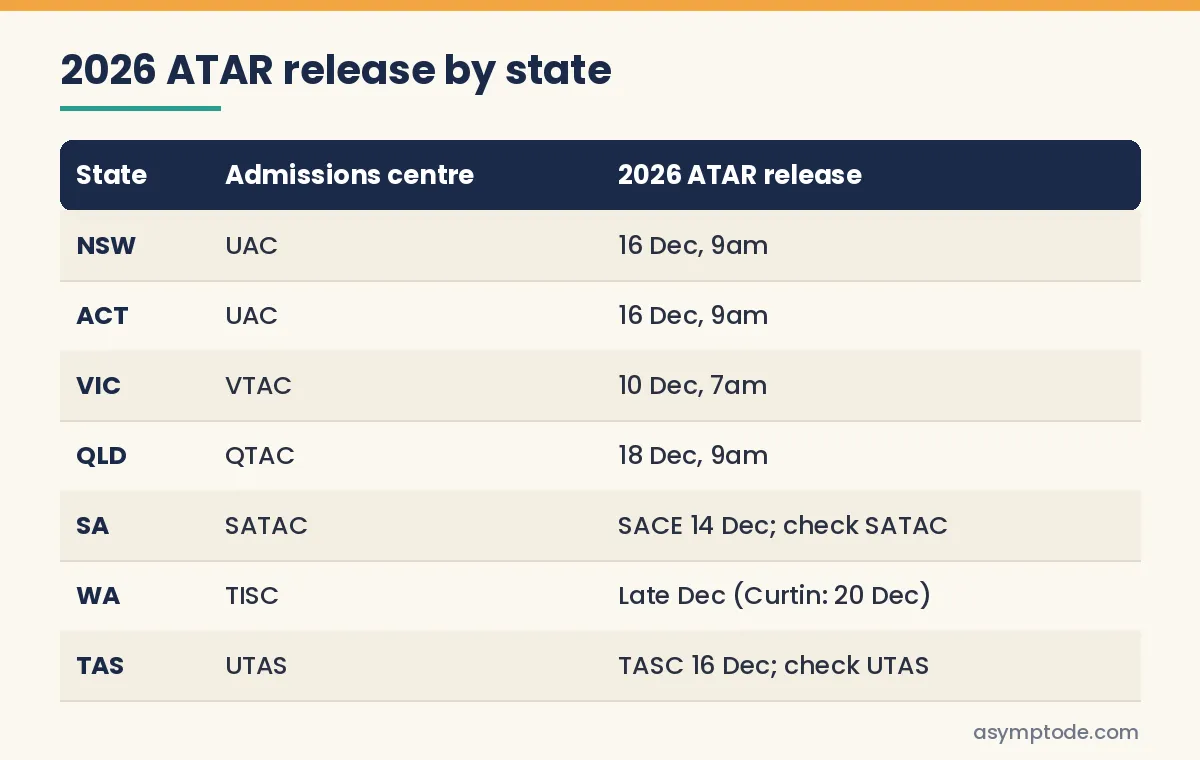 Who releases your ATAR in 2026, state by state.
The table lists each state, its admissions centre and its 2026 ATAR date. Victoria (VTAC): VCE results and ATARs on 10 December, 7am (VTAC). NSW and ACT (UAC): 16 December, 9am; NSW HSC results come from NESA at 6am that day (UAC). Queensland (QTAC): 18 December, 9am (QTAC). South Australia: SACE results on 14 December, 8.30am; check SATAC for the ATAR. Tasmania: TASC results on 16 December; check UTAS for the ATAR. WA: TISC says "late December", and Curtin University lists 20 December.
When are offers made?
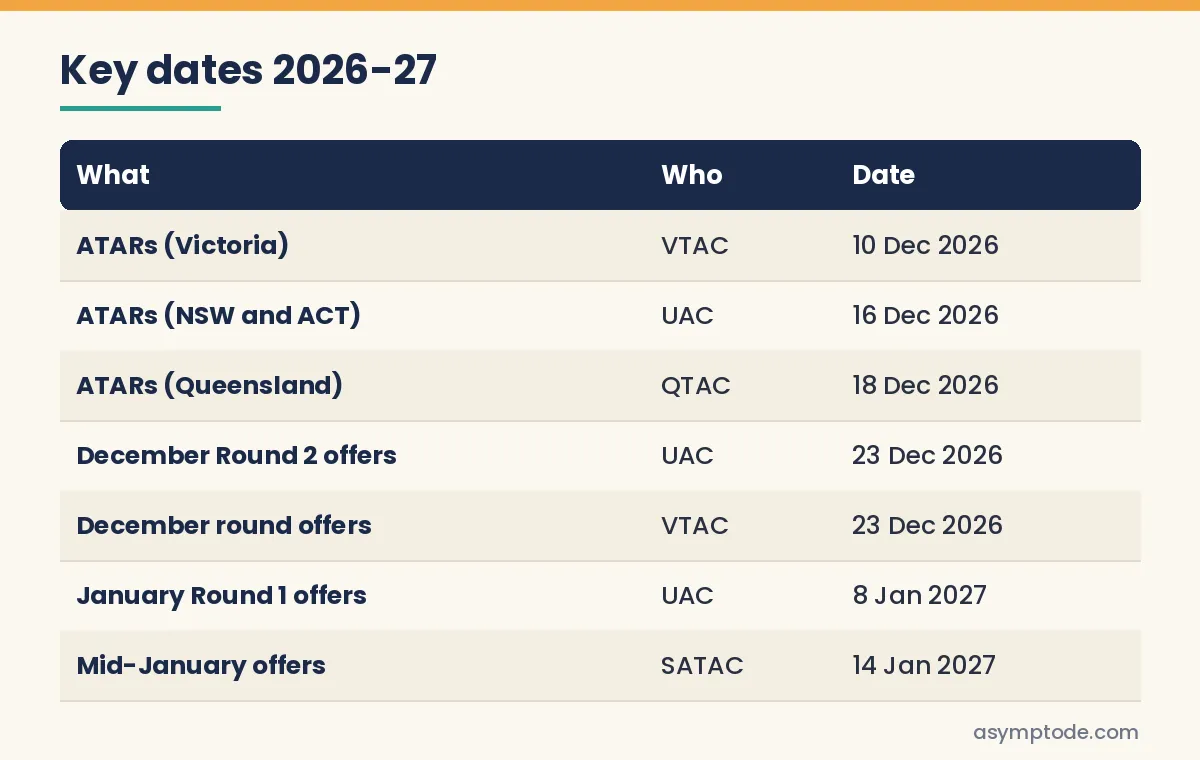 Official ATAR and offer dates for summer 2026-27.
The table shows the main official dates. ATARs: VTAC on 10 December 2026, UAC on 16 December, QTAC on 18 December. Offers: UAC December Round 2 and VTAC's December round are both on 23 December 2026. UAC January Round 1 is on 8 January 2027, and SATAC's mid-January round is on 14 January 2027.
- UAC (NSW and ACT): December Round 2 offers on 23 December 2026 (change preferences by 18 December). January Round 1 offers on 8 January 2027 (change preferences by 29 December). (UAC).
- VTAC (Victoria): December round offers on 23 December 2026. VCE students change preferences by 12 December, noon. January offers: 12 and 27 January 2027 (VTAC).
- SATAC (SA and NT): change of preference deadline 6 January 2027 (11:59pm). Offers on 14 and 28 January 2027 (SATAC).
- QTAC and TISC: check the official key dates pages at qtac.edu.au and tisc.edu.au.
Dates for students finishing Year 12 in 2027 are not yet announced.
What should you do after you get your ATAR?
Your ATAR arrives shortly before the big offer rounds. That gap is your chance to change your preferences.
- Check your ATAR and results on release day.
- Compare your likely selection rank (ATAR plus any adjustments) with each course's lowest selection rank from last year.
- Re-order your preferences. Put the course you want most at the top. Keep safer choices lower down.
- Meet the change of preference deadline for the round you want. Some centres have short periods before an offer round when you cannot make changes.
- Check your email on offer day and accept your offer by the date given.
- Did not get the offer you wanted? Later offer rounds may still give you a chance. Ask your admissions centre what is still open.
How should you prepare for the ATAR in Year 11 and Year 12?
Year 11, Term 1-2: choose well
- Check your state's eligibility rules (for example, the 10 units with 2 units of English in NSW).
- Check prerequisites for courses you might want, and pick subjects you can do well in.
Year 11, Term 3-4 and Year 12, Term 1-2: build habits
- Fix gaps in core skills, especially algebra if you take maths.
- Learn how each subject is assessed, and treat every school task seriously.
- Practise with past papers from your state's exam body, timed.
Year 12, Term 3: plan your applications
- Open your admissions centre account and note the early-bird and closing dates. For UAC, the early-bird deadline was 30 September 2026.
- Look at equity schemes such as EAS if your study was affected by hard circumstances.
Year 12, Term 4: exams and results
- Focus on exams first. Then mark your ATAR date and change of preference deadline.
How Asymptode helps you with your ATAR
At Asymptode, a qualified mentor teaches your child one-to-one, live online. The lessons follow the actual subjects that build their ATAR, whether that is HSC Maths Advanced, VCE Methods, QCE General Mathematics or SACE Physics, and they plan around your state's real dates, from school assessment tasks to the December release.
Between classes, your child gets practice made just for them. Their mentor looks at what the last attempt showed they had not yet understood. Asymptode's AI then helps write a worksheet at their level, following the mentor's brief. The mentor checks and approves it before it is sent. It is never a generic sheet.
The mentor marks the work. You see what your child understood and what to practise next. This keeps preparation correcting itself, task by task, towards the results that count for the ATAR. For subjects outside maths and science, such as English, the mentor helps with planning, method and reviewing practice.
Book a free demo class to talk through your child's subjects, or see our plans and fees.
Facts checked against official sources on 12 November 2026.
FAQ
What is a good ATAR?
There is no single "good" ATAR. What matters is whether your selection rank is high enough for your course. Look at each course's lowest selection rank from last year; it can change each year.
Is an ATAR of 99.95 the highest possible?
Yes. The ATAR runs from 0.00 to 99.95 in steps of 0.05. There is no ATAR of 100, because the ATAR is a rank, not a mark.
Do bonus points change my ATAR?
No. Adjustment factors (once called bonus points) raise your selection rank for a course, not your ATAR. UAC says universities cap the points they add, and you may only get 1 or 2 points.
Can I compare my ATAR with a student in another state?
Yes, that is part of its purpose. TISC says the ATAR lets the results of a WA student applying interstate be compared directly with results in other states. Each state still has its own rules for how the ATAR is calculated.
When do Victorian students get their ATAR in 2026?
VCE results and ATARs are available from 7am on 10 December 2026, after registering with the results service. Paid VTAC applicants get a digital ATAR statement from 15 December.
What if I do not get an ATAR?
Some courses do not use the ATAR; VTAC notes that VCE Vocational Major students can apply for those. Check your admissions centre and each university's entry schemes page.
Ready to start? Book a free demo class and advisor call, or see our plans and fees.
Sources
- UAC: The ATAR
- UAC: FAQs about the ATAR
- UAC: University selection rank adjustments
- UAC: Educational Access Scheme
- UAC: University applicants with an IB Diploma
- UAC: Key dates for Year 12 students 2026-2027
- UAC: International Year 12 students
- VTAC ATAR and Scaling Guide 2026
- VTAC: Important dates August 2026 - January 2027
- QTAC: Understanding ATAR
- QTAC: Year 12 ATAR
- SATAC: ATAR
- SATAC: Key dates
- SACE: Students Online
- TISC: About ATAR
- TASC: Your results