

HSC Mathematics Advanced is the most popular calculus course in the NSW Higher School Certificate. A new syllabus starts for Year 12 in Term 4, 2026 and is examined for the first time in the 2027 HSC. This guide explains the exam, the new syllabus, how the HSC mark is made and a Year 12 plan that works.
Key takeaways
- The HSC Mathematics Advanced exam is one 3-hour paper with 10 minutes reading time, worth 100 marks.
- Section I has 10 marks of multiple-choice questions. Section II has 90 marks of written questions.
- A reference sheet is given and NESA-approved calculators are allowed.
- Your HSC mark is 50% exam and 50% school-based assessment, so every school task counts.
- The Mathematics Advanced 11–12 Syllabus (2024) starts for Year 12 in Term 4, 2026. Its first HSC exam is in 2027.
What is HSC Mathematics Advanced?
Quick answer: Mathematics Advanced is a 2-unit HSC maths course in New South Wales. It covers functions, trigonometry, exponentials and logarithms, calculus, statistics, sequences and financial maths. It is the course for students who want calculus and is the base for Mathematics Extension 1 and 2.
NSW offers several senior maths courses. Mathematics Standard focuses on everyday and practical maths. Mathematics Advanced adds calculus and more algebra. Extension 1 and Extension 2 go further and are taken alongside Advanced.
Advanced is a good fit for students who are confident with algebra from Year 10 and are thinking about university courses in science, engineering, commerce, health or economics. Many of those courses list Mathematics Advanced as assumed knowledge or a recommended study, so check the university's own course page.
What is the HSC Mathematics Advanced exam format?
Quick answer: The exam is a single written paper of 3 hours plus 10 minutes reading time, worth 100 marks. Section I has 10 marks of objective-response (multiple-choice) questions. Section II has 90 marks across 37 to 42 items, including some worth 4 or 5 marks. A reference sheet is provided and approved calculators are allowed.
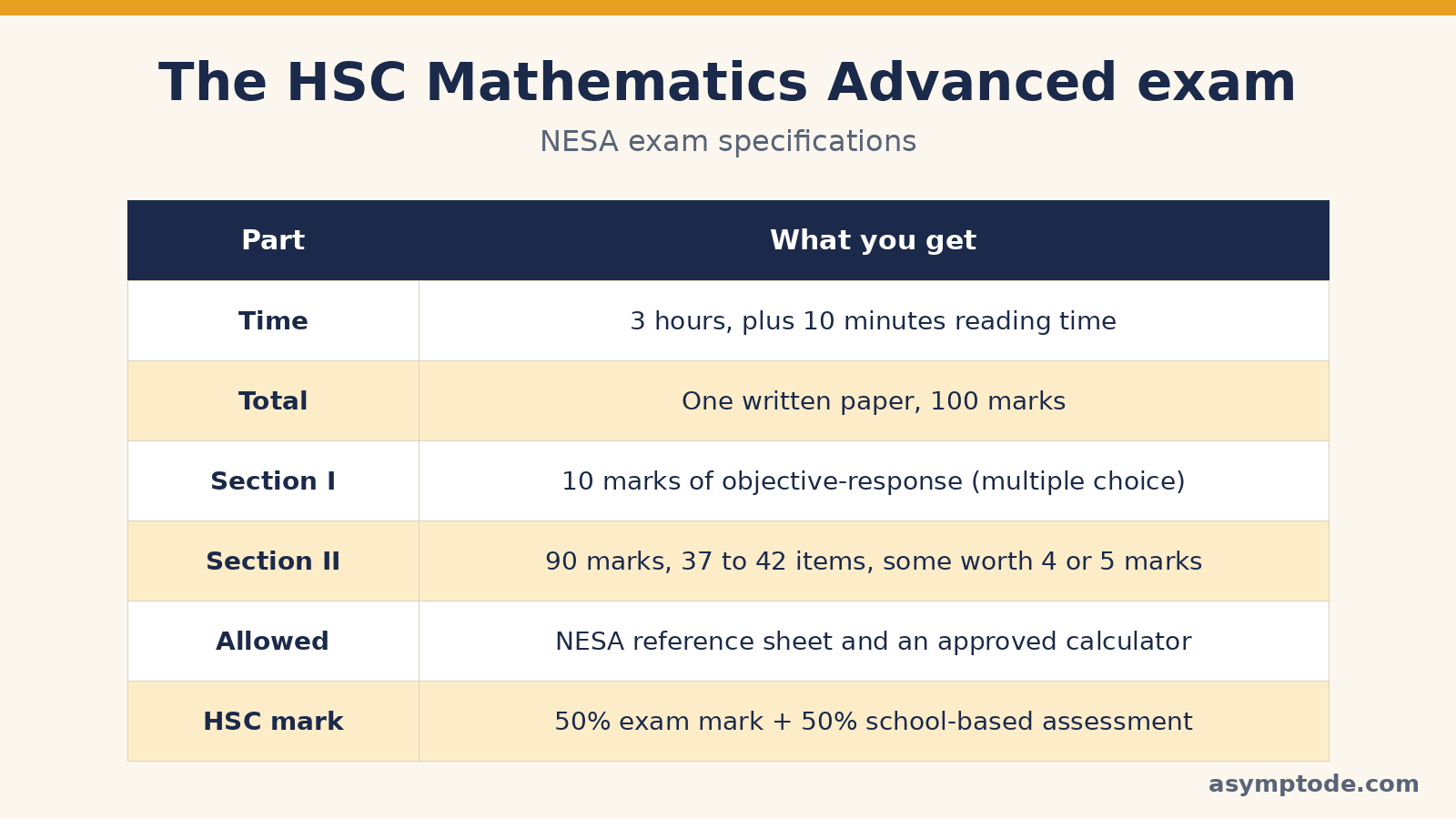
| Part | Details |
|---|---|
| Time | 3 hours, plus 10 minutes reading time |
| Total | One written paper, 100 marks |
| Section I | 10 marks of objective-response questions |
| Section II | 90 marks, 37 to 42 items; at least two worth 4 or 5 marks |
| Allowed | NESA reference sheet and a NESA-approved calculator |
| HSC mark | 50% exam mark and 50% school-based assessment mark |
These specifications are the same for the 2026 HSC (old syllabus) and the 2027 HSC (new syllabus), based on NESA's published exam specifications. One change for 2027: the old exam shared 20 to 25 marks of common questions with Mathematics Standard 2. The new syllabus removes this common content.
What is changing in the new syllabus?
Quick answer: The Mathematics Advanced 11–12 Syllabus (2024) started for Year 11 in Term 1, 2026 and starts for Year 12 in Term 4, 2026. It is first examined in the 2027 HSC. The main changes are clearer content, technology built into the course, new school assessment rules and no shared exam content with Mathematics Standard.
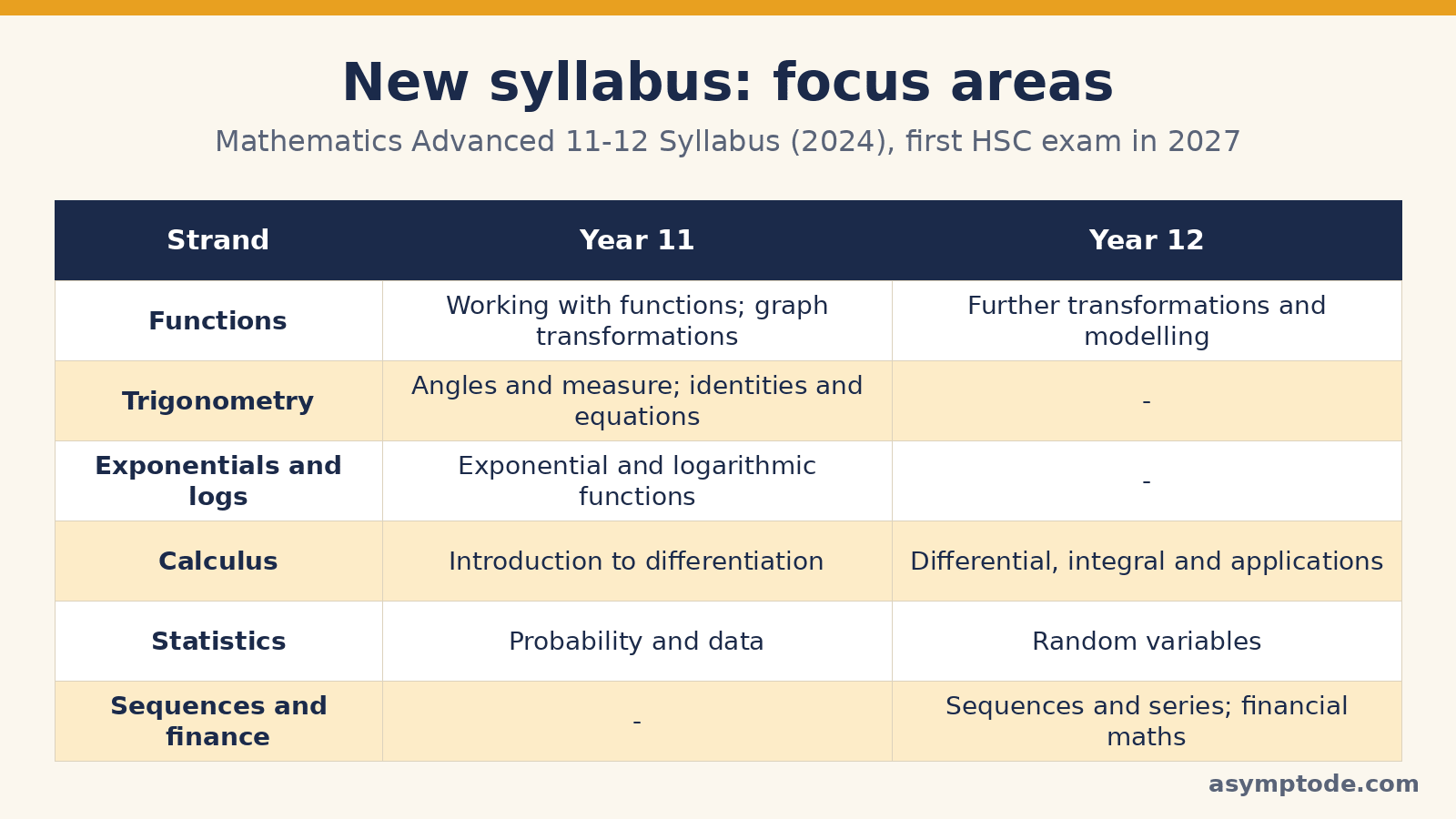
| Strand | Year 11 | Year 12 |
|---|---|---|
| Functions | Working with functions; graph transformations | Further graph transformations and modelling |
| Trigonometric functions | Trigonometry and measure of angles; identities and equations | — |
| Exponential and log functions | Exponential and logarithmic functions | — |
| Calculus | Introduction to differentiation | Differential calculus; integral calculus; applications of calculus |
| Statistical analysis | Probability and data | Random variables |
| Sequences and finance | — | Sequences and series; financial mathematics |
The HSC exam can test Year 11 content too, so the Year 11 topics still matter in Year 12. Students moving into Year 12 now are the first group to sit the new HSC exam in 2027. Past papers are still useful for most topics, but check each question against the new syllabus.
How is the HSC Mathematics Advanced mark calculated?
Quick answer: Your final HSC mark for the course is 50% exam mark and 50% school-based assessment mark. The school mark comes from tasks such as topic tests, an investigation and the Trial exam. NESA moderates school marks using the exam, so doing well in both matters.
Two practical points for families:
- Rank matters at school. NESA uses the exam results of your school group to adjust school marks. Your position in the school ranking is what carries through, so steady results in every task count.
- The Trial exam is big. Most schools hold Trials in Term 3 and weight them heavily. Plan to be fully prepared by then, not just by the HSC.
Worked examples in the HSC style
These original examples show the kind of working markers look for. Write every step.
Example 1: Arithmetic series
Find the sum of the first 20 terms of 5, 8, 11, ...
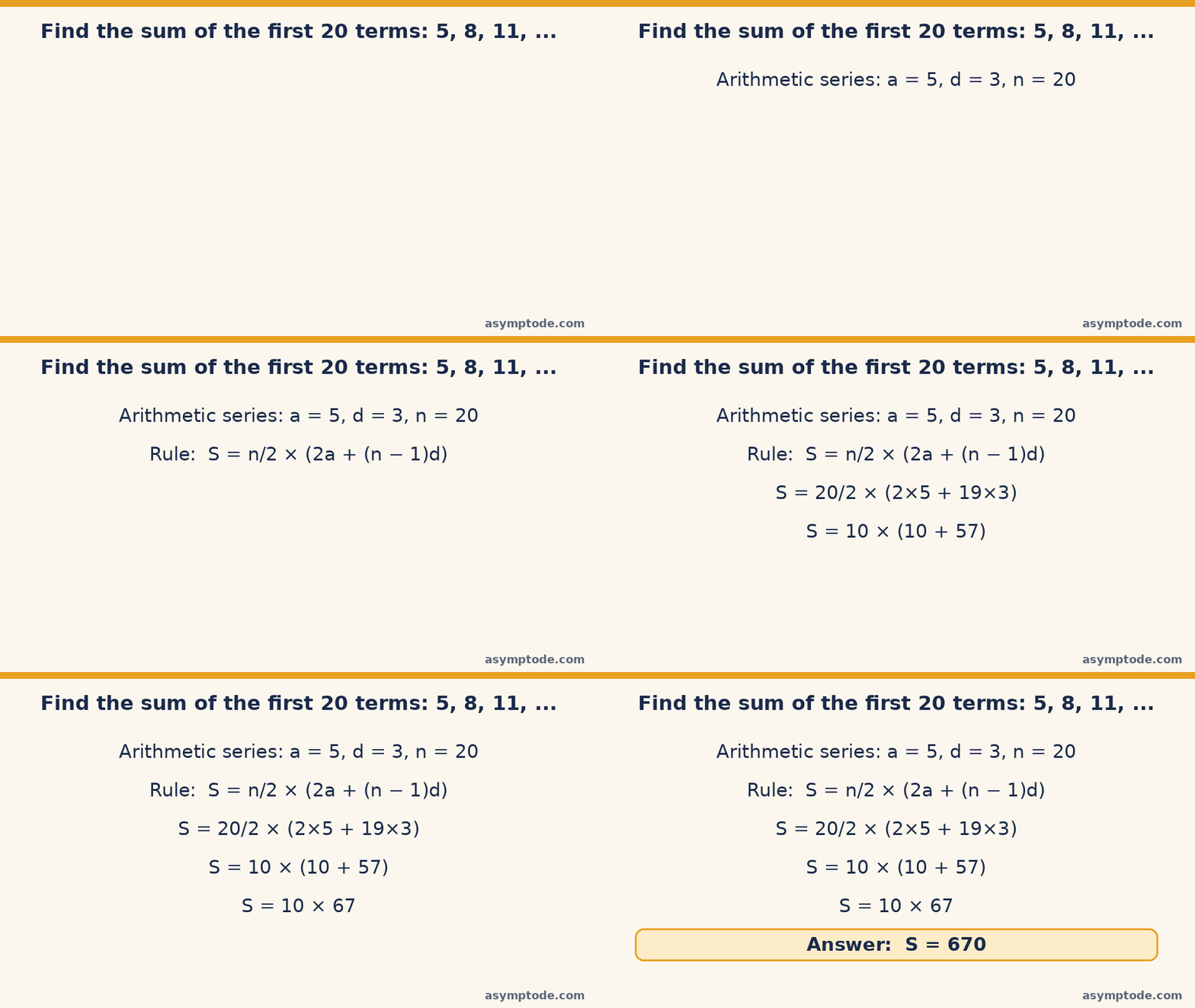
- This is an arithmetic series with a = 5 and d = 3. We need n = 20.
- Use S = n/2 × (2a + (n − 1)d).
- S = 20/2 × (2 × 5 + 19 × 3)
- S = 10 × (10 + 57) = 10 × 67
- S = 670
Example 2: Stationary points
Find the stationary point of y = x² − 6x + 5 and say whether it is a minimum or maximum.
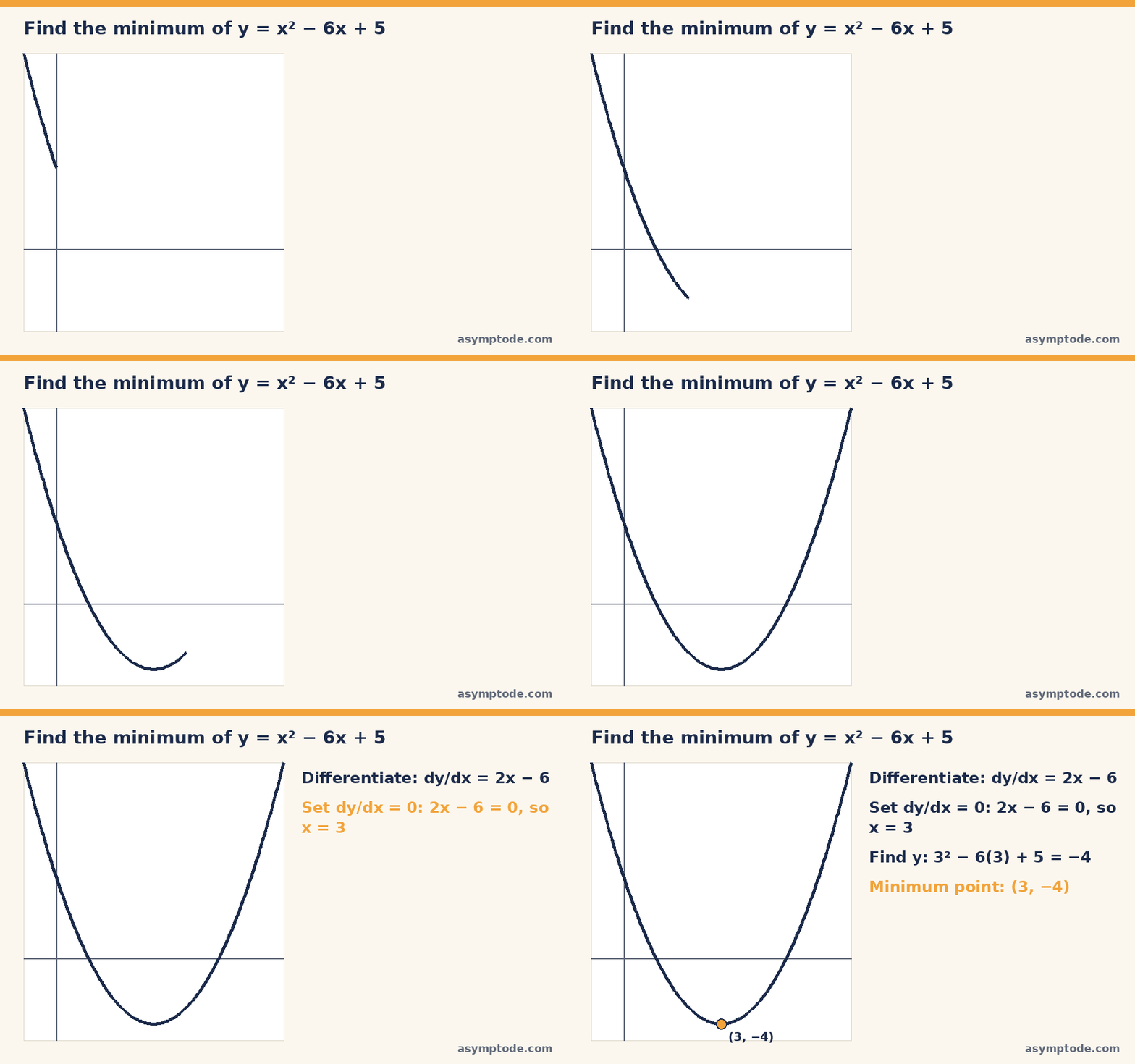
- Differentiate: dy/dx = 2x − 6.
- Set dy/dx = 0: 2x − 6 = 0, so x = 3.
- Find y: y = 3² − 6(3) + 5 = 9 − 18 + 5 = −4.
- Second derivative: d²y/dx² = 2, which is positive.
- So (3, −4) is a minimum turning point.
Example 3: A definite integral
Evaluate the integral of (3x² + 2x) from x = 0 to x = 2.
- Integrate each term: the primitive of 3x² is x³ and of 2x is x².
- So the primitive is x³ + x².
- Substitute the limits: (2³ + 2²) − (0³ + 0²) = (8 + 4) − 0.
- Answer: 12
Need a refresher on quadratics before calculus? See our guide to solving quadratic equations three ways.
A Year 12 study plan for Mathematics Advanced
Quick answer: Start Year 12 in Term 4 with weekly topic tests and an error log. Build calculus in Term 1, cover statistics, series and financial maths in Term 2, and use Term 3 for full timed papers before the Trials. In the final weeks, do two past papers a week and fix your top three error types.
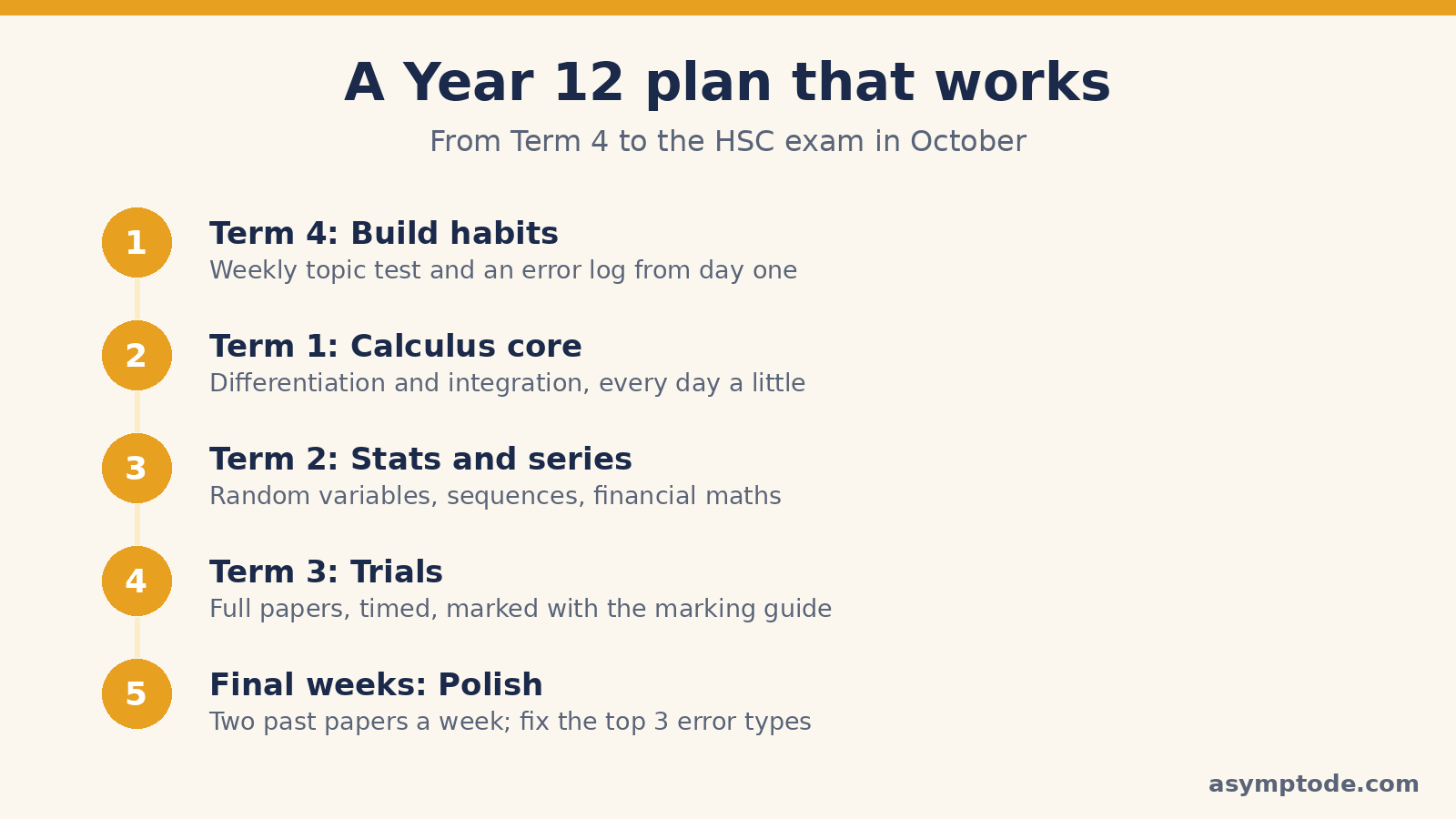
| When | Focus | Weekly routine |
|---|---|---|
| Term 4 (Year 12 starts) | Habits | Short topic quiz every week; start an error log |
| Term 1 | Calculus core | 20-30 minutes of calculus most days |
| Term 2 | Statistics, series, finance | Mixed practice sets; one longer question a day |
| Term 3 | Trials | Full timed papers; mark them with the marking guidelines |
| Final weeks | Polish | Two past papers a week; redo every lost mark |
Habits that lift marks
- Show every line. Many questions give marks for method even when the final answer is wrong.
- Learn the reference sheet. Know what is on it, and what is not, before the exam.
- Practise without a calculator first. It builds algebra skill. Use the calculator to check.
- Read the 10 minutes well. Plan which questions to start with and spot the 4 and 5-mark items.
- Use marking guidelines. NESA publishes them with past papers. Learn how marks are given.
Common mistakes in HSC Mathematics Advanced
| Mistake | How to avoid it |
|---|---|
| Not showing working on long questions | Write each step on its own line. |
| Forgetting to test a stationary point | Use the second derivative or a table of values. |
| Calculator in degrees for a radians question | Check the mode before every trig question. |
| Dropping the constant or the limits in integrals | Write the primitive in square brackets, then substitute. |
| Leaving Year 11 topics until the end | Mix in Year 11 questions every week in Year 12. |
How 1-on-1 tutoring helps with HSC Mathematics Advanced
The HSC rewards steady, careful work across a whole year of school tasks and one long exam. Small gaps in algebra can grow into lost marks in calculus. 1-on-1 lessons find and fix those gaps early.
At Asymptode, lessons are live, online and 1-on-1 with the same mentor every time. They follow your child's own school program and assessment dates. For Mathematics Advanced this means:
- A short assessment first, then a plan built around school tasks, the Trials and the HSC.
- Method-first teaching. The mentor watches each step and fixes the method, not just the final answer.
- Homework at the right level, on topics already taught, checked by the mentor.
- Every class recorded and searchable by topic, so revision before the Trials is quick.
- Short updates for parents on progress and what to practise next.
Flexible scheduling across time zones also helps students in Australia fit lessons around school and sport. Wondering how many hours to plan? Read how many hours of maths tutoring per week a student really needs. For younger students in Australia, see our NAPLAN numeracy guide. Families comparing systems may like our guide to IB Maths AA vs AI.
Want a calm plan for Year 12 maths? Book a free demo class with an Asymptode advisor, or see our fees.
FAQ
Is HSC Mathematics Advanced hard?
It is a step up from Year 10 because of calculus and longer problems. Students who are secure in algebra and practise every week usually do well.
When does the new Mathematics Advanced syllabus start?
It started for Year 11 in Term 1, 2026 and starts for Year 12 in Term 4, 2026. The first HSC exam on the new syllabus is in 2027.
How long is the HSC Mathematics Advanced exam?
Three hours plus 10 minutes reading time. It is worth 100 marks: 10 for multiple choice and 90 for written answers.
Can I use a calculator in HSC Mathematics Advanced?
Yes. NESA-approved calculators are allowed, and a reference sheet is provided in the exam.
Should I do Mathematics Advanced or Standard?
Choose Advanced if you are confident with algebra and may need calculus for university or a career. Choose Standard if you want practical maths and less algebra. Talk to your maths teacher about your Year 10 results.
How much does the school assessment count?
School-based assessment is 50% of the HSC mark for the course. The other 50% comes from the HSC exam.