

NAPLAN numeracy is a short national maths test that Australian students sit in Years 3, 5, 7 and 9. It is not a pass or fail exam, but the results can tell you a lot about how your child is going. This guide explains the format, what is tested, how the online test adapts, and how to help at home without stress.
Key takeaways
- NAPLAN numeracy is for students in Years 3, 5, 7 and 9, in March each year.
- The 2027 test window is 10 to 22 March 2027.
- Most students sit it online, and the test adapts to how well they are going.
- Years 7 and 9 have a non-calculator part, then a calculator part. Years 3 and 5 have no calculator.
- Results come as four proficiency levels: Exceeding, Strong, Developing and Needs additional support.
What is NAPLAN numeracy?
Quick answer: NAPLAN numeracy is the maths part of Australia's National Assessment Program – Literacy and Numeracy. Students in Years 3, 5, 7 and 9 sit it in March. It checks number and algebra, measurement and geometry, and statistics and probability, based on the Australian Curriculum.
NAPLAN has four parts: writing, reading, conventions of language, and numeracy. This guide covers numeracy only.
NAPLAN is run by ACARA (the Australian Curriculum, Assessment and Reporting Authority) with each state and territory. It does not decide school entry or report card grades. Instead, it gives parents and teachers a national snapshot of skills at one point in time.
When is NAPLAN 2027 and how long is the numeracy test?
Quick answer: NAPLAN 2027 runs from 10 to 22 March 2027. The numeracy test takes 45 minutes in Year 3, 50 minutes in Year 5, and 65 minutes in Years 7 and 9. Your child's school sets the exact day within the window.
| Year level | Numeracy test time | Calculator | How it is sat |
|---|---|---|---|
| Year 3 | 45 minutes | Not allowed | Online, tailored |
| Year 5 | 50 minutes | Not allowed | Online, tailored |
| Year 7 | 65 minutes | Non-calculator part, then calculator part | Online, tailored |
| Year 9 | 65 minutes | Non-calculator part, then calculator part | Online, tailored |
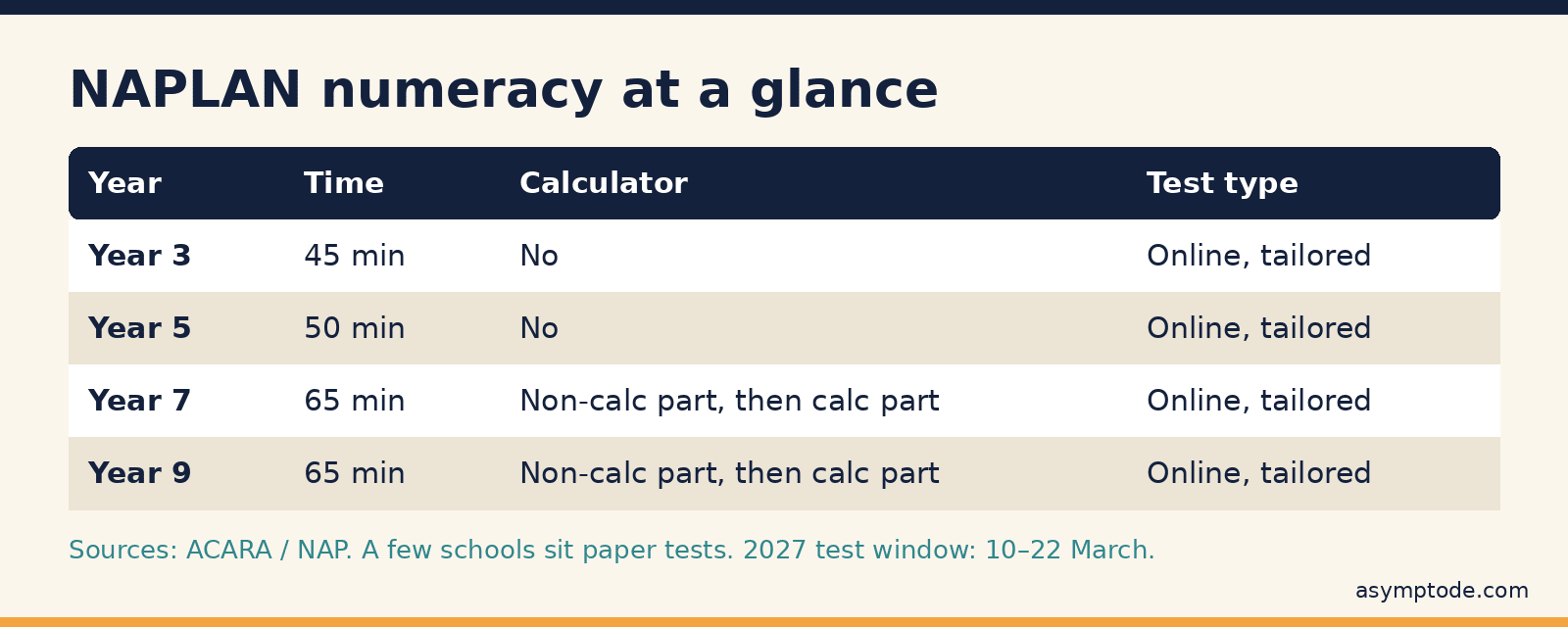
Most schools sit NAPLAN online. A small number of schools with an approved alternative curriculum use paper tests. If your child is absent, the school may let them catch up within the test window.
How does the online NAPLAN numeracy test adapt?
Quick answer: The online numeracy test is a "tailored test". It has three stages. After each stage, the next set of questions is matched to how your child is going, so strong students get harder questions and others get questions at their level.
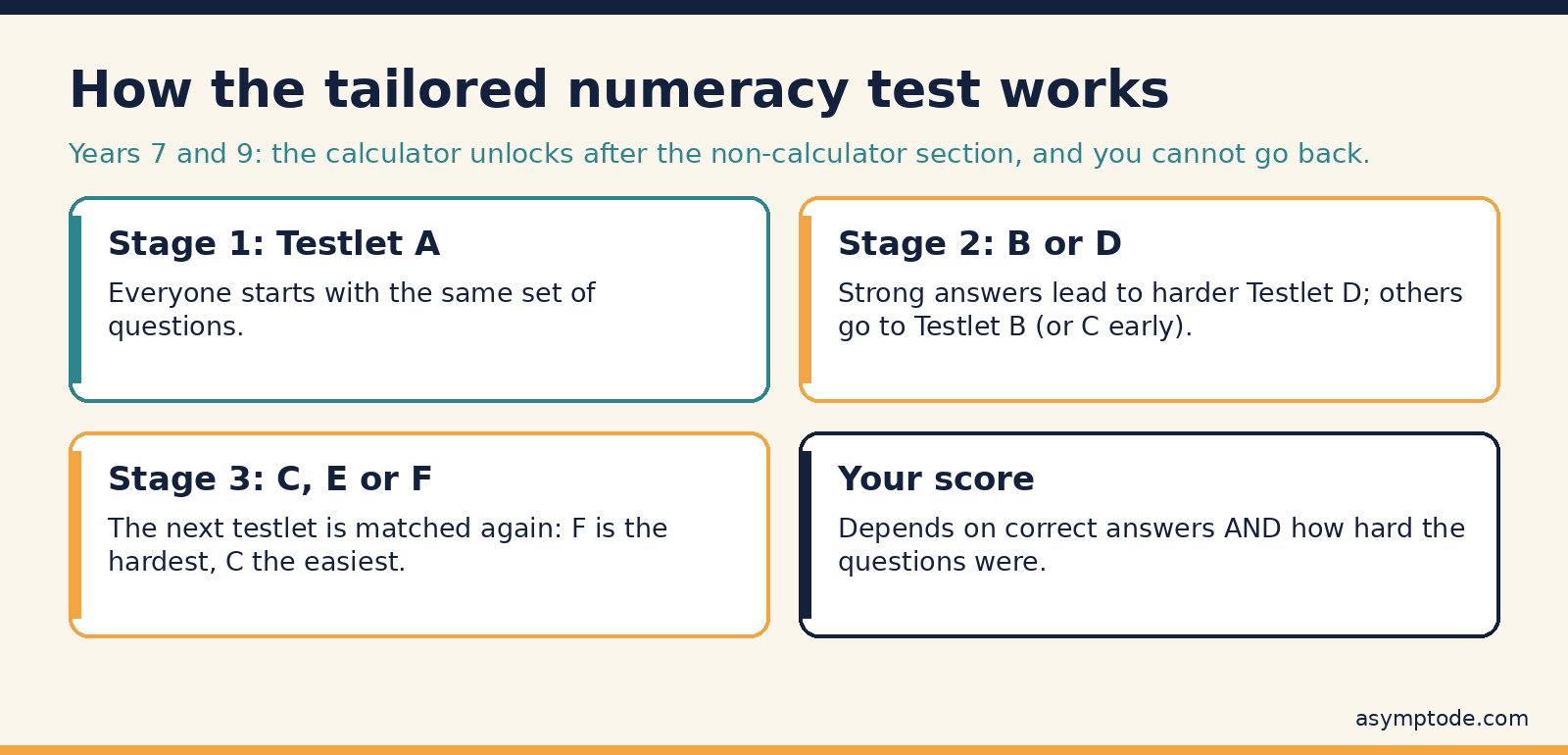
Here is how it works, based on the official NAP information:
- Stage 1: Everyone starts with Testlet A.
- Stage 2: Students who do well move to a harder testlet (D). Others go to testlet B. Students who find A very hard may move to C.
- Stage 3: The test branches again. Testlet F is the hardest and C is the easiest.
The final score depends on how many questions are correct and how hard those questions were. Two students with the same number correct can get different scores.
For Years 7 and 9, the calculator section comes after the non-calculator section. Once a student moves to the calculator part, they cannot go back. Tell your child to check their non-calculator answers before moving on.
What maths is on the NAPLAN numeracy test?
Quick answer: NAPLAN numeracy covers three areas from the Australian Curriculum: number and algebra; measurement and geometry; and statistics and probability. Questions use everyday contexts like money, time, maps and data.
| Year | Typical skills tested |
|---|---|
| Year 3 | Place value, adding and subtracting, simple fractions, time, money, shapes, reading simple graphs |
| Year 5 | Multiplying and dividing, fractions and decimals, area and perimeter, 24-hour time, chance, data tables |
| Year 7 | Fractions, decimals and percentages, ratio, integers, simple equations, angles, mean and median |
| Year 9 | Algebra, linear relationships, Pythagoras, area and volume, probability, interpreting data |
These are typical skills, not an official list. The test checks what students should know by that year level.
Worked examples by year level
Year 3: adding two-digit numbers. What is 25 + 38?
- Add the tens: 20 + 30 = 50.
- Add the ones: 5 + 8 = 13.
- Total: 50 + 13 = 63.
Year 5: elapsed time. A movie starts at 2:45 pm and runs for 1 hour 30 minutes. When does it end?
- Add 1 hour: 3:45 pm.
- Add 30 minutes: 4:15 pm.
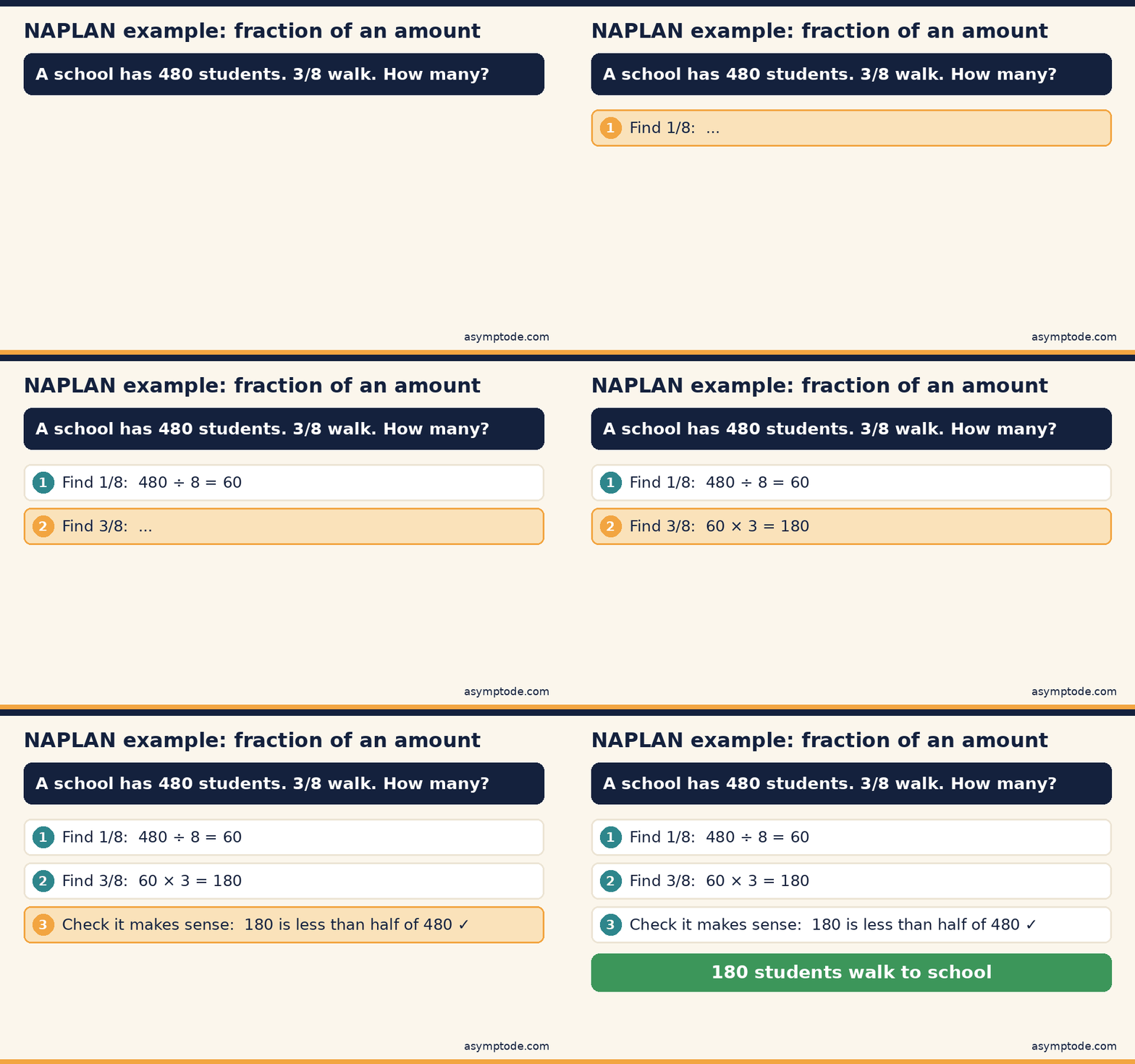
Year 7: fraction of an amount (non-calculator). A school has 480 students. Three-eighths of them walk to school. How many walk?
- Find one-eighth: 480 ÷ 8 = 60.
- Find three-eighths: 60 × 3 = 180.
- Check: 180 is less than half of 480, which makes sense because 3/8 is less than 1/2.
Year 9: probability. A bag has 3 red marbles and 5 blue marbles. One is picked at random. What is the probability it is red?
- Total marbles: 3 + 5 = 8.
- Red marbles: 3.
- Probability of red: 3/8 (or 0.375).
How are NAPLAN results reported?
Quick answer: NAPLAN results use four proficiency levels: Exceeding, Strong, Developing and Needs additional support. Your child's school gives you an individual student report later in the year. If you don't get one, contact the school.
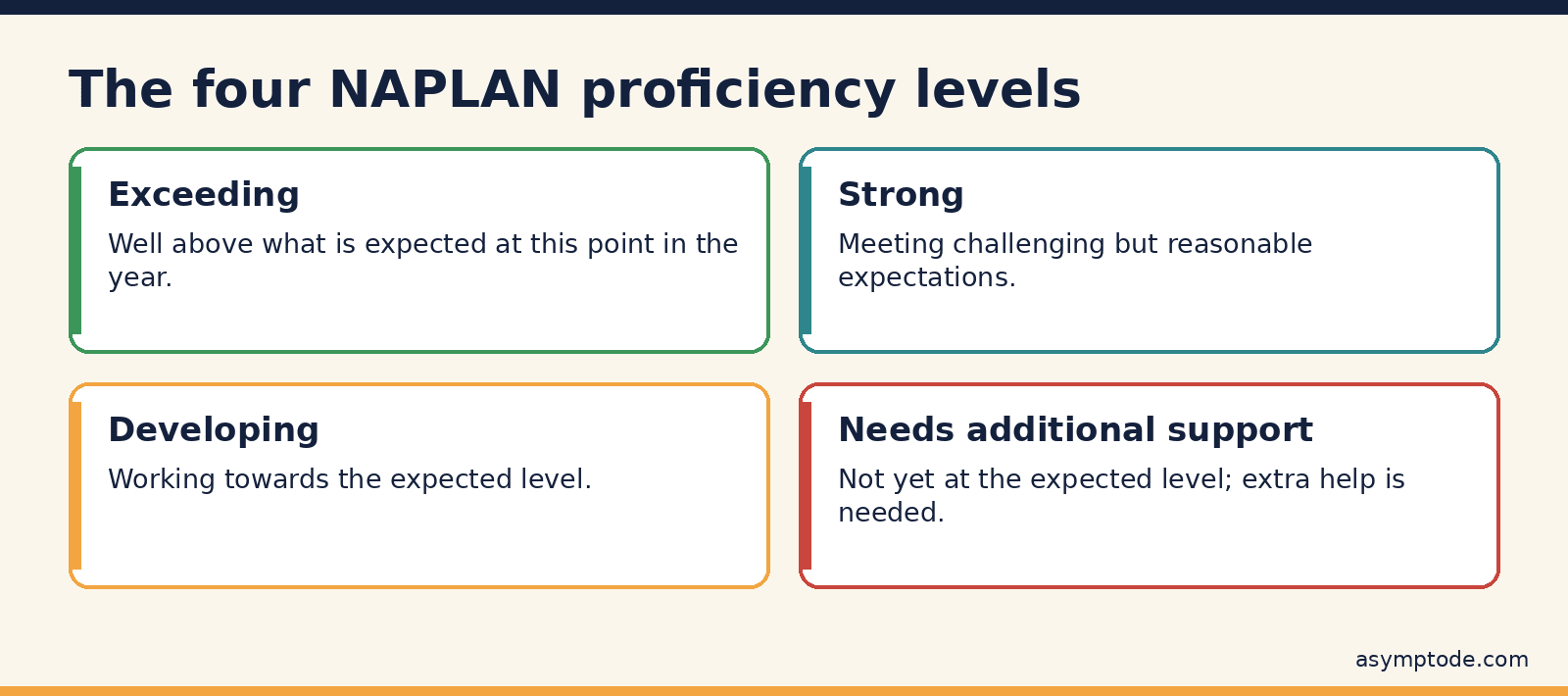
| Level | What it means |
|---|---|
| Exceeding | Well above what is expected at this time of year |
| Strong | Meeting challenging but reasonable expectations |
| Developing | Working towards the expected level |
| Needs additional support | Not yet at the expected level and needs extra help |
A "Developing" or "Needs additional support" result is not a fail. It is a signal. The most useful next step is to find which skills caused the result and work on them early in the year.
How can parents help with NAPLAN numeracy?
Quick answer: Focus on everyday maths, not test drills. Build quick number facts, talk about maths in daily life, and try the public demonstration site on the NAP website so the online format feels familiar.
Simple ideas that work:
- Number facts little and often. Five minutes a day of addition, subtraction and times tables builds speed and confidence.
- Maths in real life. Count change, read timetables, double a recipe, or estimate the shopping total.
- Try the online format once or twice. The NAP public demonstration site shows the question types and tools. Many schools also run practice tests in the test platform.
- Practise reading the question. Many errors come from missing a word or a unit.
- Keep it low-stress. NAPLAN is one snapshot. A calm child shows what they really know.
If your child finds fractions hard, our guide to adding and subtracting fractions is a good next step. For older students moving into algebra, see understanding variables in Grades 7 and 8.
What are the most common NAPLAN numeracy mistakes?
- Rushing the non-calculator part (Years 7 and 9). Students cannot go back once they move on, so careless slips stay.
- Weak place value and fractions. These two skills sit under a large share of questions.
- Not reading graphs and tables carefully. Check the scale and the labels before answering.
- Unit errors. Mixing cm and m, or minutes and hours.
- Leaving questions blank. Encourage your child to give their best answer to every question.
How 1-on-1 tutoring helps with NAPLAN numeracy
NAPLAN does not need test cramming. It needs strong everyday maths. The best preparation is fixing the gaps the school year has left behind, at your child's own pace.
At Asymptode, each student works with one dedicated mentor in live 1-on-1 online lessons, timed to suit Australian families:
- The mentor follows your child's school curriculum and year level, so the lessons support class learning instead of competing with it.
- Gaps first. A short assessment shows which skills, like place value, fractions or measurement, need work.
- The mentor watches each step of the working and fixes the method, not just the answer.
- Personalised homework on what was taught, checked by the same mentor.
- Regular updates for parents on what is improving and what needs practice.
- Recorded lessons for revision before the March test.
If your child's NAPLAN report shows "Developing" or "Needs additional support", book a free demo class and we will help you make a plan. You can also see our fees.
FAQ
When is NAPLAN 2027?
The NAPLAN 2027 test window is 10 to 22 March 2027. Your child's school sets the exact days.
Can students use a calculator in NAPLAN numeracy?
Years 3 and 5 cannot. Years 7 and 9 have a non-calculator section first, then a calculator section with an online calculator.
Is NAPLAN numeracy a pass or fail test?
No. Results are reported in four proficiency levels: Exceeding, Strong, Developing and Needs additional support.
Why did my child get harder questions than a friend?
The online numeracy test is tailored. Students who do well get harder questions. Scores take the difficulty into account, so this is fair.
How should my child prepare for NAPLAN?
Steady everyday maths practice works best. Build number facts, read questions carefully, and try the public demonstration site once or twice to learn the online format.
Does NAPLAN affect my child's school report?
NAPLAN results are separate from school report grades. They give a national snapshot of your child's skills at one point in time.
Want help building strong maths skills before March? Talk to an Asymptode advisor for a free demo class, or check our fees.