
The GMAT is the admission test business schools around the world use for MBA and business master's programmes. This guide covers the 2026 exam in plain English: format, scores, fees, booking and retakes, plus a study plan with two worked questions. Facts come from GMAC, which owns the test, or from the schools.
Key takeaways
- The GMAT has 3 sections and 64 questions: Quantitative Reasoning, Verbal Reasoning and Data Insights. It takes 2 hours 15 minutes, plus one optional 10-minute break.
- Total scores run from 205 to 805. All three sections count equally.
- You can test online or at a test centre, all year. Some schools, such as ISB and IIM Ahmedabad's PGPX, accept test-centre scores only.
- You can retake after 16 days, up to 5 times in any 12 months. Scores stay valid for 5 years.
- The GMAT costs US$275 at a test centre or US$300 online in the US and India (£250 / £275 in the UK). Prices vary by country.
What is the GMAT exam?
Quick answer: The GMAT (Graduate Management Admission Test) is a computer-adaptive exam for entry to MBA and business master's programmes. GMAC owns and runs it. It tests problem solving, reasoning and data skills in three 45-minute sections. GMAC says more than 2,400 graduate management programmes accept it, and it is given only in English.
GMAC calls itself "a global, mission-driven association of leading graduate business schools" (About GMAC). It also runs the NMAT by GMAC (see our NMAT 2026 guide).
Is it still called the GMAT Focus Edition?
Not any more. The "GMAT Focus Edition" replaced the old 10th Edition, which ended on 31 January 2024. GMAC's pages now just say "the GMAT exam". Some school pages still say "Focus Edition". It is the same test.
What is the GMAT format in 2026?
The exam has three 45-minute sections and no essay.
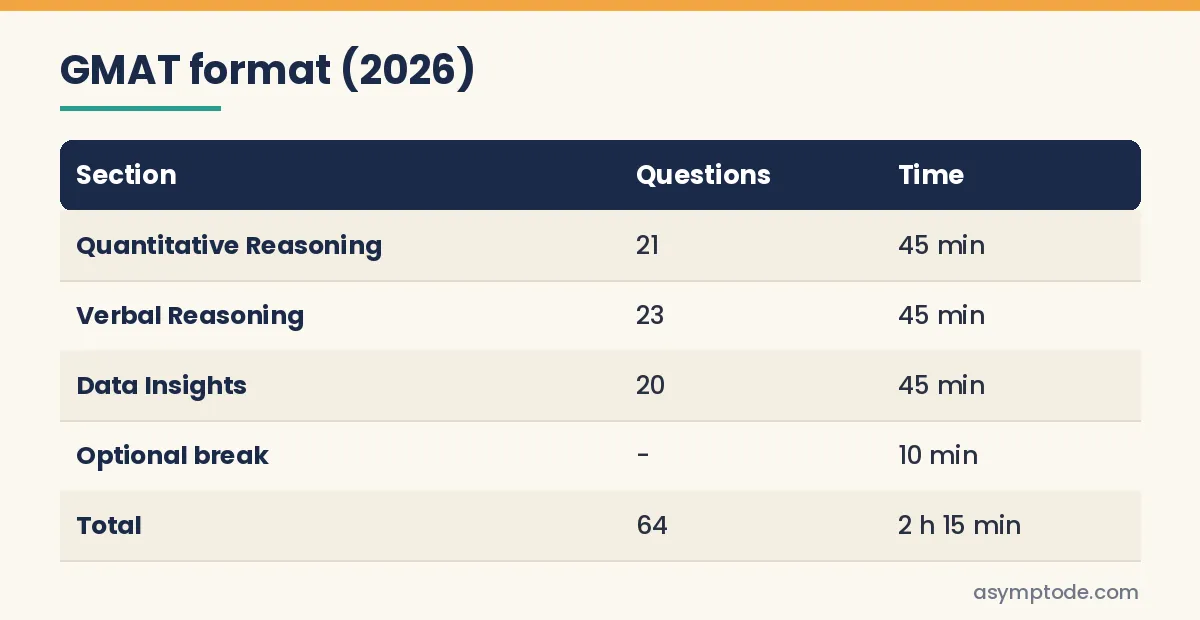 The GMAT format: three 45-minute sections, 64 questions in total.
Quantitative Reasoning has 21 questions in 45 minutes. Verbal Reasoning has 23 questions in 45 minutes. Data Insights has 20 questions in 45 minutes. You get one optional 10-minute break. The whole exam takes 2 hours 15 minutes.
Source: GMAT exam structure. Three features matter for your strategy:
- You pick the section order. You can also take the break after section 1 or section 2.
- Question Review & Edit. You can bookmark questions. At the end of a section you can review as many as you like and change up to 3 answers. If your time runs out, you skip this screen.
- It is computer-adaptive. The test usually starts with a medium question. Then it gets harder or easier based on your answers (GMAC on adaptive tests).
What is on the GMAT syllabus?
On its exam content page, GMAC describes skills rather than a chapter list:
- Quantitative Reasoning: Problem Solving questions on arithmetic and elementary algebra. No calculator.
- Verbal Reasoning: Reading Comprehension and Critical Reasoning. Critical Reasoning passages are usually under 100 words.
- Data Insights: Data Sufficiency, Multi-Source Reasoning, Table Analysis, Graphics Interpretation and Two-Part Analysis. An on-screen calculator is allowed here only.
Geometry is not listed. Focus on percentages, ratios, rates, number properties, algebra and word problems.
How is the GMAT score calculated?
Your total GMAT score runs from 205 to 805. Quant, Verbal and Data Insights each count equally (how the exam is scored). Each section is scored from 60 to 90 (GMAC school presentation).
- Results: usually in 3 to 5 days, sometimes up to 20 days.
- Score sending: you see your score first, then send it free to up to 5 programmes within 48 hours. After that, each report costs a fee (sending scores).
- Validity: 5 years; reportable for up to 10 years.
- Old scores: old 10th Edition scores (200 to 800) are on a different scale and cannot be compared.
- Percentiles: updated every year, so use your own score report.
What is a GMAT Superscore?
A Superscore combines your best section scores from all valid attempts on the current edition. It uses the same 205 to 805 scale, with no percentile. GMAC says past data shows candidates may see 20 to 50 points more than their first-attempt total (Superscore FAQ). Schools do not have to rely on it.
How much are the GMAT fees?
The GMAT fee depends on your country, your currency and whether you test online or at a centre. GMAC shows the live price in a country drop-down on its exam payment page. Check that page before you book.
Here are the official prices GMAC listed on 5 November 2026 for some locations:
| Location | Test centre | Online |
|---|---|---|
| United States | US$275 | US$300 |
| India (billed in US dollars) | US$275 | US$300 |
| United Kingdom | £250 | £275 |
Each extra score report costs US$35. In India you pay in US dollars, so your rupee cost depends on the exchange rate and your card. For any other country, pick it in the drop-down on the payment page.
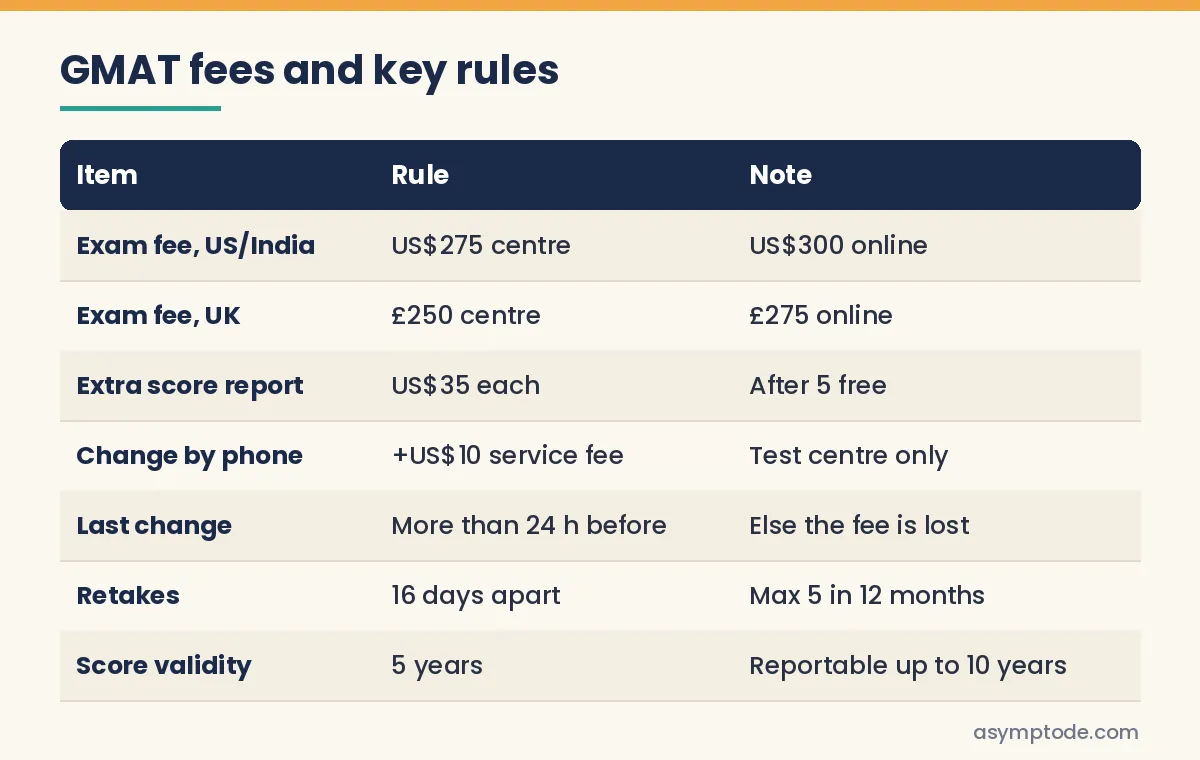 GMAT fees and key rules from GMAC's official policies.
The exam costs US$275 at a centre or US$300 online in the US and India, and £250 or £275 in the UK. Extra score reports are US$35 each. Changing a test-centre booking by phone adds a US$10 service fee. You must change or cancel more than 24 hours before your slot, or you lose the fee. You get up to 5 free score reports within 48 hours; after that, reports cost extra. Retakes need a 16-day gap, with at most 5 attempts in 12 months. Scores are valid for 5 years and reportable for up to 10.
Reschedule and cancel fees depend on how far ahead you act. For the US and India, GMAC lists:
| When you act | Reschedule fee (centre / online) | Cancel refund (centre / online) |
|---|---|---|
| More than 60 days before | US$55 / US$60 | US$110 / US$120 back |
| 15-60 days before | US$110 / US$120 | US$80 / US$90 back |
| 14 days or less before | US$165 / US$180 | US$55 / US$60 back |
If you miss your exam, you lose the fee and must wait 24 hours to rebook. A verified medical, military or bereavement emergency may get a free reschedule or refund (emergency policy). Fee waivers come from schools, not from GMAC.
Who can take the GMAT?
You must be at least 18. If you are 13 to 17, you can test at a test centre with written consent from a parent or guardian, given before you book (GMAT Policies and Procedures). GMAC's eligibility rules list no degree or work-experience requirement. Schools set their own entry rules.
What ID do I need for the GMAT?
Your ID must be original, valid, unexpired and government-issued, with a recent photo and your signature. Your name, birth date and citizenship must match your registration exactly. If you test outside your country of citizenship, a passport is always required. Passport cards and photocopies are not accepted (ID requirements).
Indian citizens testing in India should check the India entry on the ID page before booking. If your ID fails on the day, you cannot test and you lose the fee.
Can I get testing accommodations?
Yes. Options include extra time, an extra rest break, a medical device, a reader or recorder, enlarged font, adjustable contrast and a sign language interpreter. Apply and get approval before you book. Accommodations cannot be added to an existing booking (testing accommodations). You can request them outside the US too.
Online or test centre: which is better?
Neither gives a scoring advantage. Format, content and scoring are the same (test centre vs online).
| Test centre | Online | |
|---|---|---|
| Where | A centre near you | Home or a private room |
| Times | Centre opening hours | 24/7 in many regions |
| Notes | Booklet and marker given | One whiteboard, up to 12 x 20 in |
| Rules | On-site staff | Live proctor, room scan, check in 30 min early, no headphones |
But schools can set their own rules. ISB accepts only test-centre GMAT or GRE scores for its PGP since the April 2025 intake (ISB FAQ). IIM Ahmedabad's MBA-PGPX (2027-28 batch) says online take-home scores are not valid (IIMA PGPX admission). If you are applying in India, test at a centre unless your school says otherwise.
When can I take the GMAT, and how do I register?
You can take the GMAT all year. Appointments usually open up to 6 months ahead, and seats fill up in busy admission months (where and when). GMAC asks you to leave at least 20 calendar days before your application deadline for your score.
 The four official steps to register for the GMAT.
- Create an mba.com account. Use your name exactly as it is on your ID.
- Pick online or test centre. Check what your target schools accept first.
- Complete your profile. Make any account changes at least 72 hours before the exam.
- Schedule and pay. Choose your date and time, add any voucher code, then pay.
Start on the GMAT registration page.
How many times can I take the GMAT?
You must wait at least 16 calendar days between attempts. You can take it up to 5 times in a rolling 12-month period, online and test centre combined. There is no lifetime limit (retake policy). If you score a perfect 805, you must wait 5 years to test again. GMAC says retesting can raise scores by 20 to 30 points on average.
How should I prepare for the GMAT?
Start with GMAC's free Official Starter Kit: more than 70 sample questions and two full-length practice exams with real timing and scoring. Paid options include the Official Guide 2026-2027 (975+ real questions) and more practice exams (official prep).
GMAC says "it only takes 6 weeks to study with GMAT Official Prep". If your maths feels rusty, allow longer. Here is a sample 8-week plan:
| Weeks | Focus | What to do |
|---|---|---|
| 1 | Diagnose | Take Official Practice Exam 1. List your weakest topics. |
| 2-3 | Quant basics | Percentages, ratios, rates, number properties, algebra. Work by hand, no calculator. |
| 3-4 | Data Insights | Learn the five question types. Practise Data Sufficiency daily. |
| 4-5 | Verbal | Critical Reasoning first, then Reading Comprehension. Explain every wrong answer. |
| 6 | Mixed timed sets | 45-minute sets per section. Aim for about 2 minutes per question. |
| 7 | Full mock | Official Practice Exam 2 in real conditions. Review every mistake. |
| 8 | Polish | Redo old errors. Choose your section order. Rest before test day. |
Worked example 1: a Quant Problem Solving question
A shop raises a price by 25%. Later it cuts the new price by 20%. What is the overall change? (A) 5% increase (B) 5% decrease (C) No change (D) 1% increase (E) 2.5% increase
 Solving a Quant percentage question one step at a time.
Start with an easy price of 100. A 25% rise gives 100 x 1.25 = 125. A 20% cut gives 125 x 0.8 = 100. The price is back to 100, so the net change is 0. The answer is (C): 25% up and 20% down cancel out here.
The trap is (A): subtracting 20 from 25. But the 20% cut is taken from a bigger number (125). Starting from 100 makes percentage questions quick and safe.
Worked example 2: a Data Insights (Data Sufficiency) question
A company had revenue of $500,000 in 2025. What was its profit in 2025? (1) Its costs were 80% of its revenue. (2) Its costs were $100,000 less than its revenue.
In Data Sufficiency you do not need the final number. You only decide whether each statement gives enough information. The usual answer choices are: (A) statement 1 alone is enough, (B) statement 2 alone is enough, (C) both together are needed, (D) each alone is enough, (E) both together are still not enough.
- Statement 1: Costs = 0.8 x 500,000 = 400,000. Profit = 500,000 - 400,000 = 100,000. Enough.
- Statement 2: Profit = revenue - costs = 100,000. Enough on its own.
The answer is (D). A common mistake is to pick (C) because "two clues feel safer". Always test each statement alone first.
Common GMAT mistakes to avoid
- Doing Quant with a calculator in practice. The real Quant section has none. The calculator is only in Data Insights.
- Solving Data Sufficiency to the end. You only need to know if it can be solved.
- Spending 5 minutes on one hard question. Steady work across the section matters more.
- Booking online when your school wants a test centre. Check first, as ISB and IIMA PGPX do.
Want help building a Quant and Data Insights plan around your test date? Book a free demo class with an Asymptode mentor, or see our plans and fees.
GMAT vs GRE: which should I take?
Both are accepted for many business programmes. Compare them using official facts:
| GMAT | GRE General Test | |
|---|---|---|
| Run by | GMAC | ETS |
| Length | 2 h 15 min, plus optional 10-min break | About 1 h 58 min |
| Sections | Quant, Verbal, Data Insights | Analytical Writing, Verbal, Quant |
| Essay | None | One "Analyze an Issue" task, 30 min |
| Calculator | On-screen, Data Insights only | On-screen, Quant |
| Scores | Total 205-805 | Verbal 130-170, Quant 130-170, Writing 0-6 |
| Score life | Valid 5 years | Reportable 5 years |
Sources: GMAT structure, GRE test structure, GRE scores.
Pick the GMAT if you are set on business school. Pick the GRE if you are also considering other graduate degrees. Our GRE General Test guide explains that exam in detail. If you are in India, compare the GMAT with the CAT 2026 exam, XAT 2027 and SNAP 2026, or read CAT vs XAT. Thinking about law instead? See the LSAT guide.
Is the GMAT worth it for your career?
The GMAT is only one part of your application. GMAC says schools also look at grades, work experience, essays, recommendations and interviews, and a high score does not guarantee admission (GMAC on admissions). GMAC also says that, across GMAT and GRE test takers, more than 7 in 10 rely on the GMAT to get into business school.
The honest benefit: the skills you build, like reading data, checking arguments and working fast with numbers, are useful in business school and at work. A good score does not promise a job or a salary, so check each school's own published outcomes.
How 1-on-1 tutoring helps with the GMAT
- One dedicated mentor, live online 1-on-1. Your Asymptode mentor builds the plan around your test date, your target schools and your weakest section.
- Method-first Quant and Data Insights. The mentor watches each step of your working, so mistakes in percentages, algebra or Data Sufficiency logic are caught early, not just marked wrong.
- Honest help for Verbal. For Verbal Reasoning, the mentor helps with planning and method: a study schedule, timing practice and a routine for reviewing errors.
- Personalised homework with feedback, short updates and recorded classes. Every class is recorded so you can rewatch it. Families get short progress updates, and you can start with a free demo class.
Facts checked against official sources on 5 November 2026.
FAQ
How long is the GMAT exam?
The GMAT takes 2 hours 15 minutes: three 45-minute sections, 64 questions in total. You can add one optional 10-minute break after the first or second section.
What is a good GMAT score?
It depends on your target schools. The scale is 205 to 805, and GMAC updates percentiles every year. Check the class profiles your schools publish.
Can I take the GMAT online from India?
Yes, the online GMAT is offered in many regions. But ISB and IIM Ahmedabad's PGPX accept test-centre scores only, so check your schools first.
How many times can I retake the GMAT?
You can take it up to 5 times in any rolling 12-month period, with at least 16 days between attempts. There is no lifetime limit. Cancelled bookings and missed appointments do not count toward the 5.
How long is a GMAT score valid?
GMAT scores are valid for 5 years. You can still report them for up to 10 years, but a school may want it valid on its deadline. ISB, for example, says your score must be valid on the round deadline.
Is there an essay on the GMAT?
No. The current GMAT has three sections and no essay. The old 10th Edition had a writing section, but it ended on 31 January 2024. If you want a test with an essay task, the GRE has one 30-minute "Analyze an Issue" task.
Ready to start? Book a free demo class and advisor call, or see our plans and fees.
Sources
- GMAT exam structure (mba.com)
- GMAT exam content (mba.com)
- Register for the GMAT (mba.com)
- GMAT exam payment (mba.com)
- GMAT ID requirements (mba.com)
- GMAT testing accommodations (mba.com)
- GMAT Policies and Procedures (GMAC, Oct 2026)
- GMAT: How is the exam scored? (GMAC Help)
- GMAT: Retake policies and attempt limits (GMAC Help)
- GMAT: Sending your official score (GMAC Help)
- GMAT Superscore (GMAC Help)
- GMAT: Test center vs online (GMAC Help)
- GMAC school presentation, Aug 2024
- GRE General Test structure (ETS)
- GRE scores (ETS)
- ISB PGP FAQs
- IIM Ahmedabad MBA-PGPX admission