

CAT 2026 is on Sunday, 29 November 2026, and it is now about five weeks away. This guide covers the dates, the fee, eligibility, the exam pattern, the marking scheme, how IIMs shortlist, and a clear plan for the last month. It is written for test-takers in India and for the parents who support them.
Key takeaways
- CAT 2026 is a computer-based test on 29 November 2026, held in three sessions on the same day.
- IIM Indore is the convening institute for CAT 2026. The official site is iimcat.ac.in.
- Registration ran from 3 August to 22 September 2026 (extended from 15 September). It is now closed.
- The paper has three sections: VARC, DILR and QA. Each section has a fixed 40 minutes.
- Marking is +3 for a right answer and -1 for a wrong MCQ. There is no negative mark for a wrong TITA (type-in-the-answer) question.
- Each IIM uses its own shortlisting rules, then holds a writing test and interview before it makes offers.
When is CAT 2026 and what are the key dates?
Quick answer: CAT 2026 is on Sunday, 29 November 2026. Admit cards come out on 4 November 2026 on iimcat.ac.in. The provisional answer key is expected in early December 2026. The result usually comes in late December or early January, so expect it around late December 2026 to early January 2027.
The table below lists every CAT 2026 date we could check. Dates marked "expected" are not yet confirmed by IIM Indore.
| CAT 2026 event | Date (2026-27 cycle) | Status |
|---|---|---|
| Registration opened | 3 August 2026 | Done |
| Registration closed | 22 September 2026, 5 pm | Done (extended from 15 Sept) |
| Form correction window | 5-6 October 2026 | Done |
| Admit card download | From 4 November 2026 | Announced |
| CAT 2026 exam | Sunday, 29 November 2026 | Announced |
| Provisional answer key | Early December 2026 | Expected |
| Result | Late Dec 2026 to early Jan 2027 | Expected |
The registration dates (3 August to 22 September 2026), admit card date (4 November 2026) and test day (29 November 2026) are listed on the official CAT website. Always check it for the final word.
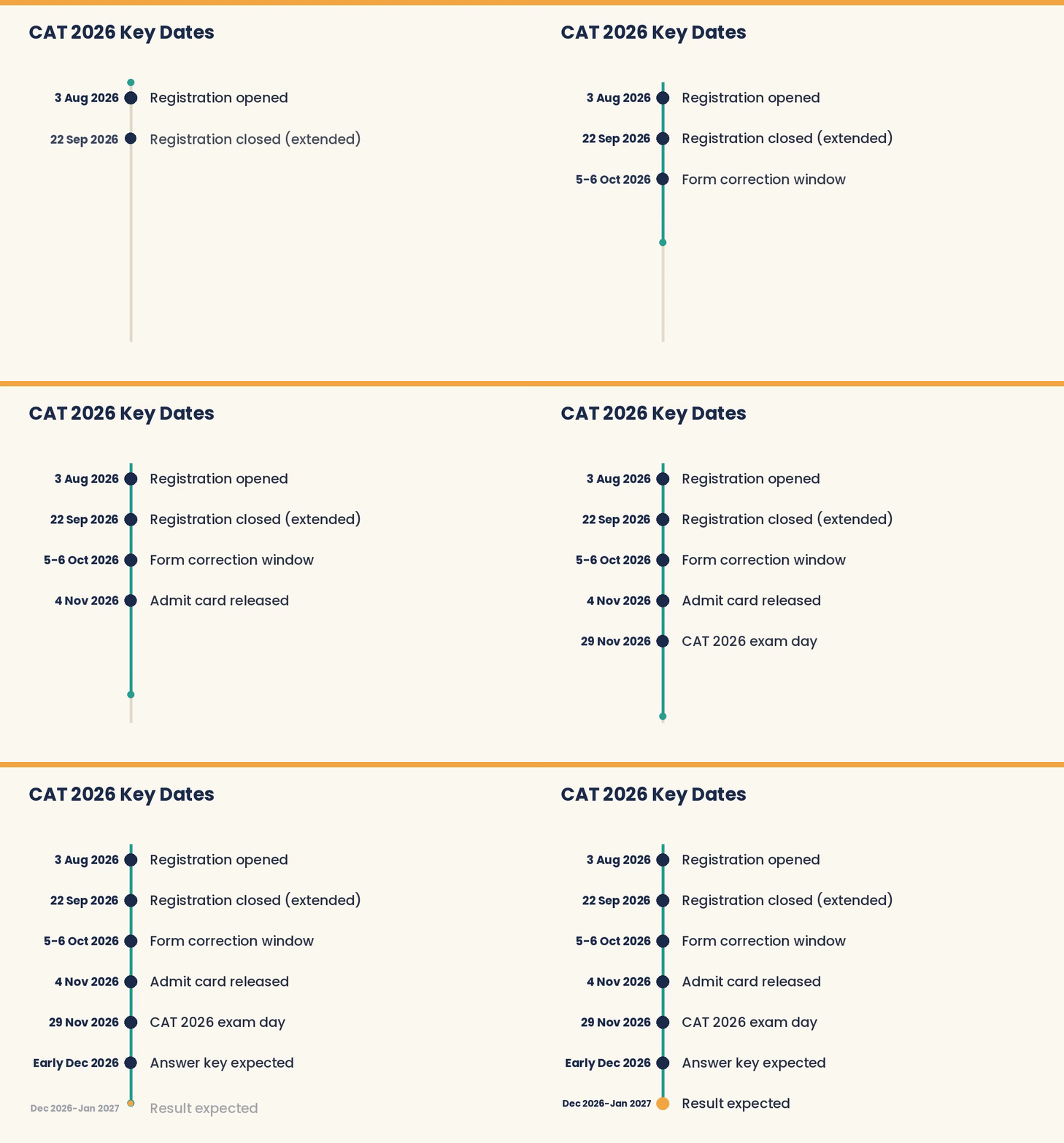
The same timeline as text:
- 3 Aug 2026: Registration opened.
- 22 Sep 2026: Registration closed (extended).
- 5-6 Oct 2026: Form correction window.
- 4 Nov 2026: Admit card released.
- 29 Nov 2026: CAT 2026 exam day.
- Early Dec 2026: Answer key expected.
- Late Dec 2026 to early Jan 2027: Result expected.
What are the CAT 2026 slot timings?
CAT 2026 runs in three sessions on one day. You sit only one session. Your admit card shows your session and centre. As reported by several test-prep sites, the session times are:
| Session | Exam time |
|---|---|
| Session 1 | 8:30 am to 10:30 am |
| Session 2 | 12:30 pm to 2:30 pm |
| Session 3 | 4:30 pm to 6:30 pm |
Reporting time is earlier than the start time. Follow the exact time printed on your admit card, not a website.
What was the CAT 2026 registration fee?
According to the official CAT 2026 Information Bulletin, the fee for CAT 2026 was:
| Category | CAT 2026 fee |
|---|---|
| SC, ST and PwD (PwBD) | Rs 1,350 |
| All other candidates | Rs 2,700 |
The fee is non-refundable. Registration is now closed, so there is no way to apply for CAT 2026 now.
Who runs CAT 2026?
The Indian Institutes of Management (IIMs) run CAT together. One IIM leads each year, and the role rotates. For CAT 2026 the convening IIM is IIM Indore. CAT 2026 scores are used for admissions to the 2027-29 batch. Careers360 reports the score is valid until 31 December 2027.
Who is eligible for CAT 2026?
You need a bachelor's degree with at least 50% marks or equal CGPA. For SC, ST and PwD candidates, the minimum is 45%. The degree must come from a recognised university. This rule matches what IIM Ahmedabad's admissions page states for the CAT 2026 cycle.
More points to know:
- Final-year students can take CAT. If an IIM selects you, you must finish your degree on time and show proof by that institute's deadline.
- No age limit. CAT has no upper age limit and no cap on attempts.
- Professional degrees such as CA, CS and ICWA are generally accepted if you meet the marks rule.
- CGPA conversion: your university's own rule is used. If it has none, a fixed formula applies. Check the official CAT page.
Can NRIs and foreign nationals apply through CAT?
NRIs who are Indian citizens apply through CAT like any other Indian candidate. Foreign nationals are different. Some IIMs let foreign nationals apply using a GMAT score instead of CAT. For example, IIM Ahmedabad says foreign passport holders apply through a separate quota using a test-centre GMAT score. Rules differ by IIM, so check each IIM's international admissions page before you plan.
What is the CAT 2026 exam pattern?
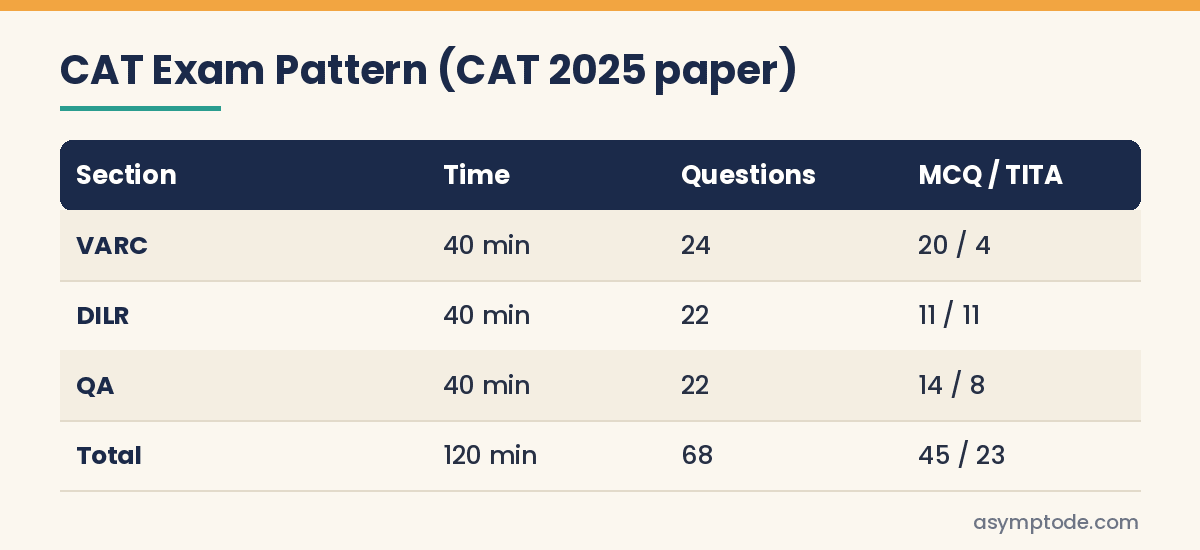
CAT is a 2-hour computer-based test in English. It has three sections, always in the same order. Each section gets a fixed 40 minutes. You cannot move between sections. When time ends for one section, the next one opens.
IIM Indore does not fix the number of questions in advance. The CAT 2025 paper had 68 questions, as reported in IMS India's slot analysis. Use these numbers as a guide, not a promise.
| Section | Time | Questions (CAT 2025) | MCQ / TITA (CAT 2025) |
|---|---|---|---|
| VARC (Verbal Ability and Reading) | 40 min | 24 | 20 / 4 |
| DILR (Data Interpretation and Logical Reasoning) | 40 min | 22 | 11 / 11 |
| QA (Quantitative Aptitude) | 40 min | 22 | 14 / 8 |
| Total | 120 min | 68 | 45 / 23 |
What is a TITA question? TITA means "type in the answer". There are no options. You type a number or a word using the on-screen keypad. You cannot guess from choices, but a wrong TITA answer costs you nothing.
How does CAT marking work?
| Question type | Correct | Wrong | Not attempted |
|---|---|---|---|
| MCQ | +3 | -1 | 0 |
| TITA (non-MCQ) | +3 | 0 | 0 |
With 68 questions, the maximum raw score is 204. CAT runs in three sessions, so IIM Indore normalises scores across sessions. It then converts them into percentiles. Your percentile is the number IIMs look at.
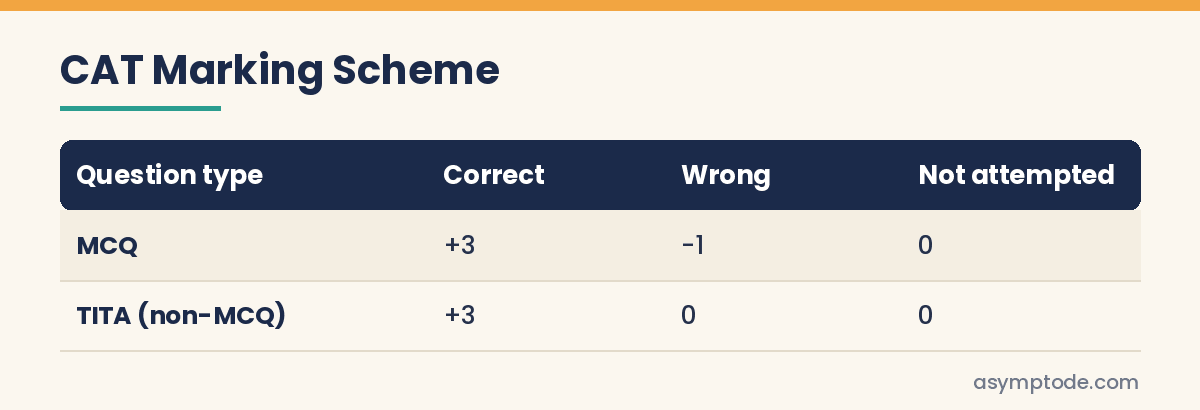
One practical rule follows from this. Always attempt a TITA question if you have a sensible answer. A wrong MCQ costs a mark, so skip MCQs where you have no method.
Where are the CAT 2026 test cities?
The official CAT 2026 Information Bulletin says CAT 2026 is held in about 170 test cities. Admit cards can be downloaded from 4 November 2026 until test day, 29 November 2026. Candidates chose five preferred cities in the form. You get one of them, or a nearby city if none is free. Your admit card shows the final centre.
How do IIMs shortlist after CAT 2026?
Each IIM sets its own rules. There is no single cut-off for all IIMs. Most IIMs look at your CAT percentile along with your 10th, 12th and degree marks, work experience and, in some cases, academic diversity.
Here is a real example. IIM Ahmedabad's published process for the CAT 2026 cycle:
- Builds a composite score that is 65% CAT percentile and 35% application rating (10th, 12th, degree marks, work experience and other factors).
- Applies minimum CAT cut-offs. For General and EWS candidates it lists a 95 overall percentile and 85 in each section. Lower cut-offs apply for other categories.
- Shortlists candidates for an Analytical Writing Test (AWT) and Personal Interview (PI).
- Makes final offers using 50% interview, 10% writing test and 40% composite score.
Other IIMs use different weights. Many use a Written Ability Test (WAT) or a group exercise in place of an AWT. Read each IIM's admissions policy when it is published.
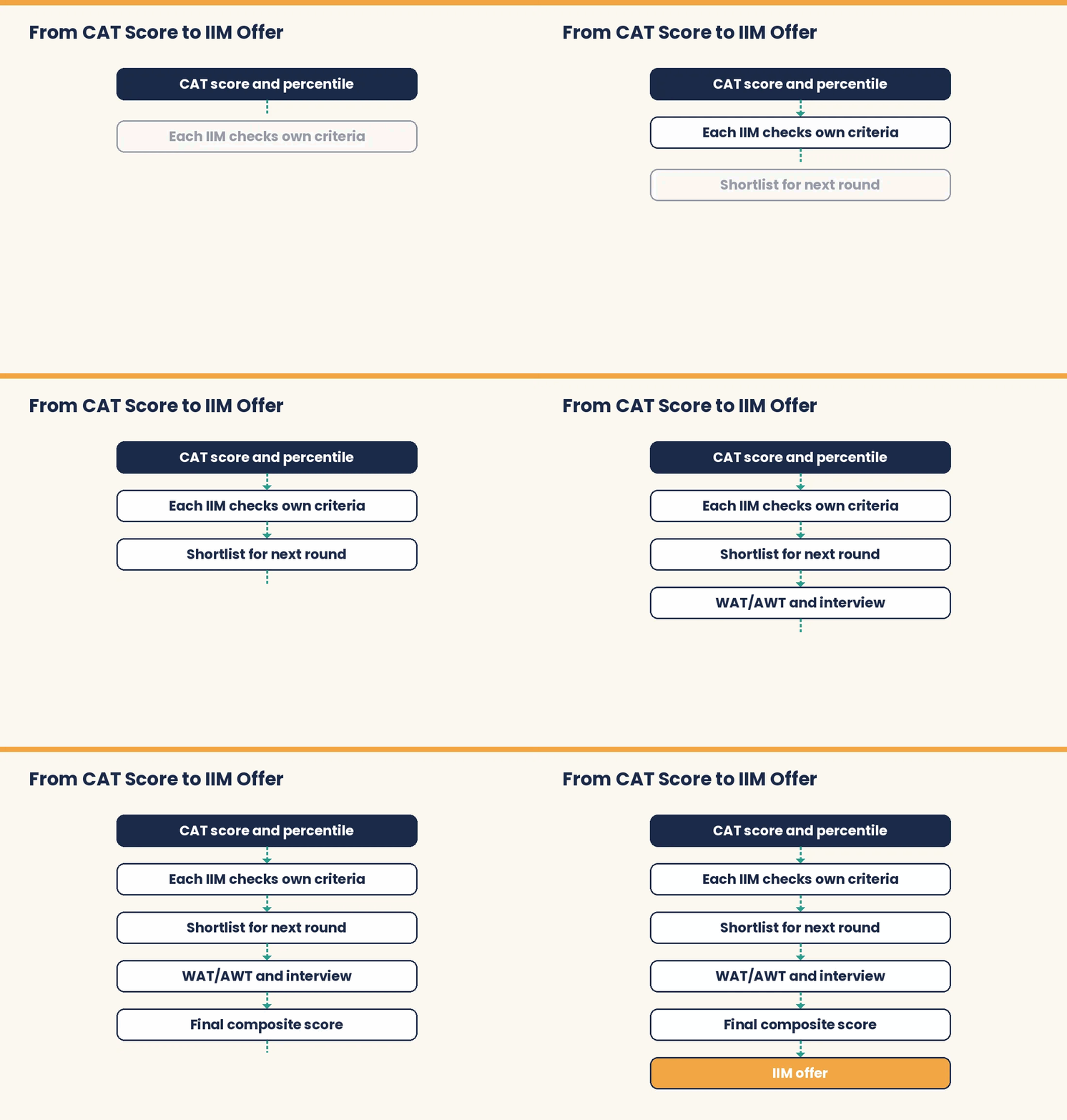
The same flow as text:
- CAT score and percentile come out with the result.
- Each IIM checks its own criteria: percentile, sectional cut-offs and profile.
- Shortlist for the next round.
- WAT/AWT and Personal Interview round.
- Final composite score combines test, profile and interview.
- IIM offer is made category by category.
Which other colleges accept CAT scores?
Many non-IIM business schools use CAT. Well-known names include FMS Delhi, SPJIMR Mumbai, MDI Gurgaon and the management schools at several IITs. Each school runs its own application process. You often apply to them separately, and their deadlines can fall soon after the CAT result. Check each school's admissions page.
How should you prepare for CAT 2026?
CAT rewards method and choice, not speed alone. You need to pick the right questions and solve them cleanly. Here is how to approach each section.
Quantitative Aptitude (QA). Most QA questions come from school maths up to Class 10. Arithmetic (percentages, ratio, profit and loss, time and work, speed) carries a lot of weight. Algebra, geometry and number systems come next. Write clean working, even on rough sheets. Many marks are lost to small slips, not to hard topics.
DILR. You get sets of data or puzzles, each with a few questions. The key skill is choosing sets. Spend the first two or three minutes scanning all sets. Pick the two or three that look clearest. Draw a neat table or grid before you answer anything.
VARC. Reading comprehension carries most of this section. Read daily: editorials, long-form essays and books. Practise finding the main idea of each paragraph. Para-jumbles and odd-sentence questions are often TITA, so attempt them.
Mocks. Take full-length mocks under real timing, including the fixed 40-minute sections. Spend more time reviewing a mock than taking it. The official mock on iimcat.ac.in shows the real interface, so try it once it is released.
If you are building maths basics, these guides help: solving quadratic equations three ways and how many hours of maths tutoring per week.
Want a mentor to check your QA and DILR method before exam day? Book a free demo class or see our fees.
CAT 2026 QA worked example
Here is a typical arithmetic question, solved step by step.
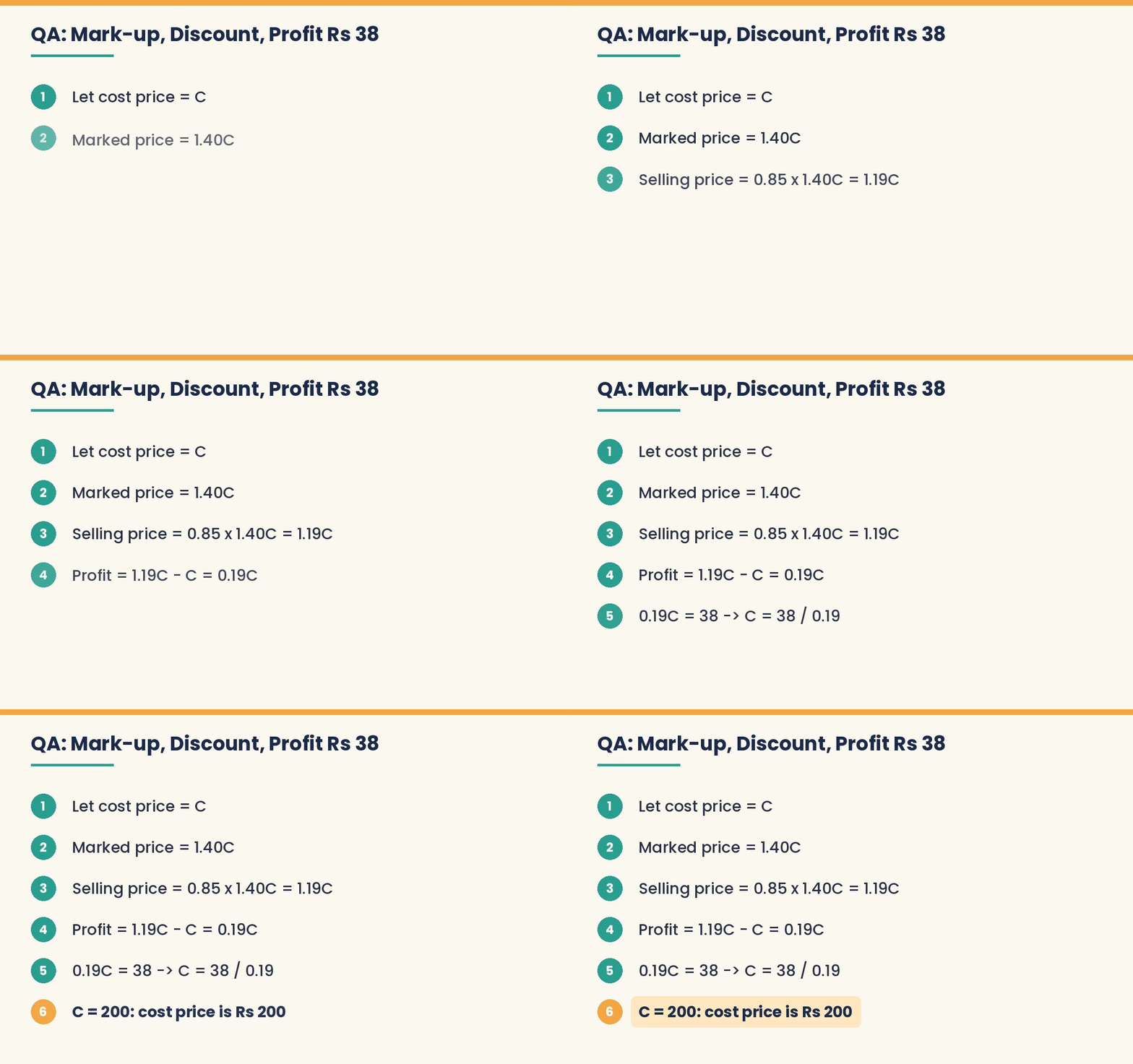
Question: A shopkeeper marks an item 40% above its cost price. He then gives a 15% discount on the marked price. His profit is Rs 38. What is the cost price?
The same steps as text:
- Let the cost price be C.
- Marked price = 1.40 x C.
- Selling price = 0.85 x 1.40 x C = 1.19C.
- Profit = 1.19C - C = 0.19C.
- 0.19C = 38, so C = 38 / 0.19.
- C = 200. The cost price is Rs 200.
Check: marked price = Rs 280. Selling price = 85% of 280 = Rs 238. Profit = 238 - 200 = Rs 38. Correct.
Why this matters: using multipliers (1.40 and 0.85) turns two steps into one. It is faster and leaves fewer places to slip. If this were an MCQ, you could also test the options, but the multiplier method works for TITA too.
What are the most common CAT mistakes?
- Guessing on MCQs. A wrong MCQ costs one mark. Random guesses add up to real losses.
- Skipping TITA questions. A wrong TITA costs nothing. Leaving one blank when you have a sensible answer wastes a chance.
- Getting stuck on one DILR set. If a set is not opening after a few minutes, move on. Time does not carry over between sections.
- Ignoring sectional cut-offs. Many IIMs need a minimum percentile in every section. A great QA score cannot save a very weak VARC score.
- Taking mocks without review. The marks are in the review. Find out why each wrong answer went wrong.
- Messy rough work. Many QA errors are copying or sign slips. Write each step clearly.
- Trying new topics in the last week. Late new topics cause panic. Revise what you know.
- Not reading the admit card closely. Check your session, reporting time, centre and ID rules early.
What should your last-month CAT 2026 plan look like?
You have about five weeks before 29 November 2026. Use them like this.
Week 1 (26 Oct to 1 Nov): find your gaps
- Take one full mock under exam timing.
- List your three weakest QA topics and two weakest DILR set types.
- Fix one weak topic each day with short, focused practice.
Week 2 (2 to 8 Nov): build accuracy
- Download your admit card from 4 November and check every detail.
- Take two full mocks this week. Review each one for at least as long as the test.
- Keep an error log: question, mistake, the right method.
Week 3 (9 to 15 Nov): sharpen choice
- Take two or three mocks. Try the official mock once it is out.
- Practise picking DILR sets in the first three minutes.
- Set a rule for MCQ guessing: only when you can rule out at least two options.
Week 4 (16 to 22 Nov): steady practice
- Take two mocks at the same time of day as your session.
- Revise formulas and your error log daily.
- Read one long article every day to keep VARC warm.
Final week (23 to 29 Nov): stay calm
- One light mock early in the week, then stop full mocks.
- Revise only. No new topics.
- Visit or map your test centre. Pack your admit card and photo ID the night before.
- Sleep well on 27 and 28 November.
How 1-on-1 tutoring helps with CAT 2026
Asymptode is a maths and science tutoring company, so we are honest about where we help. We support the Quantitative Aptitude section and the method behind DILR: setting up tables, reading data carefully and checking logic step by step. We do not offer VARC coaching. For VARC, your mentor can help you plan practice time and build steady study habits, but the reading itself is your work.
Here is how our sessions work:
- One dedicated mentor in live, 1-on-1 online sessions.
- Method-first teaching. Your mentor watches each step of your working and fixes the method, not just the final answer. This is where most QA marks are won or lost.
- Your own plan and dates. Sessions follow your weak topics and your exam date of 29 November 2026.
- Personalised homework with feedback on the exact question types you get wrong.
- Every class is recorded, so you can revise the method before exam day.
- Flexible times across time zones, which helps working candidates.
- Short updates for parents who want to know how practice is going.
With five weeks left, even a few focused sessions on arithmetic, algebra and DILR set selection can make your practice sharper. To choose well, read how to choose an online maths tutor.
Key dates, fee and test cities checked against the official CAT website (iimcat.ac.in) and the CAT 2026 Information Bulletin, and eligibility rules against IIM Ahmedabad's admissions page, on 25 October 2026. Session times are as reported by test-prep sites; your admit card is final. Updated 25 October 2026: fee and test-city count now confirmed from the official bulletin.
FAQ
When is CAT 2026?
CAT 2026 is on Sunday, 29 November 2026. It runs in three sessions on that day, and each candidate sits one session.
Can I still register for CAT 2026?
No. Registration closed on 22 September 2026 after a one-week extension. If you missed it, you will need to wait for CAT 2027 or look at other entrance tests.
When will the CAT 2026 result come out?
The CAT result usually comes out in late December or early January. For CAT 2026, expect it between late December 2026 and early January 2027. The official date is not yet announced.
Is there negative marking for TITA questions in CAT?
No. A wrong TITA answer scores 0. A wrong MCQ answer loses 1 mark. A right answer of either type earns 3 marks.
Can final-year students take CAT 2026?
Yes. Final-year students can take CAT 2026. If selected, they must finish their degree and submit proof by the deadline set by the admitting IIM.
What CAT percentile do I need for an IIM?
There is no single number. Each IIM sets its own cut-offs and also looks at your profile. For example, IIM Ahmedabad lists a 95 overall percentile and 85 in each section as minimums for General candidates in the CAT 2026 cycle. Meeting a minimum does not guarantee a call.
Ready for focused QA and DILR practice in the final weeks? Book a free demo class or see our fees.