

The Math 30-1 diploma exam is the big provincial maths exam for Alberta students who plan to study maths, science, engineering or business after high school. It counts for 30% of the final course mark. This guide explains the format, the 2026-27 dates, what is tested and how to prepare in a calm, step-by-step way.
Key takeaways
- The Math 30-1 diploma exam has 32 machine-scored questions (24 multiple choice and 8 numerical response) and 3 written-response questions.
- It is designed for 3 hours, and students may take up to 3 extra hours if they need them.
- The exam mark is 30% of the final course mark. The school-awarded mark is 70%.
- Relations and Functions is the biggest area, at about 53% to 58% of the exam.
- An approved graphing calculator is required, and a formula sheet is provided.
- In 2026-27 the exam is offered in November, January, April, June and August.
What is the Math 30-1 diploma exam?
Quick answer: The Math 30-1 diploma exam is a provincial exam set by Alberta Education and Childcare for students finishing Mathematics 30-1, the Grade 12 academic maths course. It tests functions, trigonometry and counting methods. The exam mark is 30% of the final course mark, and universities look closely at that final mark for admission.
Math 30-1 is the course most universities ask for when a student applies to science, engineering, commerce and many health programs. Math 30-2 is the other Grade 12 route. It suits students heading to programs that do not need calculus. If your child is not sure which one they need, check the admission pages of the universities they like before Grade 12 starts.
Because the exam is set by the province, every student in Alberta writes the same kind of paper. That makes it fair, but it also means the questions can look different from the tests your child sees at school. Good preparation closes that gap.
What is the Math 30-1 exam format?
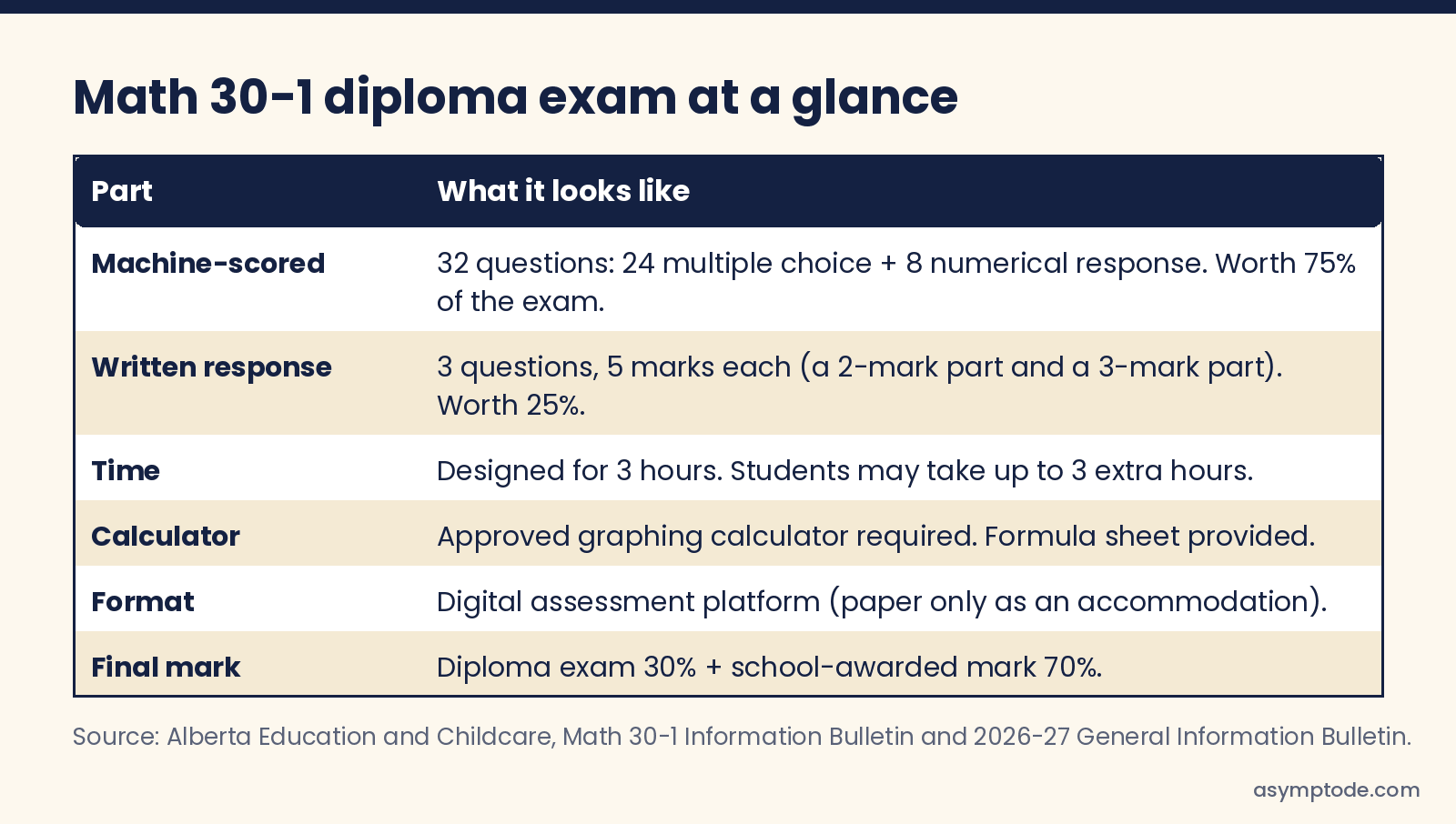
| Part | Details |
|---|---|
| Machine-scored | 32 questions: 24 multiple choice and 8 numerical response |
| Machine-scored weight | 75% of the exam |
| Written response | 3 questions, each worth 5 marks (a 2-mark part and a 3-mark part) |
| Written-response weight | 25% of the exam |
| Time | Designed for 3 hours, with up to 3 more hours if needed |
| Calculator | An approved graphing calculator is required |
| Formula sheet | Provided (on screen in the digital exam; a paper copy is also allowed) |
| Delivery | The digital assessment platform; paper only as an accommodation |
Numerical-response questions ask for a number, not a letter. There are no answer choices to check against, so careful working matters.
Written-response questions are marked by teachers using a scoring guide. Each question has two parts. A 2-mark part checks one skill. A 3-mark part asks for a fuller solution, such as an identity proof or a full algebraic method. Half marks can be given for answers between two levels.
The extra time is a real help. Most students do not need it, but knowing it is there lowers stress. The calculator must be on the province's approved list, and its memory is cleared before and after the exam. Practise with the exact model your child will use on the day.
When are the 2026-27 Math 30-1 diploma exams?
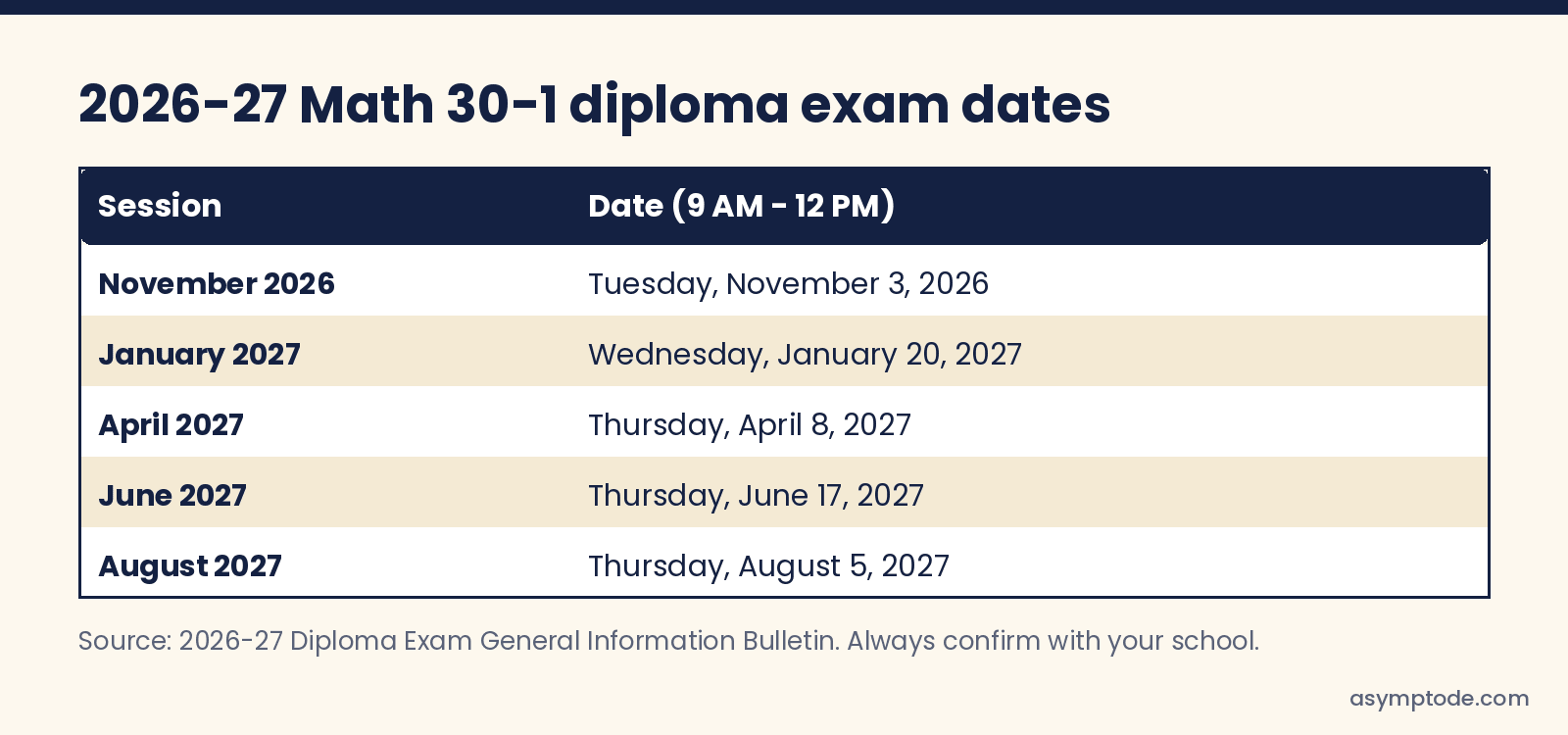
| Session | Date and time |
|---|---|
| November 2026 | Tuesday, November 3, 2026, 9 AM to 12 PM |
| January 2027 | Wednesday, January 20, 2027, 9 AM to 12 PM |
| April 2027 | Thursday, April 8, 2027, 9 AM to 12 PM |
| June 2027 | Thursday, June 17, 2027, 9 AM to 12 PM |
| August 2027 | Thursday, August 5, 2027, 9 AM to 12 PM |
Most students write in January (if they take Math 30-1 in the first semester) or June (second semester or full year). November, April and August are mainly used for rewrites. Your child's school will tell you which session applies and how to register for a rewrite.
What topics does the Math 30-1 exam test?
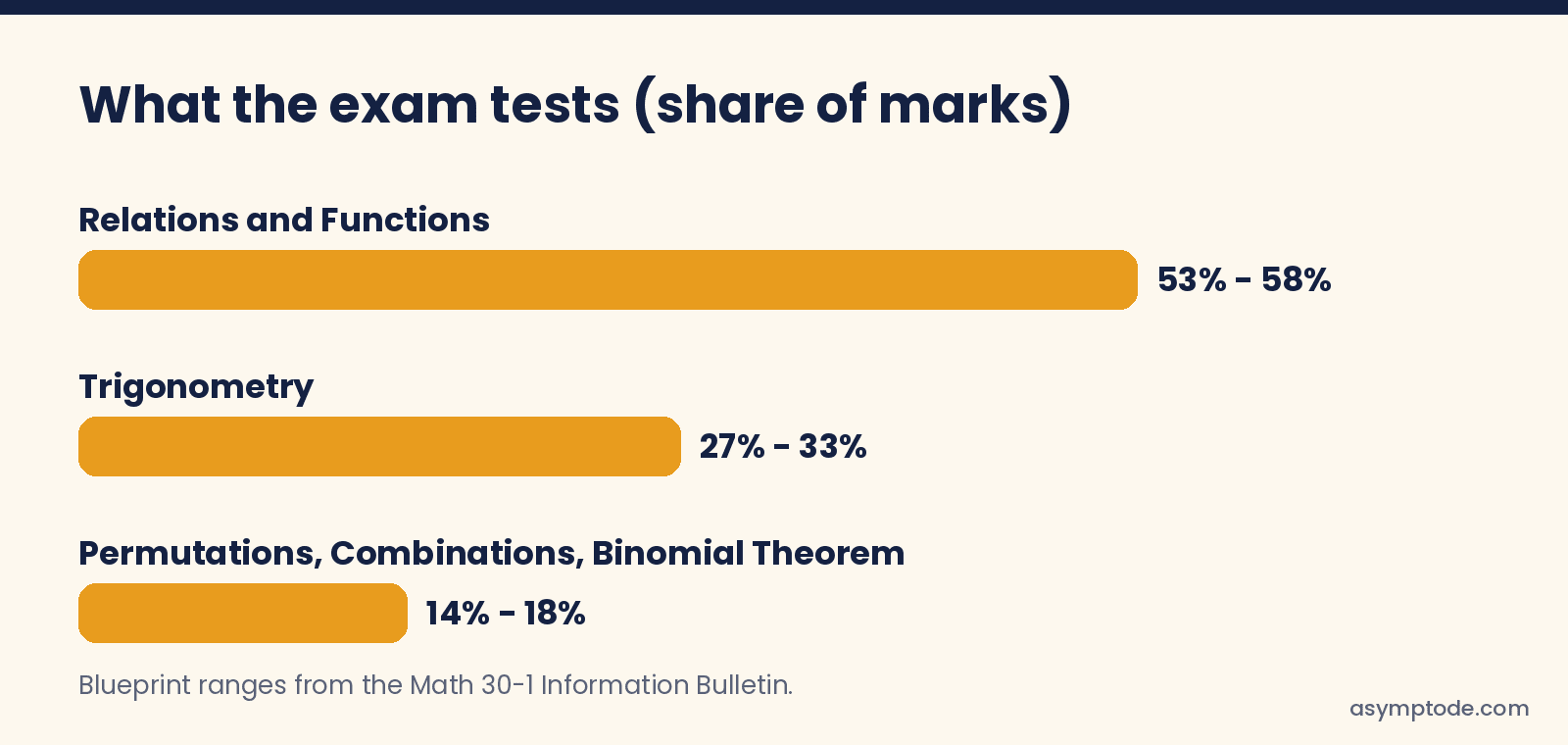
The province publishes a blueprint. It shows how much of the exam comes from each part of the course.
| Topic area | Share of the exam | What it includes |
|---|---|---|
| Relations and Functions | 53% to 58% | Transformations, inverses, exponential and logarithmic functions, polynomial, radical and rational functions |
| Trigonometry | 27% to 33% | Radians, the unit circle, trig graphs, trig equations and identities |
| Permutations, Combinations and Binomial Theorem | 14% to 18% | Counting, arrangements, choosing groups, the binomial expansion |
The blueprint also splits the exam by type of thinking: about 34% conceptual, 36% problem solving and 30% procedural. That means fewer than a third of the marks come from simply following a method. Most marks need your child to understand why the method works, or to choose one in a new situation.
The simple lesson for parents: functions come first. They are more than half the exam, and they also link to trigonometry. A student who is shaky on transformations will lose marks in two places.
Worked examples in the Math 30-1 style
These examples show the kind of thinking the exam rewards. Each one is written out step by step.
Example 1: Solve an exponential equation with logarithms
Solve 2(3^x) = 30. Give x to two decimal places.
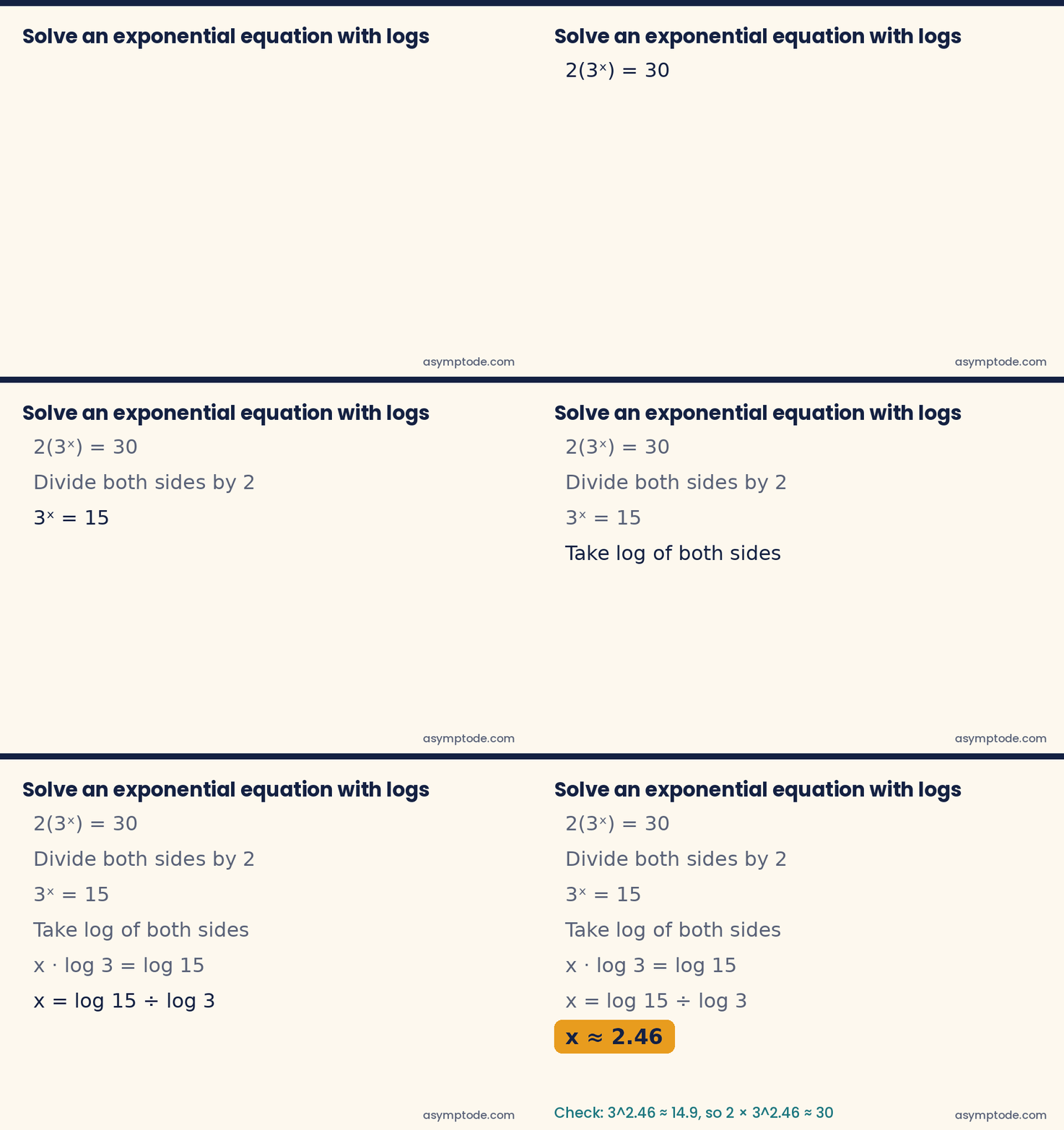
- Divide both sides by 2: 3^x = 15.
- Take the log of both sides: log(3^x) = log 15.
- Use the power law: x · log 3 = log 15.
- Divide: x = log 15 ÷ log 3.
- Use the calculator: x ≈ 1.1761 ÷ 0.4771 ≈ 2.46.
- Check: 3^2.46 is about 14.9, and 2 × 14.9 is about 30. It works.
A common mistake is to "take the log" before dividing by 2. That gives log 2 + x · log 3 = log 30. It still works, but it adds a step and more chances to slip.
Example 2: Arrangements with repeated letters
How many different arrangements are there of the letters in the word ALBERTA?
- Count the letters: A, L, B, E, R, T, A. That is 7 letters.
- Look for repeats: A appears 2 times. No other letter repeats.
- If all letters were different, there would be 7! = 5040 arrangements.
- Swapping the two A's gives the same word, so divide by 2!: 5040 ÷ 2 = 2520.
Answer: 2520. This is a typical numerical-response question. There are no choices, so the student must trust their method.
Example 3: One term of a binomial expansion
Find the term containing x^3 in the expansion of (x + 2)^5.
- The general term is C(5, k) · x^(5 − k) · 2^k.
- We want x^3, so 5 − k = 3, which gives k = 2.
- C(5, 2) = 10 and 2^2 = 4.
- The term is 10 × 4 × x^3 = 40x^3.
Example 4: A trigonometric equation
Solve 2 sin θ − 1 = 0 for 0 ≤ θ < 2π.
- Rearrange: sin θ = 1/2.
- The reference angle is π/6.
- Sine is positive in Quadrants I and II.
- So θ = π/6 and θ = π − π/6 = 5π/6.
Students often find only one answer. Drawing the unit circle for every trig equation is a simple habit that stops this.
What are the most common Math 30-1 mistakes?
- Transformations in the wrong order. For y = 2f(3(x − 1)) + 4, students mix up stretches and shifts. Teach one fixed order and use it every time.
- Losing solutions in trig equations. Only one angle is given when there should be two or more. Check the domain and the quadrants.
- Weak log laws. Writing log(a + b) = log a + log b is a classic error. Make a one-line list of the real laws and test them with numbers.
- Calculator in the wrong mode. Degrees instead of radians costs easy marks. Check the mode at the start of every practice paper.
- Thin written responses. In the 3-mark parts, a correct answer with no clear method can lose marks. In identity proofs, students must show each step and work on one side at a time.
- Rushing the counting questions. "Arrange" and "choose" sound similar. Ask: does order matter? If yes, it is a permutation. If no, a combination.
How should my child prepare for the Math 30-1 diploma exam?
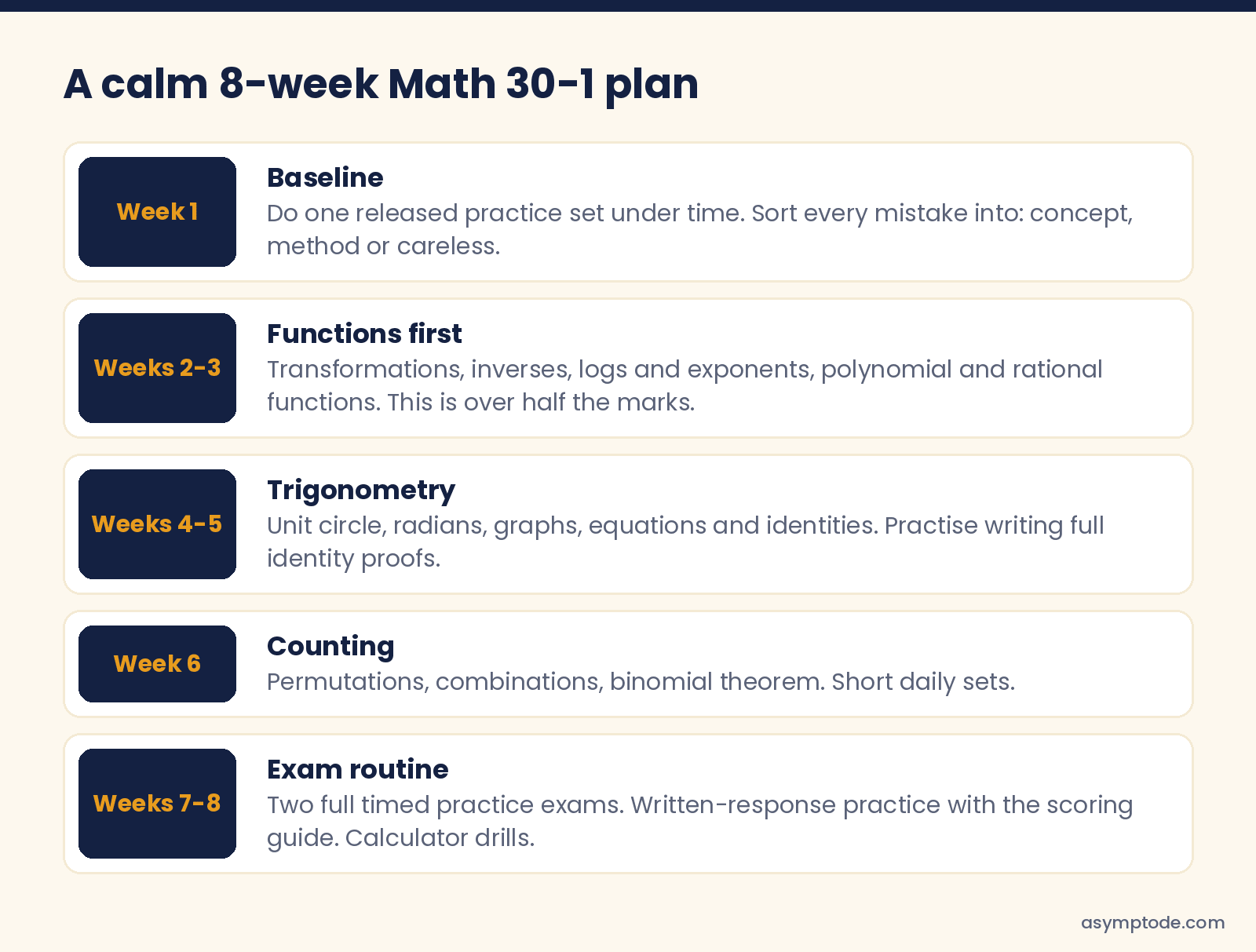
Here is a simple 8-week plan that works for the January or June session.
| Weeks | Focus | What to do |
|---|---|---|
| 1 | Baseline | One timed practice set from the province's released materials. Sort every error as concept, method or careless. |
| 2-3 | Relations and Functions | Transformations, inverses, exponents and logs, polynomial, radical and rational functions. This is more than half the marks. |
| 4-5 | Trigonometry | Unit circle, radians, graphs, equations and identities. Write out full identity proofs. |
| 6 | Counting | Permutations, combinations and the binomial theorem in short daily sets. |
| 7-8 | Exam routine | Two full timed practice exams. Practise written responses against the scoring descriptions. Drill the calculator. |
Daily habit: 30 to 45 minutes on school days is enough for most students. Short, regular practice beats a long weekend cram.
Use official materials. Alberta Education and Childcare publishes the information bulletin, written-response information with sample scoring, and practice questions on its digital platform. These show exactly how questions are worded.
Keep an error log. Every wrong answer goes in a notebook with the correct method and one sentence on why it went wrong. Before the exam, your child reads the log, not the whole textbook.
Not sure how many hours of support your child needs each week? Our guide to how many hours of maths tutoring per week gives a simple way to decide.
Want a plan built around your child's exam date? Book a free demo class and we will look at where they are now.
How does 1-on-1 tutoring help with Math 30-1?
Math 30-1 is a course where small gaps add up. A student who is unsure about function notation in September will struggle with logs in November and with trig graphs in the spring. Classroom teachers have to keep the whole group moving. A 1-on-1 mentor can stop and fix the exact piece that is missing.
At Asymptode, every class is live and 1-on-1, with the same mentor each time. Here is how that works for Math 30-1:
- We follow the Alberta course and your child's exam session. The mentor plans back from January, June or a rewrite date.
- We watch the working, not just the answer. In the written-response questions, method earns marks. The mentor sees each line and fixes the habit that loses marks.
- Homework is set on what was taught, checked by the mentor, and used to plan the next class.
- Parents get short updates on what has improved and what still needs practice.
- Every class is recorded, so your child can rewatch a trig proof or a transformation the night before a test.
We do not promise a score. We do promise a clear plan and steady, honest feedback. If 1-on-1 support is not the right fit for your child, we will say so.
Related guides
- Moving from Ontario or comparing provinces? Read our Ontario Grade 9 maths guide.
- Studying an international course with calculus? See our IB Maths AA vs AI guide.
- Planning support time: how many hours of maths tutoring per week.
Ready to start? Talk to an Asymptode advisor and book a free demo class, or see our fees.
FAQ
How much is the Math 30-1 diploma exam worth?
The diploma exam mark is worth 30% of the final course mark. The school-awarded mark is worth the other 70%.
Can you use a calculator on the Math 30-1 diploma exam?
Yes. An approved graphing calculator is required. It must be on the province's approved list for the school year, and its memory is cleared before and after the exam.
How long is the Math 30-1 diploma exam?
It is designed for 3 hours. Students may take up to 3 extra hours if they need them.
How many questions are on the Math 30-1 diploma exam?
There are 32 machine-scored questions (24 multiple choice and 8 numerical response) and 3 written-response questions. The written-response part is worth 25% of the exam.
Can my child rewrite the Math 30-1 diploma exam?
Yes. Students can rewrite in a later session, such as November, April or August. Ask the school about registration, fees and how the new mark is used.
What is the hardest part of Math 30-1?
Many students find trigonometric identities and logarithms the hardest. Both reward clear, step-by-step working, which can be built with regular practice and feedback.