
The Chemistry 30 diploma exam is the final exam for Grade 12 chemistry in Alberta. It counts for 30% of the final mark, so it can move a grade up or down. This guide covers the 2026-27 exam dates, the exam format, the blueprint, four worked examples, common mistakes and an 8-week study plan.
Key takeaways
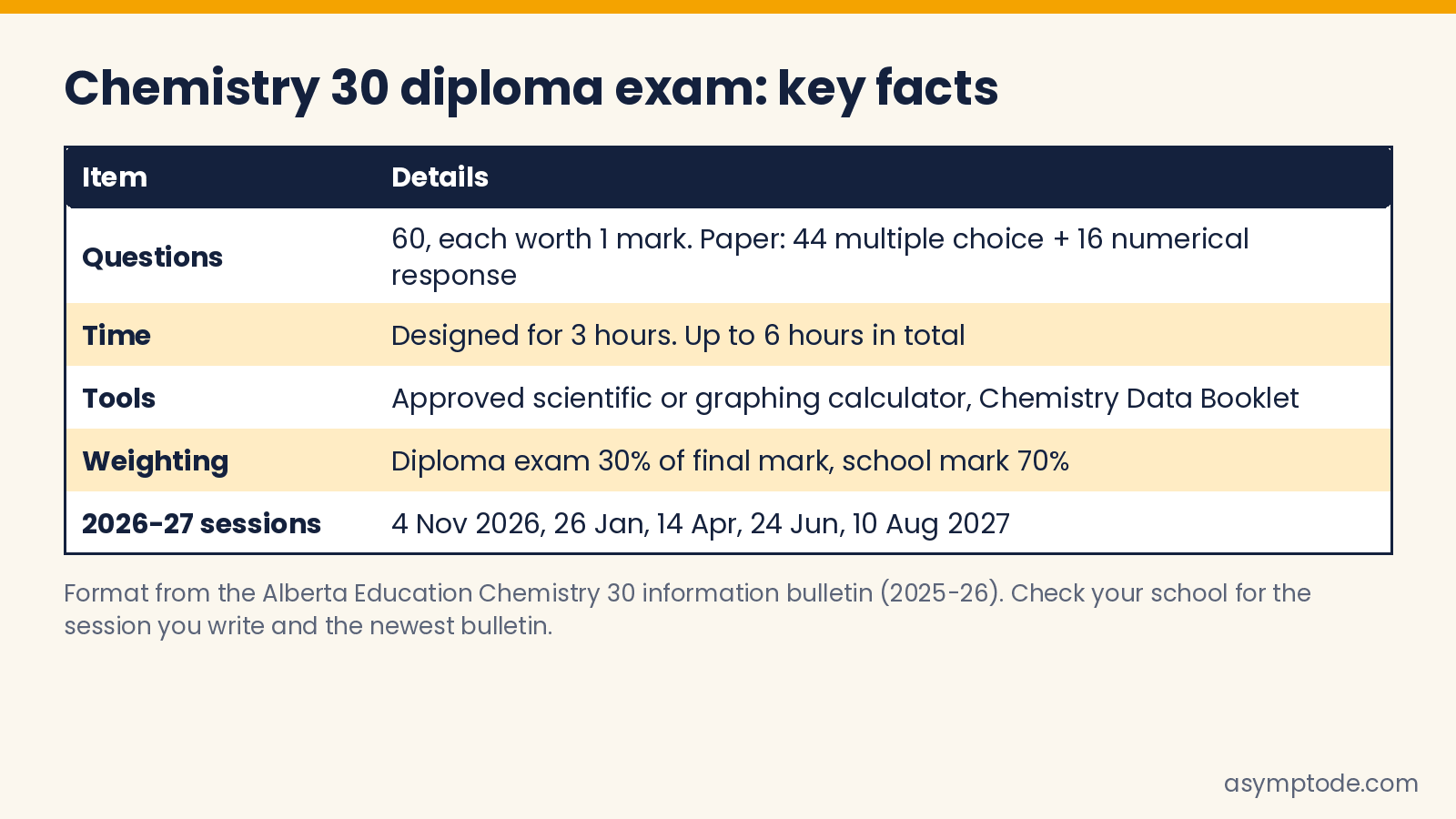
- The exam has 60 questions worth 1 mark each. The paper version has 44 multiple-choice and 16 numerical-response questions.
- It is designed for 3 hours, and students may take up to 6 hours in total.
- The diploma exam is 30% of the final mark. The school mark is 70%.
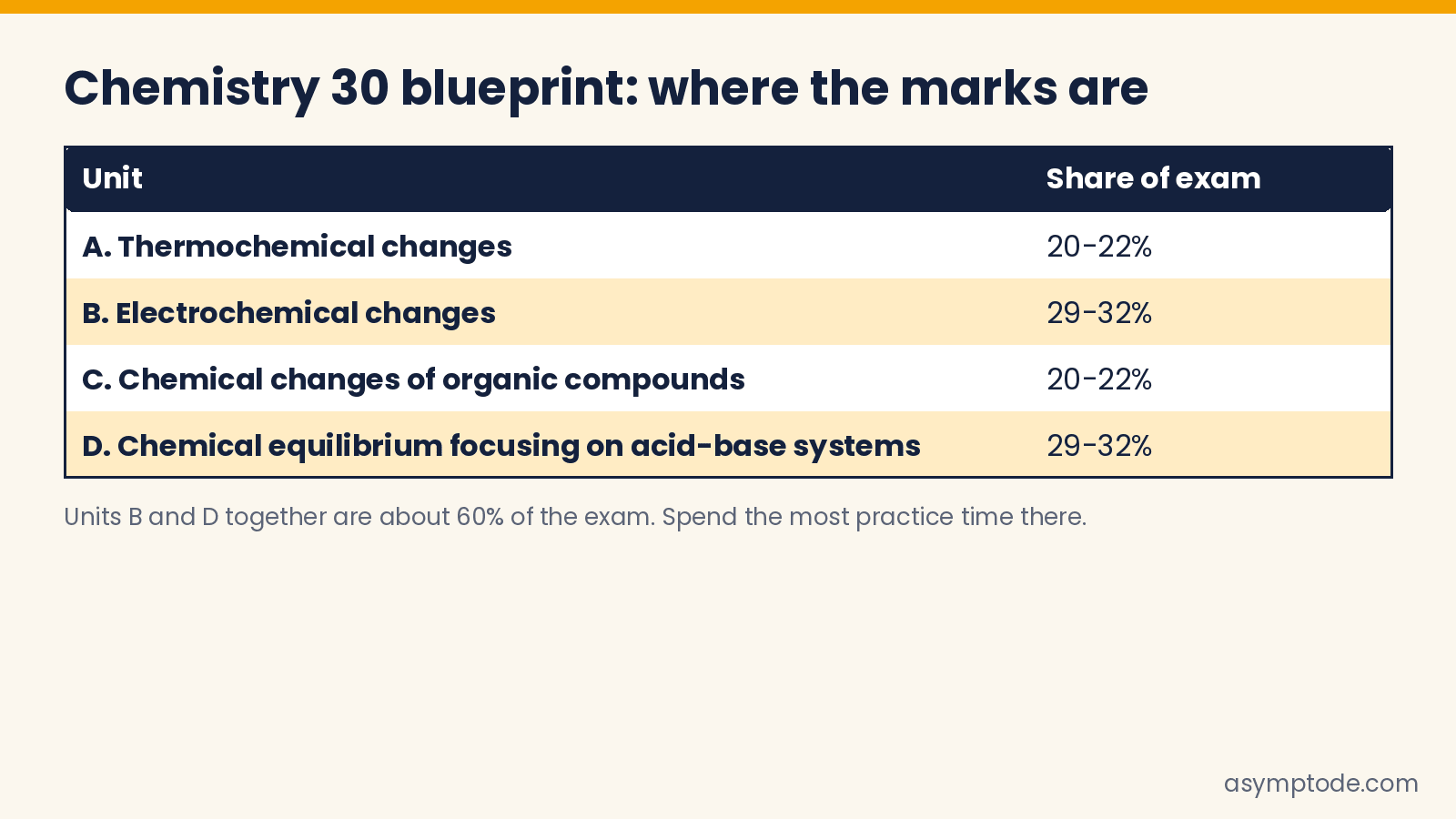
- Electrochemistry and acid-base equilibrium are each about 29-32% of the exam. Together that is about 60%.
- 2026-27 sessions: 4 November 2026, 26 January, 14 April, 24 June and 10 August 2027.
What is the Chemistry 30 diploma exam?
Quick answer: The Chemistry 30 diploma exam is a provincial exam set by Alberta Education for students finishing Chemistry 30. It has 60 one-mark questions, is designed for 3 hours, and allows up to 6 hours. It covers thermochemistry, electrochemistry, organic chemistry and acid-base equilibrium. It is worth 30% of the final course mark.
Chemistry 30 is often needed for university programs in science, engineering, health and pharmacy. It follows Chemistry 20 and builds on stoichiometry, solutions and gases. If your child also takes Math 30-1 or Physics 30, those diploma exams follow the same 30/70 rule.
When is the Chemistry 30 diploma exam in 2026-27?
| Session | Date |
|---|---|
| November | Wednesday 4 November 2026 |
| January | Tuesday 26 January 2027 |
| April | Wednesday 14 April 2027 |
| June | Thursday 24 June 2027 |
| August | Tuesday 10 August 2027 |
Most students write in January or June, at the end of their semester. Your child's school will confirm the session and the start time.
What is the format of the Chemistry 30 exam?
Alberta Education's Chemistry 30 information bulletin describes two versions:
| Item | Paper exam | Digital exam |
|---|---|---|
| Questions | 44 multiple choice + 16 numerical response | 60 questions of different types |
| Marks | 1 mark each (60 total) | 1 mark each (60 total) |
| Designed time | 3 hours | 3 hours |
| Time allowed | Up to 6 hours | Up to 6 hours |
Students may use one approved calculator (scientific or approved graphing) and the Chemistry Data Booklet. The data booklet has the periodic table, the table of redox half-reactions, and the table of acids and bases. Learning to use these tables quickly is a big part of doing well.
What is a numerical-response question?
A numerical-response (NR) question has no answer choices. Students work out a number and fill it in. Some NR questions ask for a number in a set format, such as "to three digits" or "as a code" for a list of steps. Read the instructions on each one with care. A correct answer in the wrong format scores zero.
What is on the Chemistry 30 blueprint?
| Unit | Share of the exam |
|---|---|
| A. Thermochemical changes | 20-22% |
| B. Electrochemical changes | 29-32% |
| C. Chemical changes of organic compounds | 20-22% |
| D. Chemical equilibrium focusing on acid-base systems | 29-32% |
Unit A (thermochemistry): heat and enthalpy, calorimetry, Hess's law, energy diagrams, activation energy and catalysts.
Unit B (electrochemistry): oxidation and reduction, the redox table, predicting spontaneous reactions, balancing half-reactions, voltaic and electrolytic cells, and cell voltage.
Unit C (organic): naming, structural formulas, functional groups, and reactions such as addition, substitution, elimination, esterification, combustion and polymerization.
Unit D (equilibrium): Le Chatelier's principle, Kc, Brønsted-Lowry acids and bases, conjugate pairs, pH and pOH, titration curves, indicators and buffers.
Worked example 1: calorimetry (Unit A)
Question: When 0.0500 mol of a salt dissolves in 100 g of water, the temperature rises by 12.0 °C. Find the molar enthalpy of solution. Use c = 4.19 J/(g·°C).
- Q = mcΔt = 100 × 4.19 × 12.0 = 5028 J = 5.03 kJ.
- The water got warmer, so the reaction released energy. ΔH is negative.
- Molar enthalpy = −5.03 kJ ÷ 0.0500 mol = −101 kJ/mol (3 s.f.).
Worked example 2: cell voltage (Unit B)
Question: Find the standard voltage of a zinc-copper voltaic cell.
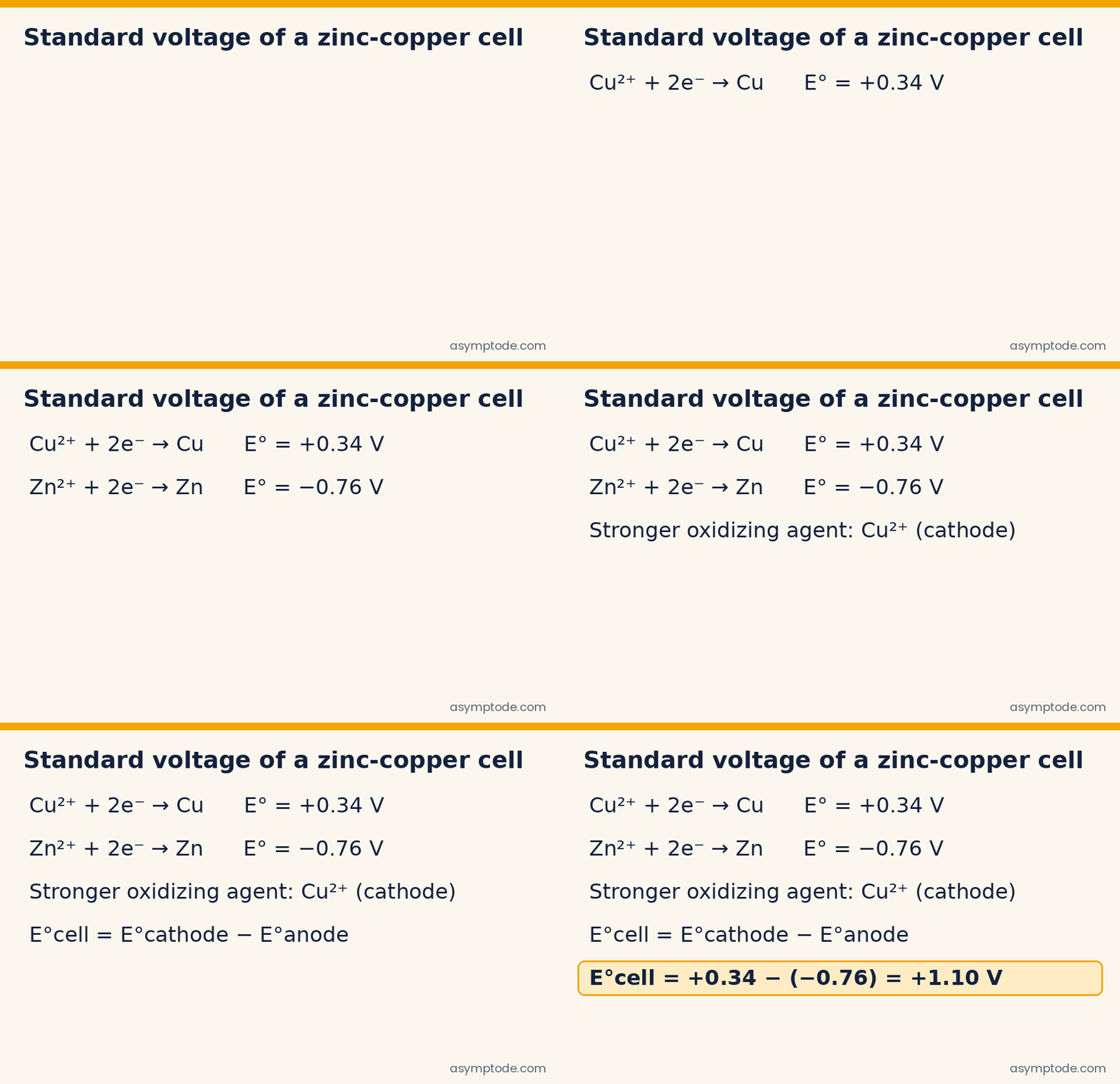
- From the redox table: Cu²⁺ + 2e⁻ → Cu, E° = +0.34 V.
- Zn²⁺ + 2e⁻ → Zn, E° = −0.76 V.
- Cu²⁺ is the stronger oxidizing agent, so it is reduced at the cathode. Zinc is oxidized at the anode.
- E°cell = E°cathode − E°anode = +0.34 − (−0.76) = +1.10 V.
A positive voltage means the reaction is spontaneous.
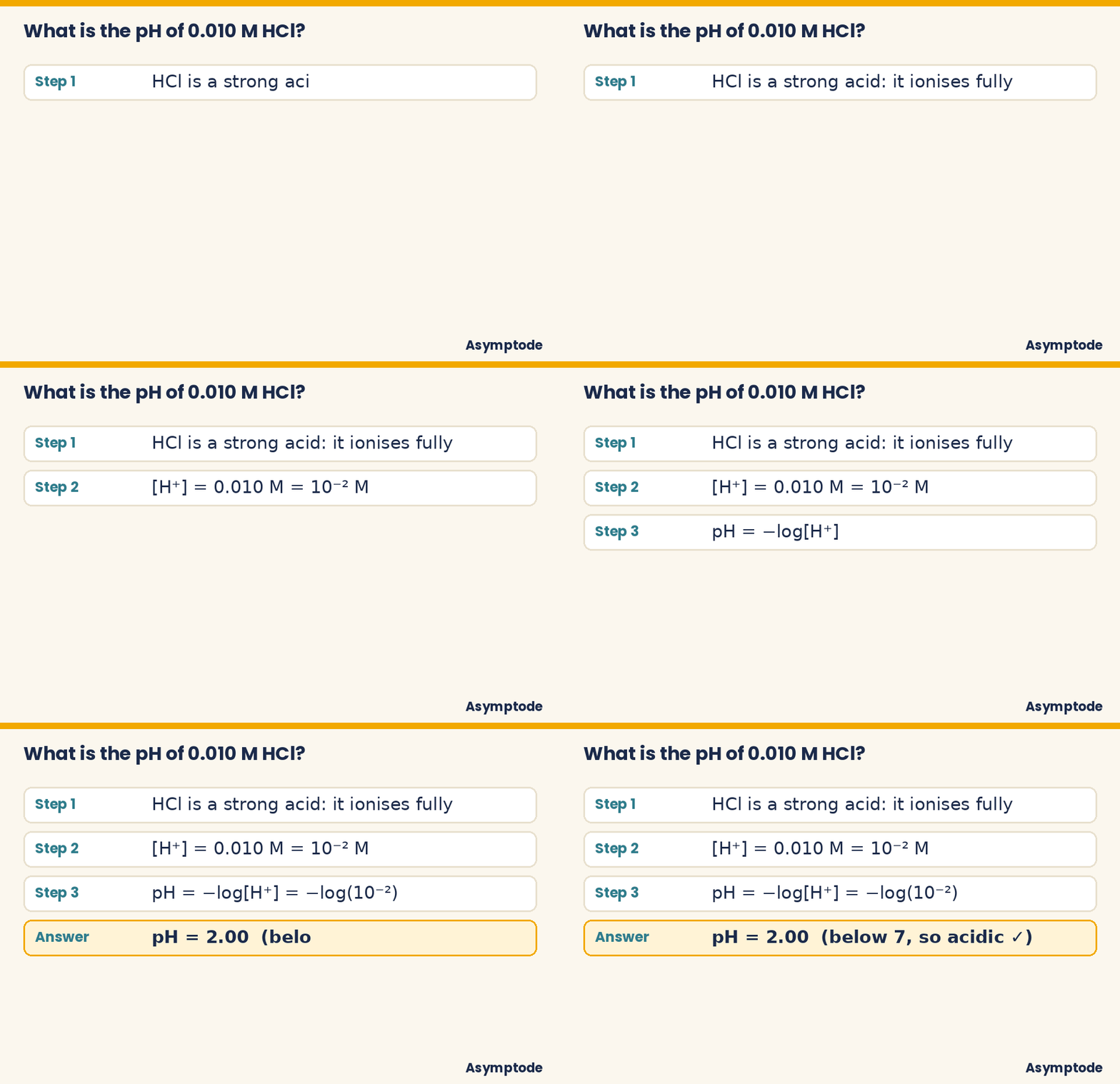
Worked example 3: pH from hydronium concentration (Unit D)
Question: A solution has [H₃O⁺] = 3.2 × 10⁻⁴ mol/L. Find the pH.
- pH = −log[H₃O⁺] = −log(3.2 × 10⁻⁴).
- pH = 3.49.
Tip: pH values get as many decimal places as the concentration has significant figures. Two significant figures in 3.2 means two decimal places in 3.49.
Worked example 4: naming an organic compound (Unit C)
Question: Name CH₃-CH₂-CH₂-OH.
- The longest chain has 3 carbons, so the root is "prop".
- The -OH group makes it an alcohol, so the ending is "-ol".
- The -OH is on carbon 1.
- The name is propan-1-ol (also written 1-propanol).
What are the most common Chemistry 30 mistakes?
- Reading the redox table the wrong way. The strongest oxidizing agent is at the top left. The strongest reducing agent is at the bottom right. Practise finding both fast.
- Mixing up anode and cathode. Remember: oxidation at the anode, reduction at the cathode.
- Sign errors in ΔH. If the surroundings warm up, ΔH for the reaction is negative.
- Treating weak acids like strong acids. Weak acids only partly ionize. Use Ka and an equilibrium set-up.
- NR format slips. Read how each numerical-response answer must be entered.
- Studying only from notes. The exam rewards practice with real diploma-style questions.
How should my child prepare for the Chemistry 30 diploma?
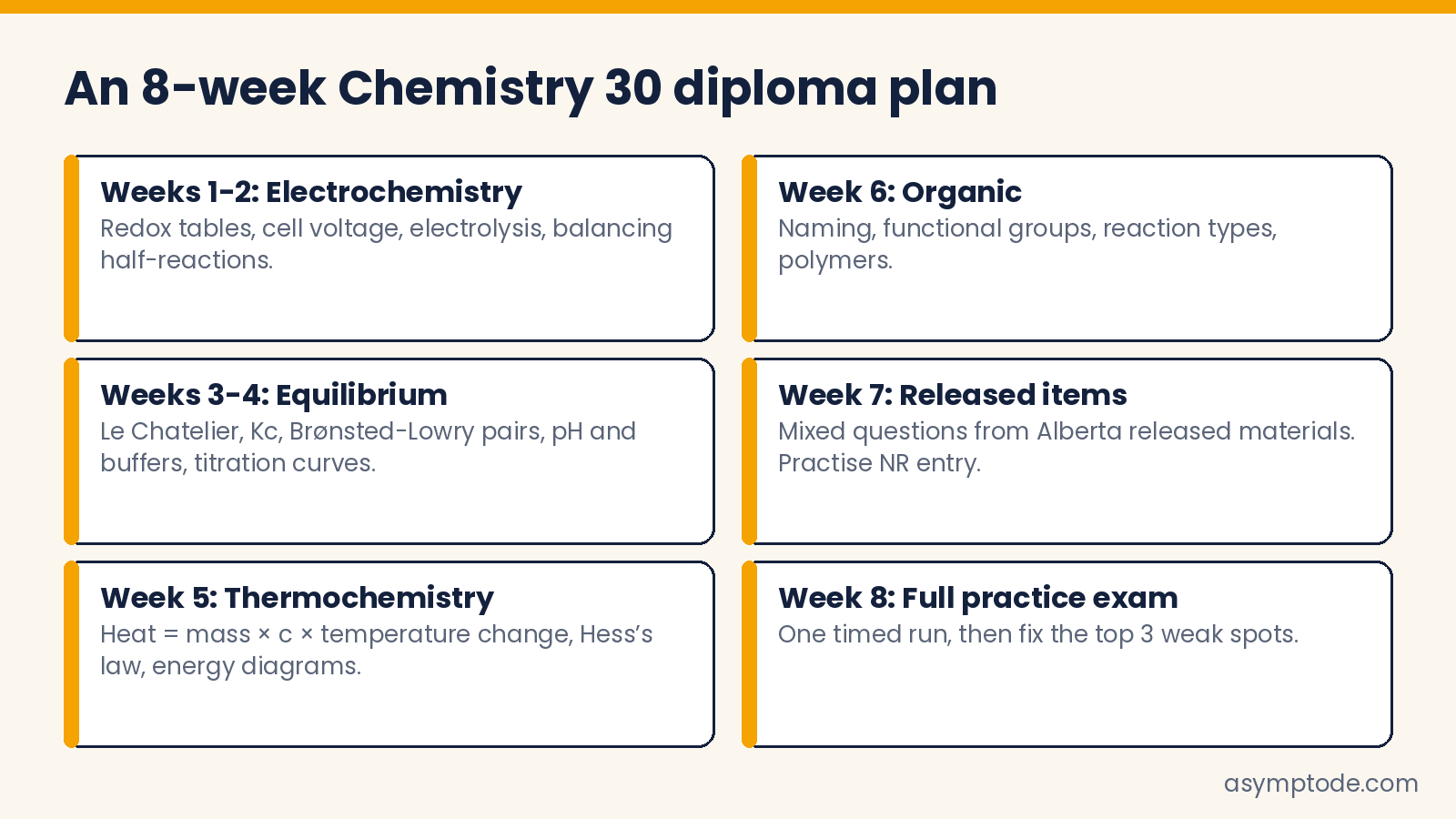
| Weeks | Focus | What to do |
|---|---|---|
| 1-2 | Electrochemistry | Redox table drills, spontaneity, half-reactions, cells and voltage. |
| 3-4 | Equilibrium | Le Chatelier, Kc, conjugate pairs, pH, titration curves, buffers. |
| 5 | Thermochemistry | Calorimetry, Hess's law, energy diagrams. |
| 6 | Organic | Naming, functional groups, reaction types, polymers. |
| 7 | Released questions | Mixed practice from Alberta released materials. Practise NR entry. |
| 8 | Full practice exam | One timed run, then fix the top three weak spots. |
Start with Units B and D, because they carry about 60% of the marks. Use the data booklet in every practice session, so it feels familiar on exam day.
Would you like a plan that fits your child's semester and school mark? Book a free demo class with an Asymptode mentor.
How 1-on-1 tutoring helps with Chemistry 30
Chemistry 30 has many linked ideas. A student who is unsure about redox will also struggle with cells and electrolysis. In 1-on-1 lessons at Asymptode, one dedicated mentor works with one student:
- The mentor follows the Alberta Chemistry 30 program and your child's school order, and plans backwards from the diploma date.
- In live lessons the mentor watches each step, such as how your child reads the redox table, and fixes the method, not just the answer.
- When a topic will not land, the mentor finds the smaller missing piece, such as logs behind pH.
- Homework is set on the topics taught and marked with feedback.
- Every class is recorded, so your child can rewatch any topic before the exam.
- Parents get regular updates on progress and what needs more practice.
Students who enjoy chemistry may also like our AP Chemistry guide, which covers many of the same ideas. Talk to an advisor or see our fees.
FAQ
How much is the Chemistry 30 diploma exam worth?
It is worth 30% of the final Chemistry 30 mark. The school-awarded mark is the other 70%.
How many questions are on the Chemistry 30 diploma exam?
There are 60 questions worth 1 mark each. The paper exam has 44 multiple-choice and 16 numerical-response questions.
How long is the Chemistry 30 diploma exam?
It is designed to take 3 hours. Students may use up to 6 hours in total.
Can you use a calculator and data booklet on the Chemistry 30 exam?
Yes. Students may use one approved scientific or graphing calculator and the Chemistry Data Booklet.
When is the Chemistry 30 diploma exam in 2027?
The 2026-27 sessions are 4 November 2026, 26 January 2027, 14 April 2027, 24 June 2027 and 10 August 2027. Check the start time with your school.
Which units are most important for the Chemistry 30 diploma?
Electrochemical changes and acid-base equilibrium are each about 29-32% of the exam. Together they make up about 60% of the marks.