
The Physics 30 diploma exam is a big step for Alberta Grade 12 students. It counts for 30% of the final course mark and is often needed for university science and engineering programs. This guide explains the 2026–27 dates, the format, the four units, worked examples and a study plan.
Key takeaways
- The Physics 30 diploma exam is worth 30% of the final mark. The school-awarded mark is worth 70%.
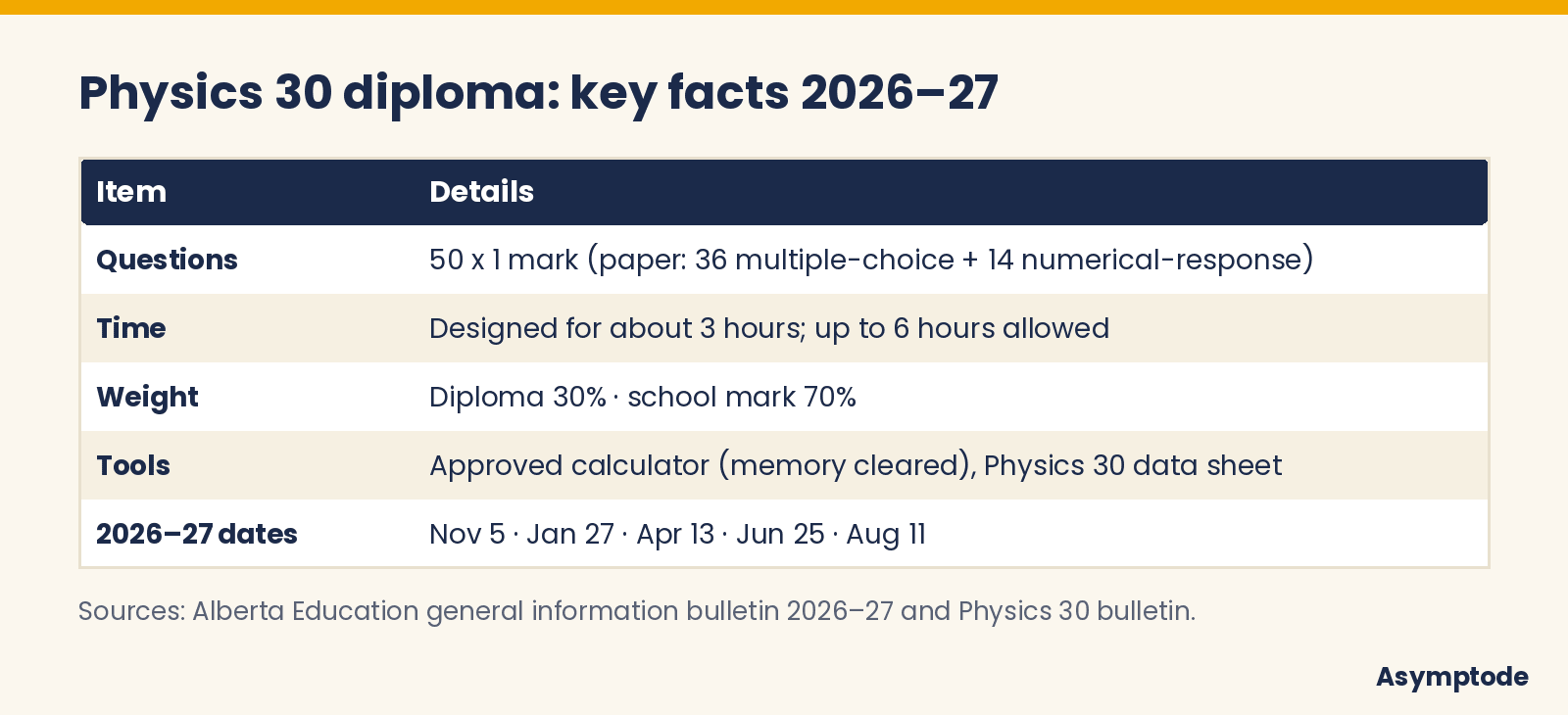
- 2026–27 dates: Nov 5, 2026; Jan 27, 2027; Apr 13, 2027; Jun 25, 2027; Aug 11, 2027 (Alberta Education general information bulletin).
- The exam has 50 questions worth 1 mark each (on paper: 36 multiple-choice and 14 numerical-response).
- It is designed for about 3 hours, and students may use up to 6 hours if they need it.
- Four units: Momentum and Impulse (10–20%), Forces and Fields (25–35%), Electromagnetic Radiation (25–35%) and Atomic Physics (20–30%).
What is the Physics 30 diploma exam?
Quick answer: The Physics 30 diploma exam is a provincial exam set by Alberta Education for students finishing Physics 30. It has 50 one-mark questions covering momentum, forces and fields, electromagnetic radiation and atomic physics. The exam mark is 30% of the final course mark, and the teacher's school mark is the other 70%.
Physics 30 is a common entry requirement for engineering and many science programs at Canadian universities. Because the exam is the same across the province, it is also a fair check of how ready a student is.
If your child also takes Math 30-1, read our Math 30-1 diploma exam guide. The two exams use many of the same skills: algebra, trigonometry and careful use of a calculator.
When are the Physics 30 diploma exams in 2026–27?
| Session | Physics 30 date |
|---|---|
| November 2026 | Thursday, November 5, 2026 |
| January 2027 | Wednesday, January 27, 2027 (9 a.m.–12 p.m.) |
| April 2027 | Tuesday, April 13, 2027 |
| June 2027 | Friday, June 25, 2027 (9 a.m.–12 p.m.) |
| August 2027 | Wednesday, August 11, 2027 |
These dates come from Alberta Education's 2026–27 diploma exam general information bulletin. Check exact start times with your school, because some sessions have both morning and afternoon times.
What is the Physics 30 exam format?
Alberta Education's Physics 30 information bulletin (2025–26) describes the exam like this:
| Feature | Details |
|---|---|
| Questions | 50, each worth 1 mark |
| Paper version | 36 multiple-choice + 14 numerical-response |
| Digital version | 50 questions in several formats |
| Time | Designed for about 3 hours; up to 6 hours allowed |
| Calculator | Approved scientific or graphing calculator, memory cleared |
| Data sheet | Physics 30 data sheet provided |
| Weight | 30% of final mark |
Alberta Education says schools are expected to use the digital assessment platform for all diploma exams. Students should practise on the digital format before exam day.
Numerical-response questions have no options. Students work out a number and enter it, often to a set number of significant digits. Rounding too early is a common way to lose these marks.
The bulletin also asks students to use the three-significant-figure constants on the data sheet, not the constants stored in their calculator.
What units are on the Physics 30 exam?
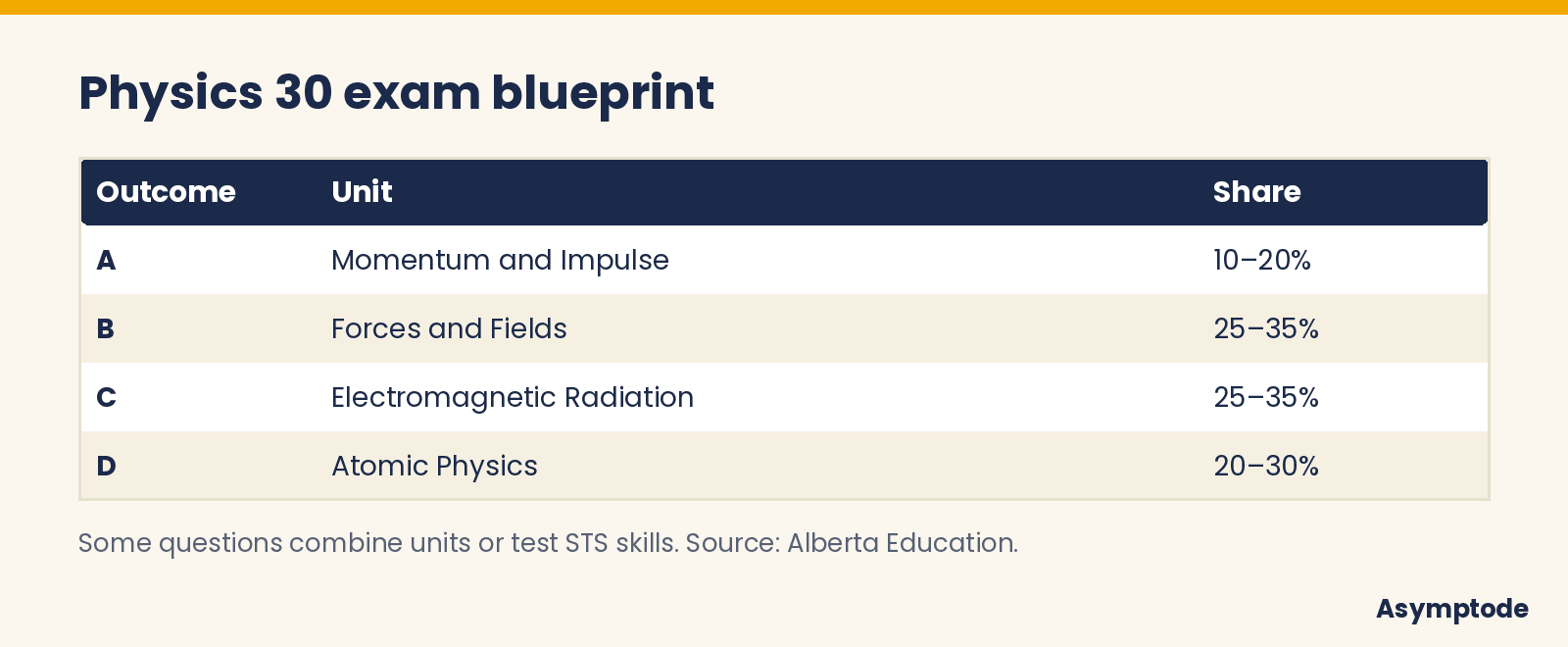
| General outcome | Unit | Share of exam |
|---|---|---|
| A | Momentum and Impulse | 10–20% |
| B | Forces and Fields | 25–35% |
| C | Electromagnetic Radiation | 25–35% |
| D | Atomic Physics | 20–30% |
Some questions combine two units, and some test science, technology and society (STS) skills, such as reading an experiment or judging a claim.
What is in each unit?
- Momentum and Impulse: momentum, impulse, conservation of momentum in one and two dimensions, elastic and inelastic collisions.
- Forces and Fields: electric charge, Coulomb's law, electric fields, magnetic fields, and forces on moving charges and currents.
- Electromagnetic Radiation: the EM spectrum, speed of light, reflection, refraction, diffraction and interference, and the photoelectric effect.
- Atomic Physics: models of the atom, energy levels and spectra, radioactive decay, half-life, and nuclear reactions.
Worked example 1: a collision (momentum)
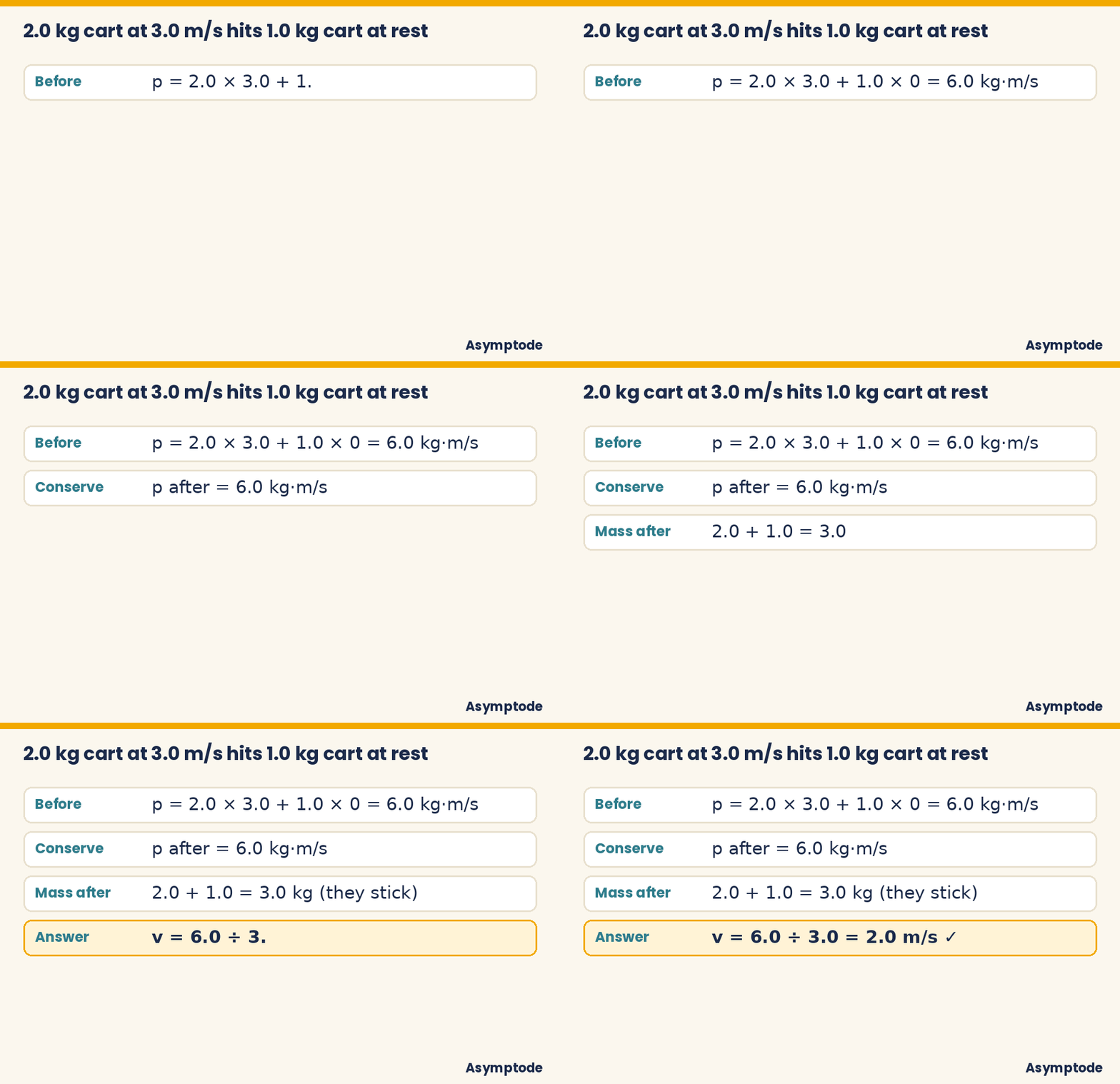
A 2.0 kg cart moving at 3.0 m/s hits a 1.0 kg cart at rest. They stick together. What is their speed after the collision?
- Momentum before = (2.0 × 3.0) + (1.0 × 0) = 6.0 kg·m/s.
- Momentum is conserved, so momentum after = 6.0 kg·m/s.
- Total mass after = 2.0 + 1.0 = 3.0 kg.
- v = 6.0 ÷ 3.0 = 2.0 m/s, in the original direction.
Check: kinetic energy before is 9.0 J and after is 6.0 J. Energy is lost, which fits an inelastic collision. That quick check catches many errors.
Worked example 2: photon energy
What is the energy of a photon with a frequency of 5.00 × 10¹⁴ Hz? Use h = 6.63 × 10⁻³⁴ J·s.
- Equation: E = h f.
- E = (6.63 × 10⁻³⁴) × (5.00 × 10¹⁴).
- E = 3.32 × 10⁻¹⁹ J (to three significant digits).
If a question asks for the answer in electronvolts, divide by 1.60 × 10⁻¹⁹ J/eV: about 2.07 eV.
Worked example 3: Coulomb's law
Two charges of 2.0 × 10⁻⁶ C each are 0.30 m apart. What is the electric force between them? Use k = 8.99 × 10⁹ N·m²/C².
- Equation: F = k q₁ q₂ ÷ r².
- q₁ q₂ = (2.0 × 10⁻⁶)² = 4.0 × 10⁻¹².
- r² = 0.30² = 0.090.
- F = 8.99 × 10⁹ × 4.0 × 10⁻¹² ÷ 0.090 ≈ 0.40 N (repulsive, since both charges are the same sign).
Squaring the distance is the step students most often forget.
What are common Physics 30 mistakes?
- Forgetting direction. Momentum and force are vectors. State the direction.
- Rounding too early. Keep full values in the calculator and round only at the end.
- Not squaring r in Coulomb's law and field questions.
- Mixing up hand rules for magnetic forces. Practise the rule your teacher uses until it is automatic.
- Using calculator constants instead of the data sheet values.
- Misreading numerical-response instructions about significant digits.
How should you study for the Physics 30 diploma? An 8-week plan
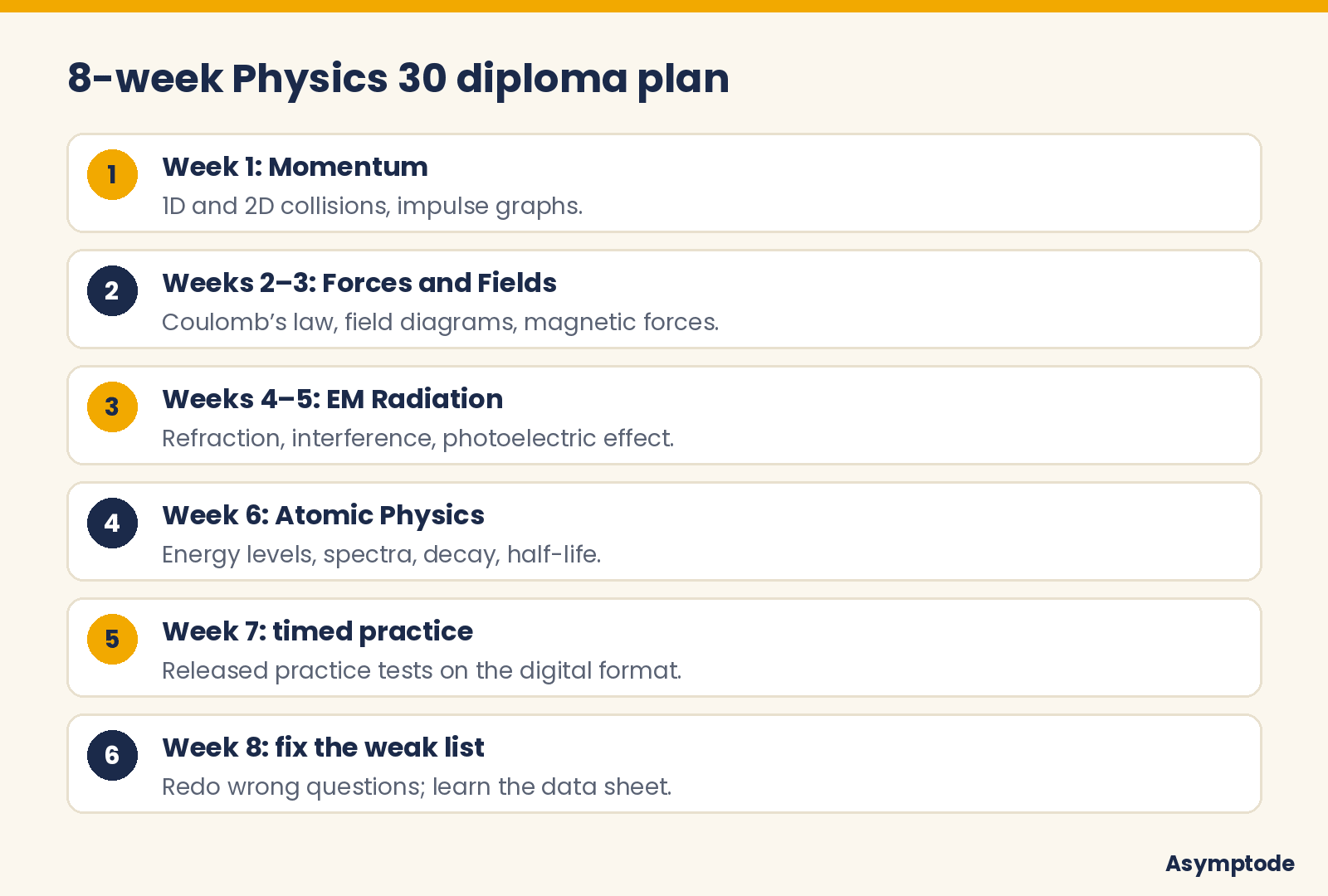
- Week 1: Momentum and Impulse. 1D and 2D collisions, impulse graphs.
- Weeks 2–3: Forces and Fields. Coulomb's law, field diagrams, magnetic forces, motors and generators.
- Weeks 4–5: Electromagnetic Radiation. Wave models, refraction, interference, photoelectric effect.
- Week 6: Atomic Physics. Energy levels, spectra, decay equations, half-life.
- Week 7: full timed practice. Use released practice material on the Alberta Education website and the digital practice tests.
- Week 8: fix the weak list. Redo every wrong question and learn the data sheet layout.
Released Physics 30 practice tests and the data sheet are on the Alberta Education diploma exam pages. Students who like a challenge can also try the CEMC contests: see our Pascal, Cayley and Fermat guide.
Want to know where your child stands before the exam? Book a free demo class with an Asymptode mentor.
How does 1-on-1 tutoring help with Physics 30?
Physics 30 mixes ideas, maths and careful reading. Most lost marks come from small method errors: a missing direction, an early rounding, a hand rule used the wrong way. A one-to-one mentor can see those errors as they happen.
At Asymptode, each student works live online with one dedicated mentor. Lessons follow the Alberta Physics 30 program and your child's school timeline and diploma session.
- A plan to the exam date. A short assessment first, then a plan for the November, January, April or June session.
- Method first. The mentor watches every step and fixes the method, not just the final number.
- Personal homework. Worksheets on the topics just taught, approved by the mentor before your child sees them.
- Recorded classes. Every class is recorded, so your child can rewatch a lesson on fields or the photoelectric effect before the exam.
- Parent updates. Short notes on what improved and what needs practice.
No tutor can promise a mark. One-to-one lessons give focused time on your child's own weak spots, across time zones and at a pace that suits them. See our fees or talk to an advisor.
FAQ
How much is the Physics 30 diploma exam worth?
The diploma exam is worth 30% of the final Physics 30 mark. The school-awarded mark is worth the other 70%.
How long is the Physics 30 diploma exam?
It is designed for about 3 hours. Students may take up to 6 hours if they need the extra time.
How many questions are on the Physics 30 diploma?
There are 50 questions, each worth one mark. On paper, that is 36 multiple-choice and 14 numerical-response questions.
Can you use a calculator on the Physics 30 diploma?
Yes. Students may use an approved scientific or graphing calculator. Its memory must be cleared, and students should use the constants on the data sheet.
When is the next Physics 30 diploma exam?
In 2026–27 the sessions are November 5, January 27, April 13, June 25 and August 11. Check the start time with your school.
Can students rewrite the Physics 30 diploma?
Yes. Students can rewrite in a later session. Check the current Alberta Education rules on rewriting before you register.