

You want your child to understand math and science, not just survive a test. You want a foundation that lasts well beyond one Saturday morning in a exam room. But the pressure around the ACT pulls everyone toward scores and quick fixes, and it's easy to worry that your child is collecting tricks instead of understanding the ideas underneath.
An ACT practice test can work against that pressure. Used as a diagnostic rather than just a drill, it shows you how your child is thinking, and that is where real improvement starts.
What a Score Report Can't Tell You
A typical ACT practice test report says something like "weak in algebra" or "weak in data interpretation." That's accurate, but it isn't useful. It doesn't say whether your child doesn't know the formulas, misread the question, or has a shaky grasp of something much earlier, like fractions or proportional reasoning.
At Asymptode, we treat a practice test as evidence about a student's thinking, not just a score. The question we care about isn't "Which topics did they miss?" It's "What does their pattern of mistakes tell us about how they're thinking?"
How We Diagnose a Practice Test
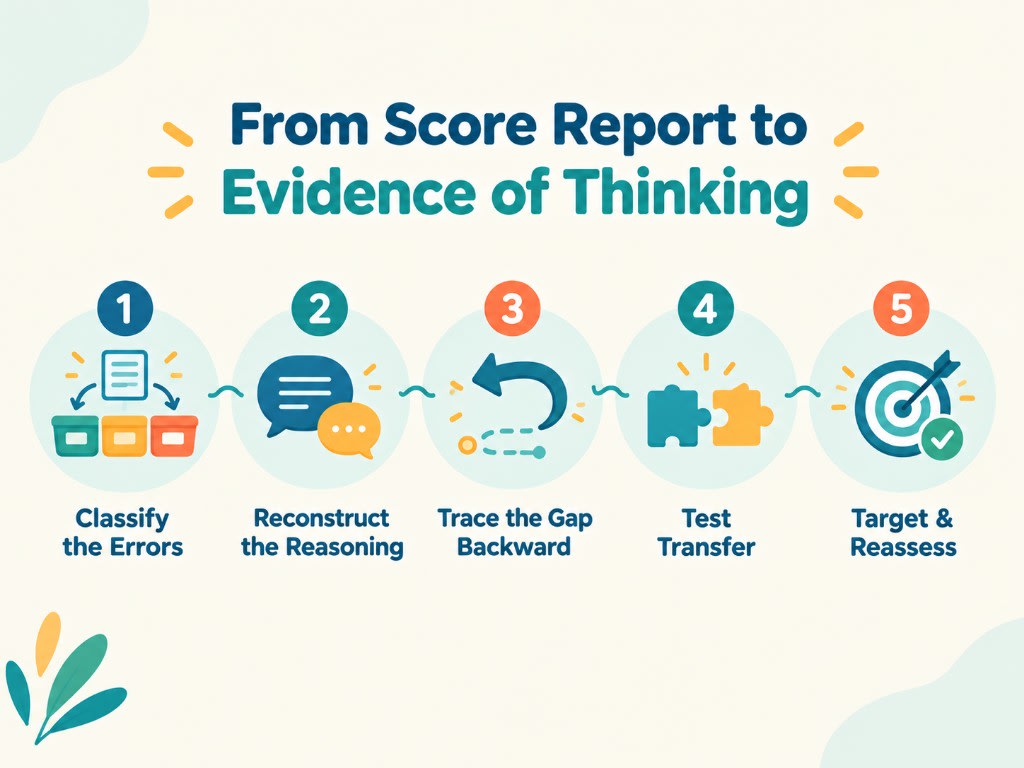
- Classify the errors. Was it a conceptual misunderstanding, a procedural slip, a misread question, careless execution, or a timing problem? Each one needs a different fix.
- Reconstruct the reasoning. We ask the student to talk us through what they noticed, what they were trying to find, and why they chose their approach. Their explanation shows their mental model.
- Trace the gap backward. If a student struggles with a current algebra problem, we check whether the real issue is further back, in fractions, negative numbers, or what an equation actually says.
- Test transfer. We give a similar problem with different numbers, wording or context. If they only succeed when the question looks familiar, that's pattern recognition, not mastery.
- Target and reassess. We teach the specific missing concept, practise it deliberately, then bring back an unfamiliar version to see whether the thinking has really changed.
Case Study 1: The "Careless" Percent Errors (Math)
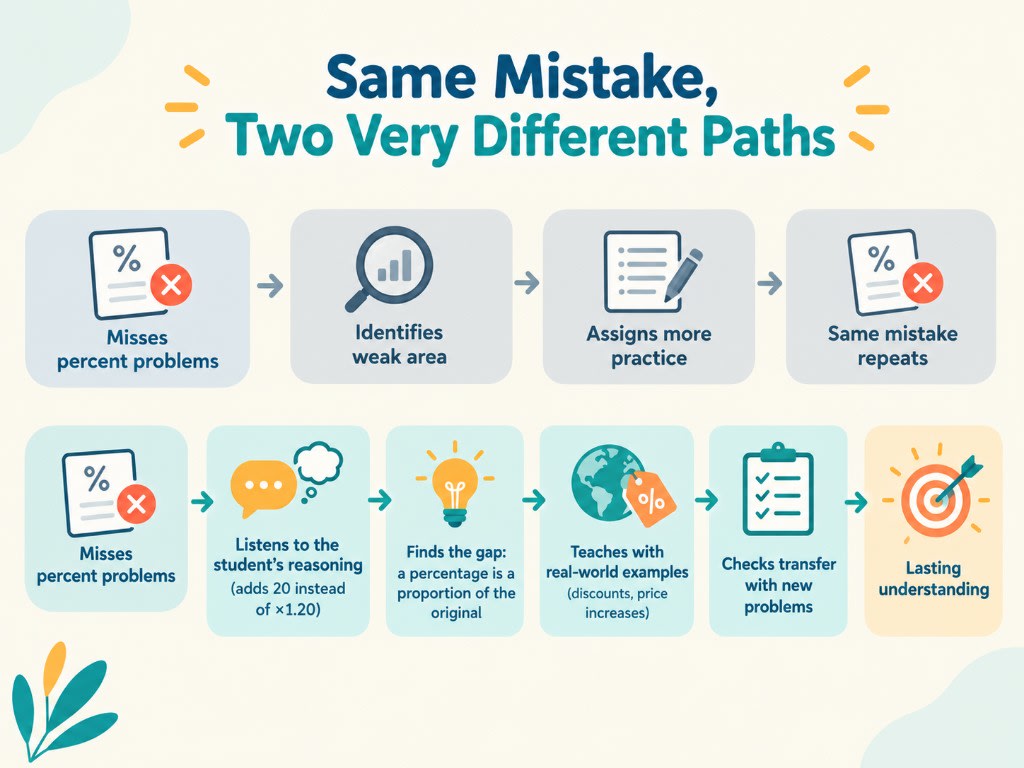
One ACT Math student kept missing percent change and ratio questions. The errors looked like careless arithmetic, and more practice questions would have been the obvious next step.
When we asked the student to explain their reasoning, the pattern was clear. They treated a 20% increase as "add 20" rather than "multiply by 1.20." They could follow the procedure once it was shown to them, but they didn't understand that a percentage is a proportion of the original quantity.
So we stepped away from ACT questions. We used everyday examples like discounts and price increases, and had the student predict whether the answer should be larger or smaller before calculating. Only then did we return to ACT questions, with new wording and new numbers.
The student didn't need more questions first. They needed a better mental model.
Case Study 2: The Graph Reader (Science)
ACT Science often looks like a reading-speed problem, but the cause is often different. One student kept missing graph questions even though they could read every value on the page.
Asking them to explain their answers showed the issue: they were locating the nearest data point instead of reading what the question asked about, which was the relationship between two variables. They also skipped the axis units. The trouble wasn't science knowledge. It was that they hadn't learned to ask, "What is this graph claiming, and what changes as what changes?"
We practised that question on simple, familiar graphs, then moved to unfamiliar experiments. The timing problem eased once the student knew what to look for.
Why Generic Prep Falls Short
Many parents tell us the same story: their child was in a group class, got lost, couldn't get their specific questions answered, and still struggles with the core concepts. A group class can tell a student that percent problems or graphs are weak spots. It can't watch this student's reasoning and see exactly where it goes wrong.
That is the advantage of 1:1 tutoring. A tutor can spot why this particular student is making the mistake, address the underlying concept, and check immediately whether the understanding carries over to a new problem.
What You Can Try Tonight
You don't need to be a math or science expert to start diagnosing at home.
- Pick three missed questions from a practice test, ideally ones that seem to be different topics.
- Ask your child to explain, out loud, how they approached each one. Don't correct them yet. Just listen for where the explanation gets vague or goes off track.
- Change the numbers or the context and ask them to try a similar question. If they struggle only when it looks different, they've probably memorized a pattern rather than learned the concept.
- Look for what repeats. Three different topics with the same underlying habit, like rushing past units or skipping the "should this be bigger or smaller?" check, point to something deeper than topic gaps.
If the explanations keep breaking down in the same place, that's the clearest sign a targeted conversation will help more than another full-length test.
From Diagnosis to a Personalized Plan
What we learn from a practice test shapes a 1:1 plan built around your child:
- Customized curriculum. Lessons focus on the specific concepts they need, at their pace.
- Deep conceptual work. Varied examples help them understand the "why" behind the math and science, not just the "how."
- Immediate feedback. A tutor sees misunderstandings as they happen and adjusts on the spot.
- Transferable skills. The goal is for your child to apply ideas in unfamiliar situations, which is what real mastery looks like and what builds confidence beyond the ACT.
Short-term practice raises a number. A true diagnosis builds durable skill, and that improves both test scores and everyday school performance.
Key Takeaways
- An ACT practice test shows how your child thinks, not just what they got wrong.
- Root causes matter. Conceptual gaps are often hiding behind "careless" mistakes and "weak topics."
- You can start at home by asking your child to explain their reasoning and testing it on a new version of the problem.
- 1:1 tutoring turns diagnosis into a plan that builds understanding that lasts.
If you're ready to move past temporary score boosts, explore how Asymptode's personalized 1:1 online tutoring can change your child's ACT prep. Visit asymptode.com to schedule a diagnostic consultation.