

When a child has math anxiety, it often shows up in small ways before they say it directly. They may avoid starting a problem, say "I'm bad at math," rush through questions, repeatedly ask for reassurance, or become quiet and frustrated when they make a mistake.
The first step is not to start teaching immediately. Our tutors first try to understand the child — what they enjoy, what they already feel comfortable with, and what has made Maths difficult for them in the past. We create a judgment-free environment where mistakes are treated as a normal part of learning.
We start with questions the student can succeed at, so they experience early wins and begin to trust the tutor. Then we gradually introduce more challenging problems, giving the student enough support to succeed without solving everything for them. The goal in those first sessions is to change the child's mindset from "I'm going to get this wrong" to "It's okay not to know — I can work it out." Once that psychological safety is established, deeper learning becomes much easier.
Guided Discovery: Letting the Student Find the Answer
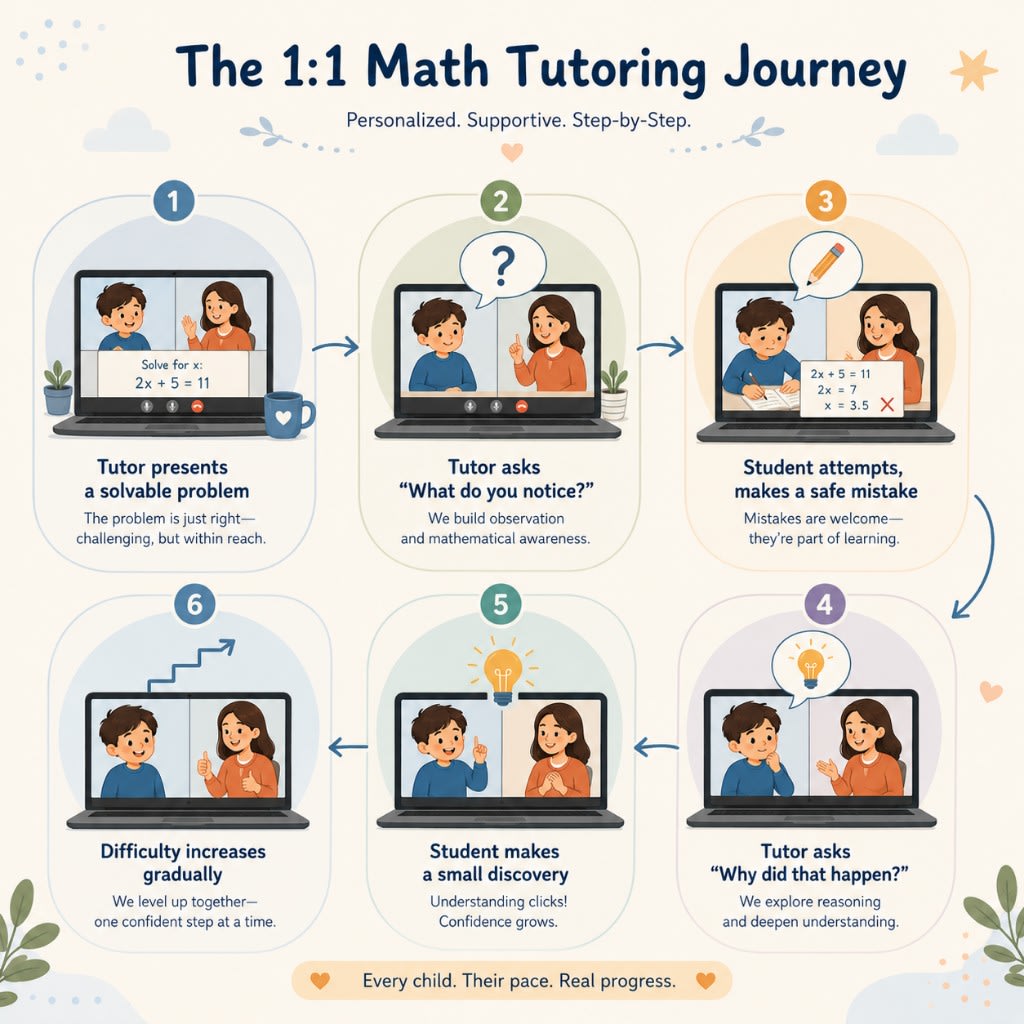
One strategy we use is "guided discovery" — instead of explaining a problem and giving the answer, the tutor lets the student work their way toward the answer through carefully chosen questions.
For example, if a child is afraid of algebra, we might start with a simple problem they can solve and then gradually change one element at a time. The tutor asks, "What do you notice?" "What do you think will happen?" and "Why?" rather than immediately correcting them.
The advantage of 1:1 is that the tutor can adjust the difficulty in real time. If the student is struggling, we simplify; if they are confident, we stretch them. The student gets enough support to experience success without feeling that the tutor solved it for them. Each small discovery becomes evidence to the child that "I can figure this out." Over time, that replaces fear with curiosity and turns problem-solving into something they actively want to engage with.
A Real Transformation
One student came to Asymptode with significant math anxiety. They would often say, "I'm not good at Maths," avoid difficult questions, and look for confirmation after almost every step. Even when they knew how to solve something, they were afraid of making a mistake.
We started by rebuilding the student's confidence rather than rushing through the syllabus. The tutor used guided discovery, beginning with problems where the student could experience small successes and then gradually increasing the difficulty. We also encouraged the student to explain their thinking, treated mistakes as useful information, and connected abstract ideas to simple visual and real-life examples.
Because it was 1:1, the tutor could adjust the pace immediately — slowing down when the student felt overwhelmed and stretching them when they were ready for more. Over time, the change became very noticeable. The student started attempting questions without waiting for reassurance, began asking "What if...?" questions, and became comfortable explaining their reasoning — even when they weren't completely sure.
The biggest "before and after" wasn't simply a higher score. It was seeing a student who once avoided Maths begin to enjoy the challenge of figuring something out. For us, that's the real transformation: when Maths stops feeling like something the child is afraid of getting wrong and starts feeling like a puzzle they are excited to solve.
The Counter-Intuitive Strategy: Quality Over Quantity
A common belief is that if a child is struggling with Maths, they simply need more practice. But sometimes giving them another 20 questions only reinforces the same misunderstanding and makes them feel even less capable.
One counter-intuitive strategy we use is to slow down and do less. Instead of solving many problems, we may spend significant time on just one problem — asking the student to explain what they understand, predict what might happen, try different approaches, and even make mistakes safely. The tutor then uses those mistakes to identify the exact gap and rebuild the concept before adding more practice.
Psychologically, this gives the child small experiences of success and control, which reduces the fear of getting things wrong. Educationally, it builds understanding that transfers to new problems rather than memorised procedures. Over time, the student starts thinking, "I can figure this out," instead of "I need more questions."
So sometimes the fastest way to build mathematical confidence is not more practice — it is better thinking, with the right amount of practice afterward.
Key Takeaways for Parents
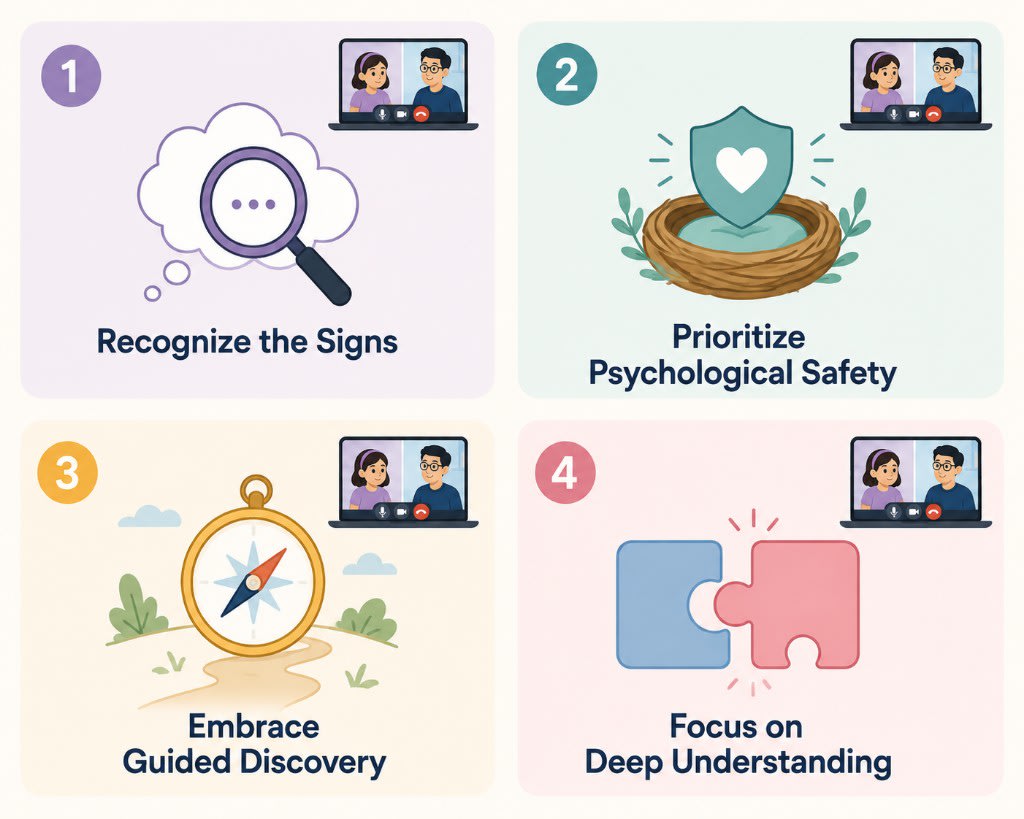
- Recognize the signs. Avoidance, rushing, and constant reassurance-seeking are usually signs of anxiety, not laziness or a lack of ability.
- Prioritize psychological safety first. A child who feels judged won't take the risks needed to learn. Safety comes before syllabus.
- Embrace guided discovery. Let your child arrive at answers through questions rather than being told — it builds real confidence, not just correct answers.
- Choose depth over volume. A single problem explored deeply can do more for confidence than a worksheet of twenty rushed ones.
Overcoming math anxiety takes patience and the right approach — not just more worksheets. At Asymptode, our 1:1 online math and science tutoring is built around exactly this: understanding each child individually, building safety first, and using strategies like guided discovery to turn fear into curiosity.
Is your child ready to move from math anxiety to confidence? Explore how Asymptode's expert tutors can help. Visit asymptode.com to learn more about our personalized 1:1 tutoring programs.