

You want your child to succeed on the SAT but if you've already tried group classes or generic prep courses, you may have run into a frustrating pattern: they're putting in the hours, but not actually getting more confident. It can feel like effort without progress, and it's one of the more disheartening things to watch as a parent.
At Asymptode, we think that gap has a specific cause, and a specific fix. Real SAT success doesn't come from more practice questions it comes from a personalized approach that builds lasting competence, not just familiarity.
The Hidden Signs Generic Prep Is Failing
The clearest sign that one-size-fits-all prep isn't working is a student doing more work without becoming more confident. They attend every class, complete every practice test and keep making the same kinds of mistakes. They start asking "which formula do I use?" or waiting for someone to show them the first step, instead of understanding why their own approach didn't work.
A second red flag: strong performance on familiar question formats, but anxiety or a freeze-up the moment the wording changes. In a group class, a teacher might notice a wrong answer, but rarely has time to understand why that particular student chose it. Over time, that gap in attention turns into a damaging internal story "everyone else understands this except me" when the real issue is usually a specific foundational gap, or a mismatch between how the material was taught and how that student actually learns.
This is exactly where 1:1 tutoring earns its keep. We trace repeated errors back to their root cause, address the actual gap, and gradually pull back support. The goal isn't more SAT practice for its own sake it's helping a student understand their mistakes well enough that confidence starts coming from real competence, not reassurance.
From Frustration to "Aha!": A Personalized Problem-Solving Routine
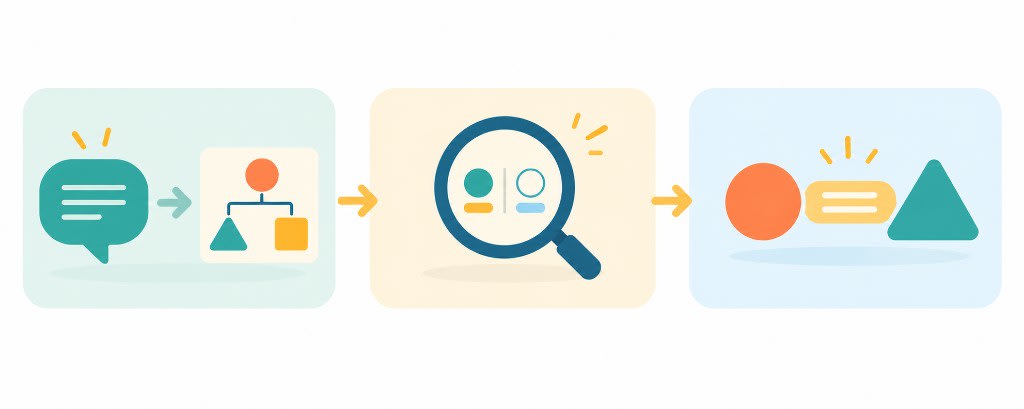
Here's a representative example. A student was doing plenty of SAT practice but kept getting stuck on algebra word problems. He could follow a worked solution afterward, but during the actual test, he often didn't know where to start and over time, that turned into a belief that he was simply "bad at SAT math."
In 1:1 sessions, the tutor stopped counting questions completed and diagnosed the real issue: the student was trying to identify a formula before he'd actually understood what the problem was describing. The fix was a simple routine translate the words into a situation or diagram, identify what's known and unknown, then decide what mathematical relationship connects them. He practiced this across different question formats, with prompts gradually withdrawn as he gained proficiency.
The breakthrough came when he hit an unfamiliar-looking problem and said, "I know what this is asking me to find I just need to set it up." The score improvement was welcome, but the real shift was bigger: he stopped seeing unfamiliar questions as something to fear, and started seeing them as something to unpack and solve.
Beyond the Diagnostic: What to Actually Watch For

A diagnostic test gives you data, but it rarely captures the full picture. We encourage parents to watch how their child behaves when a question changes shape. Does your child know the content but freeze at unfamiliar wording? Do they ask which formula to use every time, or only get a problem right after seeing an example first? These patterns often point to a conceptual gap or a dependence on memorized steps something a diagnostic alone won't reveal.
Emotional signals matter just as much: avoiding practice, rushing through questions, constantly seeking reassurance, unusual frustration after a mistake, or "I know this, but I don't know how to start." It's also worth noticing whether your child can explain why an answer is correct in their own words that's the real test of understanding versus memorization.
One useful question to ask yourself: what happens between seeing the question and getting the answer? That's usually where the actual problem lives whether it's more practice, a different explanation, stronger foundations, better test strategy, or a confidence issue that has nothing to do with math at all.
Building Lasting Understanding, Not Just a Quick Score
Plenty of prep programs lean on shortcuts and test-taking tricks. Those can help but a student who only knows shortcuts is fragile the moment the numbers, wording, or context shift. Conceptual mastery works differently: the student understands why a method works, when it applies, and how to adapt it to something they haven't seen before.
That's the deeper payoff. The same habits interpreting information, identifying relationships, testing an approach, checking whether an answer makes sense carry straight into later math, science, and any analytical subject that comes next. The SAT becomes a milestone along the way, not the finish line. The real goal is a student who leaves prep with stronger thinking skills than they walked in with.
The Bottom Line
Generic prep tends to produce more effort without more confidence. Personalized 1:1 tutoring closes the actual gap tracing mistakes to their root cause, building real understanding, and leaving your child with reasoning skills that outlast the test itself.
Ready to see your child build real, lasting confidence? Book a free consultation with Asymptode.