

As a parent, you want your child to succeed in school, especially in foundational subjects like math and science. When you see them struggling, it's natural to look for solutions. Many parents turn to online courses, hoping that readily available content and practice will help their child catch up. But often, the frustration continues, leaving both you and your child feeling more lost than before.
This isn't a reflection of your child's intelligence or effort. It's often because generic online courses, while excellent for some learners, consistently fall short for K-12 students who are truly struggling with core concepts. They simply aren't designed to provide the personalized support these children need.
Why Generic Online Courses Fall Short for K-12 Struggling Learners
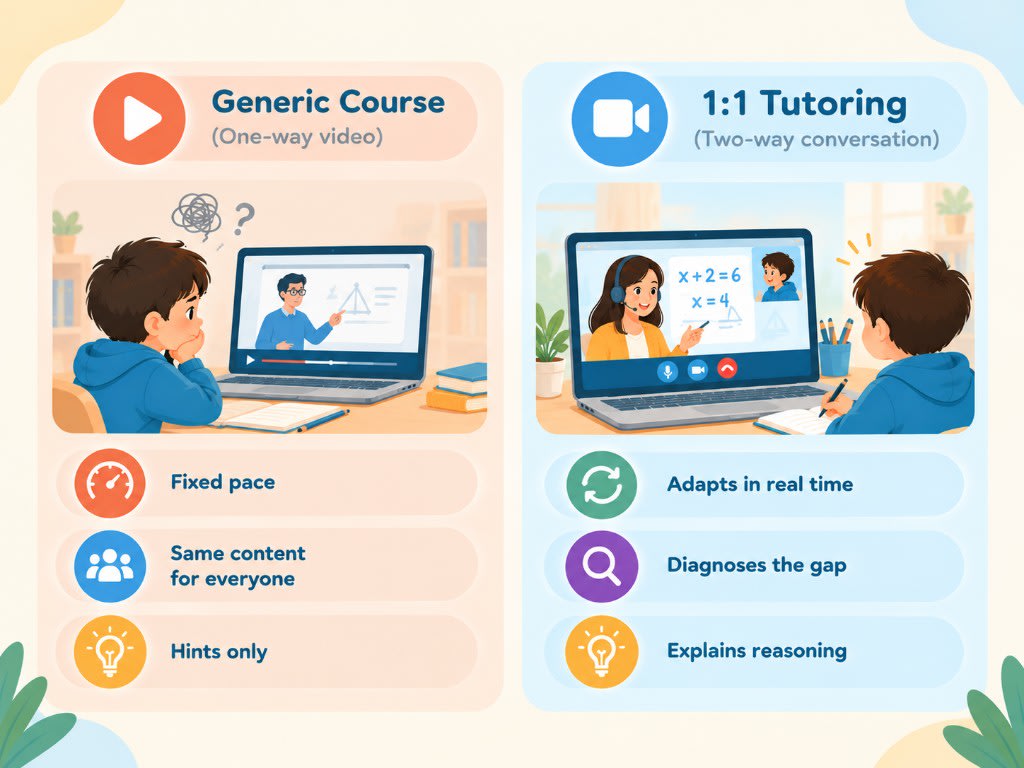
Generic online courses often operate on a flawed assumption: that if the content is available, the student will automatically learn it. For a struggling K-12 student, that assumption can actually make things worse. Your child might watch a lesson on fractions, get the next set of questions wrong because they never fully grasped equivalent fractions and then simply be given more practice on the same gap, deepening confusion and frustration.
Another significant problem is fixed pacing. If your child needs to go back two years to rebuild a missing concept, a broad online course keeps moving forward regardless leaving them increasingly lost and overwhelmed. It might offer hints, or even the correct answer, but it rarely diagnoses why your child chose the wrong approach in the first place.
This is a stark contrast to many adult-oriented platforms, like Coursera, where learners are generally expected to manage their own pace, identify their own learning needs, and proactively seek help when necessary. That model works for a self-directed adult. It doesn't work for a struggling child. For them, the missing ingredient isn't more content it's someone who can notice the gap, understand how the child is thinking, and adapt the teaching accordingly.
The Missing Pieces: Why Standardized Content Isn't Enough for Remedial Support
The biggest thing missing from a pre-recorded or standardized online course is the ability to respond to an individual child in the moment. A course can deliver the same lesson and practice to everyone, but it cannot reliably see why a child is confused, whether they have a hidden foundational gap, or when they're losing confidence. That lack of immediate, personalized interaction is critical.
This is where 1:1 tutoring changes the game. A dedicated tutor can:
- Change the pace immediately speed up when a concept clicks, slow down when it doesn't.
- Ask probing questions uncover the root of confusion, not just the symptom.
- Switch teaching models move from a formula to a visual explanation, or a hands-on activity.
- Revisit prerequisites go back to foundational concepts without disrupting the main flow.
- Give feedback on reasoning help the child understand why an answer is right or wrong, not just what it is.
If one explanation doesn't work, another can be tried instantly. Engagement also becomes active rather than passive the student predicts, explains, draws, solves, and even teaches the idea back to the tutor, instead of just watching content go by. For remedial learning, personalization isn't an added feature it's the mechanism that makes learning possible at all.
Beyond Misconceptions: The Fundamentally Different Path of 1:1 Tutoring
Parents often feel real frustration when their child isn't making progress despite trying various online learning solutions and that frustration usually traces back to a couple of common misconceptions.
One is the belief that more content, more practice, or more screen time will automatically create progress. You might think, "My child completed the lessons, so they should understand the topic" but a generic course can't always identify the foundational gap or misconception actually preventing progress.
The other is assuming an "adaptive" platform automatically personalizes everything. In reality, many systems only adapt the next question presented not the way the child needs to be taught. They might flag a weak area but lack the human judgment to explain it differently or address the emotional barriers underneath it.
With 1:1 tutoring, the tutor can observe the child's actual reasoning, diagnose the real problem, change the explanation, slow down or accelerate, and revisit missing foundations immediately. Just as important, the child receives continuous human feedback and encouragement invaluable when repeated failure has already chipped away at their confidence. So if you're frustrated, that makes sense: your child may not need another course. They may need someone to understand why the current approach isn't working, and change it.
The Breakthrough Moment: When Understanding Replaces "I'm Not Good at Math"
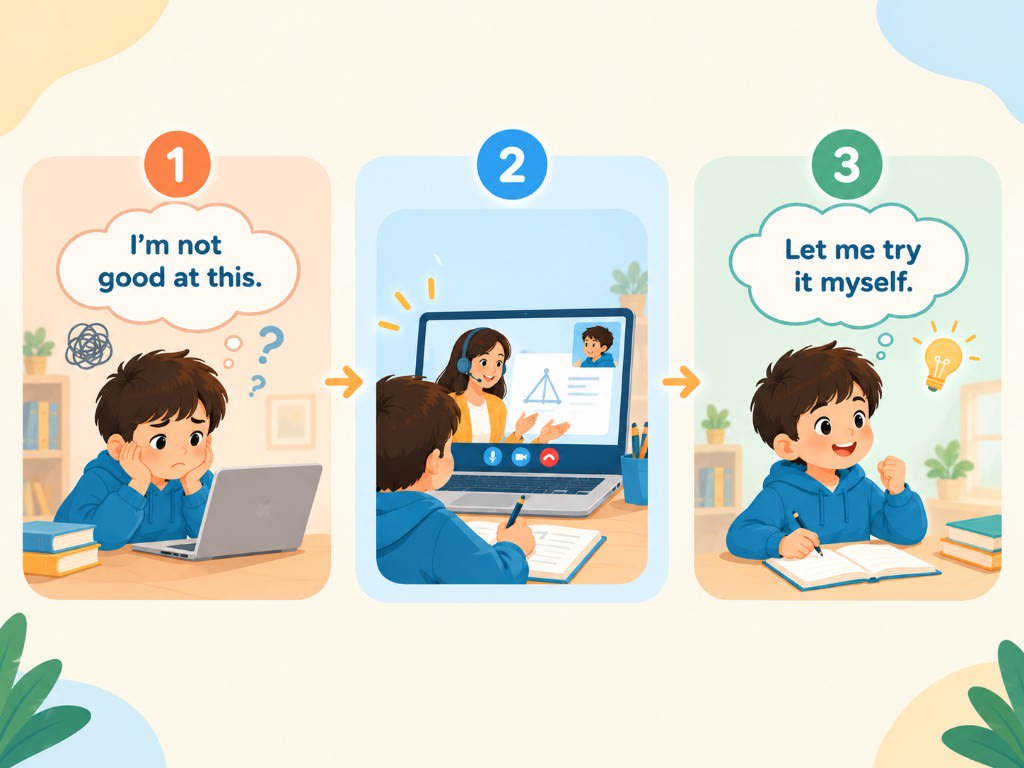
Consider a student who could complete lessons in a generic online math course but consistently struggled the moment questions changed even slightly. This student had started to internalize a hard belief: "I'm just not good at math." That's a common and heartbreaking outcome of impersonal learning environments.
In 1:1 tutoring, the key difference wasn't more practice it was diagnosis. The tutor didn't just push more problems; they took the time to discover the student was following procedures without truly understanding the concept underneath. The tutor slowed down, rebuilt that foundation with visual explanations, and gradually removed the support as the student's confidence grew.
The breakthrough came when the student faced a new problem and, instead of asking for the next step, said, "Let me try it myself." That shift in attitude was the real outcome from waiting for answers to believing they could figure things out.
Key Takeaways
Generic online courses, while accessible, often miss the mark for K-12 students struggling with core subjects. Their fixed pacing, lack of personalized feedback, and inability to diagnose individual learning gaps can leave children feeling more frustrated and further behind. Personalized 1:1 tutoring offers something fundamentally different a dynamic, responsive, empathetic environment where a tutor adapts to your child's unique needs, rebuilds foundational understanding, and fosters genuine confidence. It's about the right support, at the right pace, in the right way.
Ready to see your child thrive in math and science? Explore how Asymptode's personalized 1:1 online tutoring can make a real difference for your child. Visit asymptode.com to learn more.