

You want your child to do well in math and science. You want them to understand the material, build a strong foundation, and feel confident. But what if their current success rests on memorization rather than comprehension?
If you've ever watched your child finish homework quickly, then freeze on a test question that "looks different," you're not alone. Many parents have this fear, and it's a reasonable one. Diligent, hardworking children can end up learning tricks instead of concepts. This guide explains the difference between memorization and understanding, how to spot the signs at home, and how 1:1 tutoring can help.
The Clearest Sign: When the Question Changes
The clearest sign of memorization is that a child can solve a familiar question but gets stuck as soon as the numbers, wording, or situation changes. They may remember a formula or method, but struggle to explain why it works or which approach to choose.
Here is a simple test to try at home:
"If I change the question slightly, can your child still explain the idea and work it out?"
With true understanding, a child can:
- Explain the concept in their own words
- Apply it in a new situation
- Spot and correct their own mistakes
That is the difference between remembering an answer and knowing how to figure things out.
What It Looks Like in Math and Science
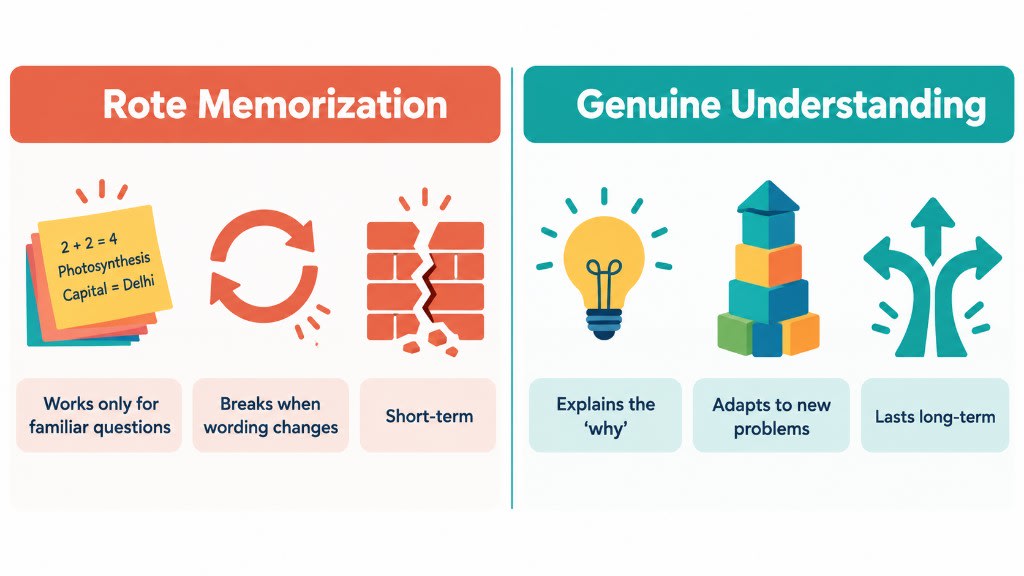
In math: A student learns "to divide fractions, flip the second one and multiply." They get every worksheet question right. But ask them why flipping works, or how many quarter-cup scoops fit into 3 cups, and they're stuck. The rule is memorized, but the idea of division as "how many groups fit?" never formed.
In physics: A student memorizes the equations of motion but freezes when a problem is framed differently from the textbook examples. They scan the question for keywords, guess which formula might match, and hope for the best.
In chemistry or biology: A student can recite definitions and reaction steps, yet can't predict what happens when one condition in an experiment changes.
In each case, the child isn't lazy or "bad at" the subject. They've been working hard on the wrong kind of learning.
The "Aha!" Moment: A Physics Example
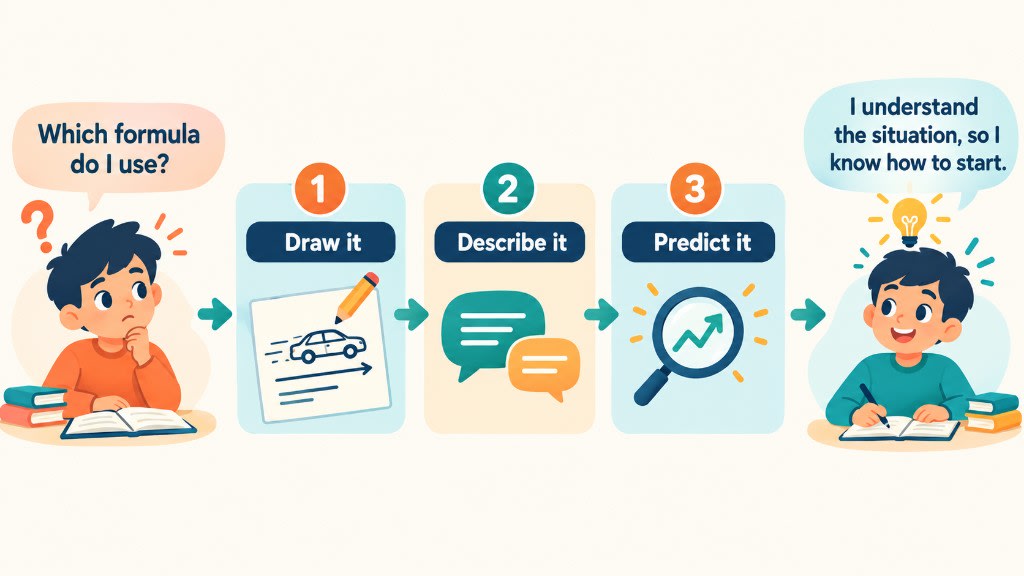
Consider a physics student who had memorized formulas for motion but froze whenever a question looked different from the textbook examples.
Instead of handing over another formula, we asked the student to:
- Draw the situation
- Describe in their own words what was physically happening
- Predict what should change, before writing any equation
The "aha!" moment came when the student said, "Let me draw it first and see what is happening." From then on, they chose formulas based on the physical situation instead of trying to remember which formula matched the question.
The real transformation was from "Which formula do I use?" to "I understand the situation, so I know how to start."
Good Grades vs. Deep Understanding
Many parents assume that a right answer means the child understands the concept. It's a natural assumption, but it can hide gaps. A student can score well by memorizing formulas, following a familiar procedure, or using a shortcut, and still struggle when a question is presented differently or when asked to explain why a method works.
This is where 1:1 tutoring helps. In a personalized session, a tutor can see the thinking behind the answer by asking the student to explain, predict, draw, and solve an unfamiliar variation. This quickly shows whether the child understands or is just following a pattern. The tutor can then adapt the teaching to fix the underlying gap, so success becomes independent understanding, not just correct answers.
How Parents Can Encourage Understanding at Home
You don't need to be a math or science expert. Try these questions during homework:
- "Can you explain that to me like I'm new to it?" If they can teach it, they know it.
- "What would happen if we changed this number?" Predicting outcomes builds reasoning.
- "Can you draw what's happening?" Diagrams reveal whether a concept is clear.
- "Why did you choose that method?" This shifts focus from steps to strategy.
- "Where do you think you went wrong?" Finding their own mistakes builds independence.
- Ask for a variation. Make up a similar question with different numbers or context and see how they respond.
Praise the thinking, not just the answer. "I like how you worked that out" encourages the "figure it out" habit better than "Great, you got it right."
The Lasting Impact: Confidence, Reasoning, and a "Figure It Out" Mindset
The change from memorizing to understanding often matters more than marks. Students become more confident, more willing to attempt difficult problems, better at asking questions, and more comfortable learning from mistakes. When they truly understand a concept, they can carry it into new topics instead of starting from zero each time.
If you've wondered, "Will my child always struggle with math or science?", that worry is completely understandable. The encouraging part is that a child who learns how to reason, solve unfamiliar problems, and recover from mistakes is building a skill that stays with them. The real long-term outcome is not just a better score today, but a student who believes:
"I may not know the answer yet, but I know how to figure it out."
How Asymptode Fosters Genuine Learning
At Asymptode, our 1:1 online math and science tutoring is built to develop this kind of understanding. We don't just teach to the test. Our mentors:
- Uncover the real gaps by asking students to explain, draw, and predict
- Adapt explanations to each child's learning style
- Set a personalized pace, so no concept is rushed and no student is left behind
- Encourage critical thinking so students can handle problems they've never seen
Every child deserves to feel capable in math and science. By moving beyond rote memorization, students can catch up, get ahead, and build a love of learning that lasts.
Ready to see your child genuinely understand math and science? Explore our personalized tutoring programs at asymptode.com.
Key Takeaways
- Memorization is short-term. It works for familiar problems but breaks down when questions change.
- Understanding is adaptable. Children can explain concepts, apply them to new situations, and solve unfamiliar problems.
- Good grades can be misleading. They don't always reflect deep comprehension.
- 1:1 tutoring reveals and fixes gaps. Personalized attention uncovers underlying misunderstandings.
- Understanding lasts. It builds confidence, reasoning, and the ability to figure things out.