

You've probably searched "how do I know if a tutor is actually good?" more than once. It's the question that sits underneath every tutoring decision a parent makes not "does this person know the subject," but "will this person actually help my child improve, and how would I even tell?"
Subject knowledge is the price of entry. It's not what separates a tutor your child forgets by June from one who changes how your child thinks about a subject. That difference comes down to something most parents never think to ask about: whether the tutor has ongoing, structured professional development training that's specific to 1:1 tutoring, not a generic teaching certificate or a one-time onboarding video.
At Asymptode, tutor professional development isn't a line on a bio. It's the mechanism we use to make sure every tutor keeps getting better at the one thing that actually moves a child's grades and confidence: correctly diagnosing why a student is stuck, not just re-explaining the material louder.
What Tutor-Specific Professional Development Actually Covers
General "educator PD" the kind covered in most professional development catalogs is built for classroom teachers managing 25 students at once. It doesn't address what a tutor needs, which is the ability to read one student, closely, through a screen, in real time.
That requires a different skill set entirely:
- Reading hesitation as data. A pause, a guess, a string of small errors, or a student leaning too hard on hints are signals of a specific misconception or a dip in confidence not just "not paying attention." Trained tutors learn to notice these cues and stop before pushing forward with more content.
- Diagnosing before reteaching. Instead of immediately correcting a wrong answer, a professionally trained tutor asks questions like "What makes you think that?" or "Can you show me another way to solve it?" Often this reveals the student can do the calculation but doesn't understand the concept underneath it a completely different problem than the one "more practice problems" would fix.
- Pacing and cognitive load in a 1:1, online setting. Knowing when to slow down, when a visual will land better than an explanation, and when a student needs a break rather than another attempt.
- Fading support on purpose. The goal isn't a tutor a child depends on indefinitely it's a tutor who deliberately gives less help over time so the student can do it alone.
None of this is intuitive, and none of it comes from knowing the subject well. It's trained.
What This Looks Like With a Real Student
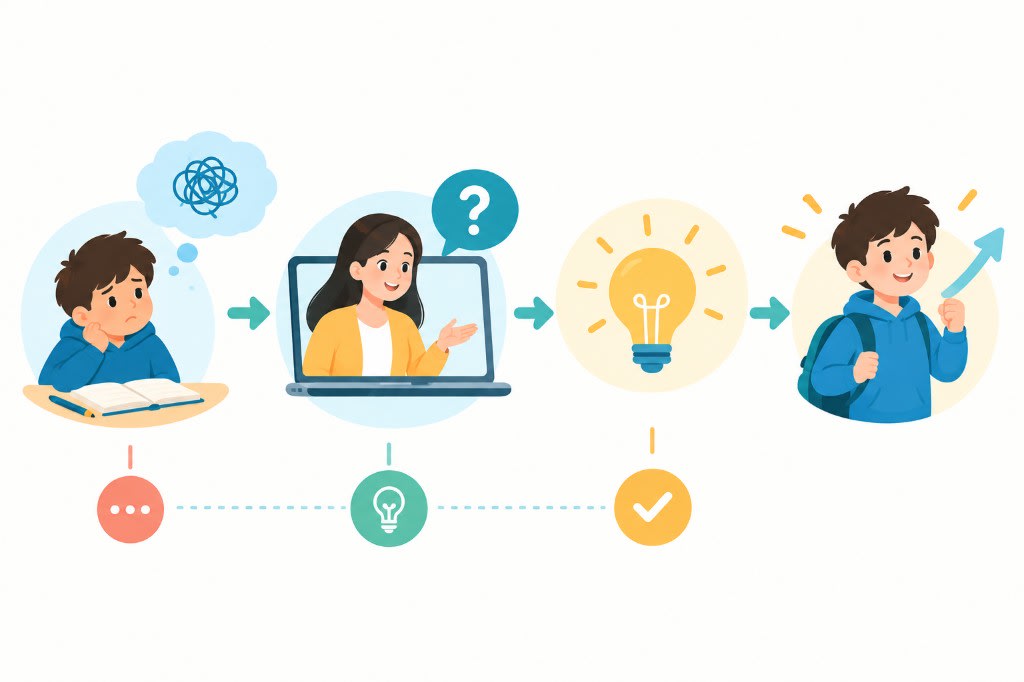
A student was comfortable following worked examples but froze on anything unfamiliar. A tutor trained to diagnose before reteaching didn't just walk through another example. Instead, they used targeted questions to find out where the student's reasoning broke down and discovered the student was picking a math method based on keywords in the problem, not an understanding of the relationship the problem described.
Once that was clear, the tutor shifted approach: visual representations, "why" questions instead of "how" instructions, and a gradual pullback of prompting as the student's answers got more independent.
The measurable outcome: the student went from needing a hint on almost every problem to choosing a method on their own, explaining the reasoning behind it, and applying it correctly to problems they hadn't seen before.
That's the actual return on investment of tutor training not more tutoring hours, but a faster, more accurate diagnosis that gets a student to independence sooner.
How We Know Where to Focus Next
We treat professional development as a continuous loop, not a certificate a tutor earns once. We look at patterns across tutoring sessions, student responses, and parent feedback, and we track emerging research on how students learn then feed that directly back into how our tutors are trained.
One current example: AI learning tools. Rather than positioning AI as a replacement for the tutor, we train tutors to use it selectively generating varied practice problems, visualizing a hard concept a different way, or exploring an alternate explanation when the first one isn't landing. The tutor stays responsible for the part AI can't do: noticing why a student is stuck and adapting to that specific student in that specific moment.
Alongside that, tutors keep building skill in online engagement, managing cognitive load, and telling the difference between a student who's struggling with the content and one who's struggling with confidence because those two problems need completely different responses.
What This Means for You as a Parent
When you're evaluating a tutor, "professional development" is worth asking about directly not as a checkbox, but as a real question: What ongoing training do your tutors get, and how does it change what they do in a session?
A service with real, ongoing tutor training gives you:
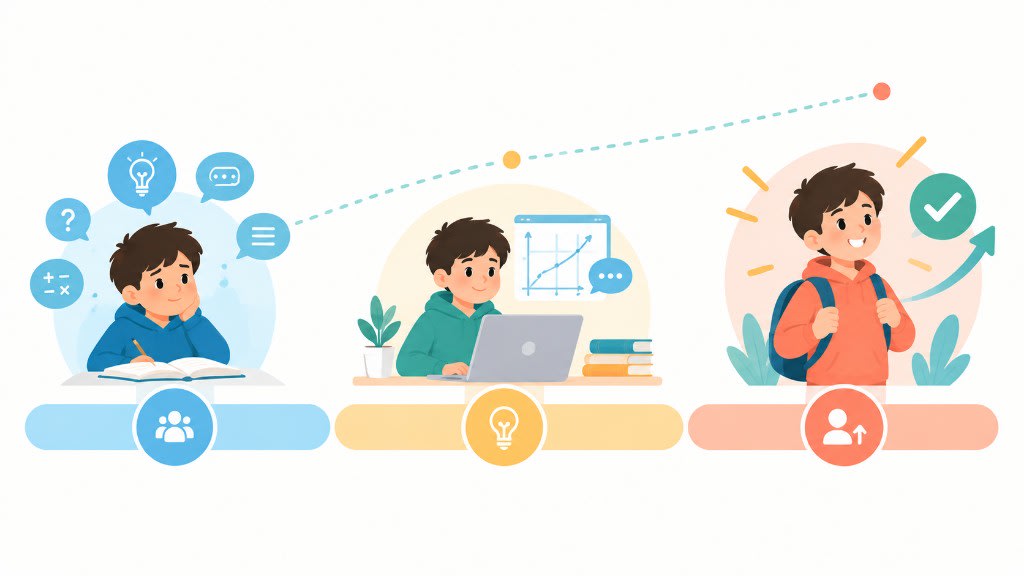
- Targeted support tutors who can diagnose the specific gap causing your child to struggle, not just cover more material
- Measurable progress a visible shift from hint-dependence to independent reasoning, not just completed worksheets
- Adaptability tutors equipped to use new tools and methods as they emerge, rather than teaching the same way indefinitely
- Genuine independence the actual goal: a child who no longer needs the tutor for that skill
That's the standard we hold every Asymptode tutor to. If you want to see what a professionally trained tutor can do for your child's math or science confidence, explore Asymptode's personalized 1:1 online tutoring at asymptode.com.