

A structured curriculum can keep a student moving. That is real value. Lessons are sequenced, problems are graded, and a stuck student can watch a step-by-step solution instead of waiting for a parent to become the teacher.
What it cannot do, on its own, is see how the child is thinking.
At Asymptode, we work with students who already have a program in place: a homeschool curriculum, a school syllabus, or an app that walks them through each lesson. Teaching Textbooks is a good example of that kind of structure. It can teach, grade, and explain. Parents often choose it because it takes a heavy subject off their plate.
The gap shows up later. The child is completing lessons. The gradebook looks fine. Then a slightly different problem appears, or a test asks them to explain the idea, and the understanding is not there. That is not a failure of the curriculum. It is the limit of automated support.
The technology can provide an answer. A 1:1 tutor helps the child understand why the answer makes sense.
Where automated tutoring falls short
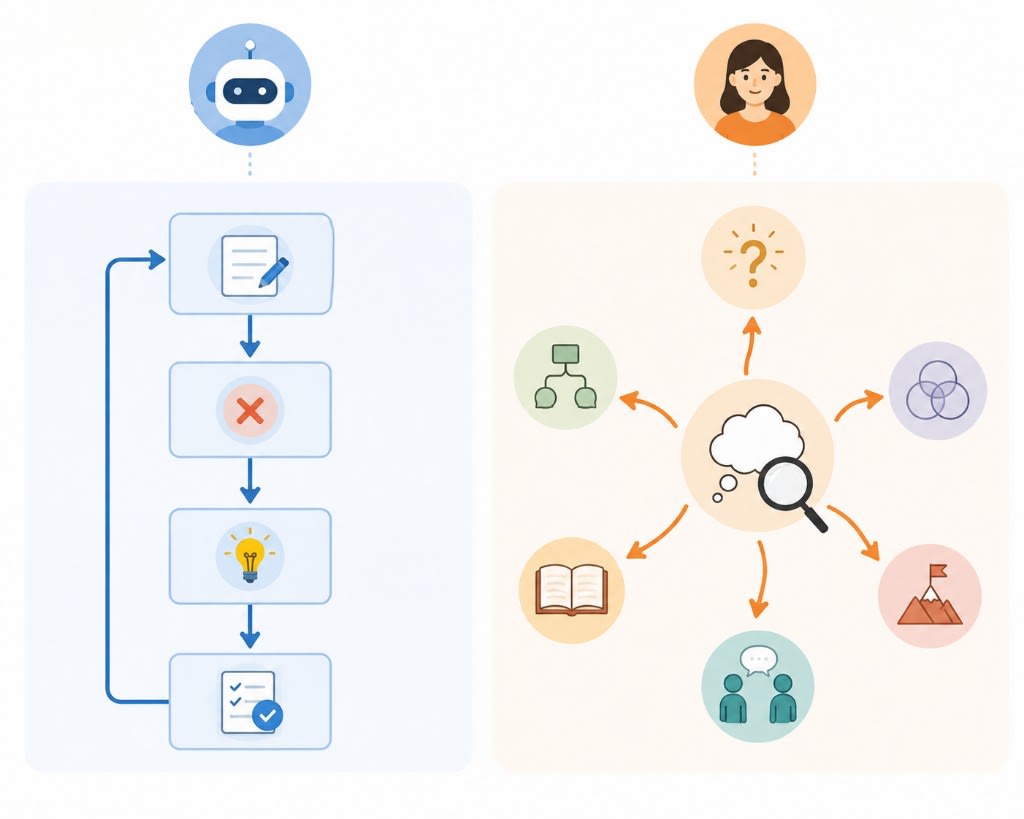
Automated tutoring is useful for practice. Its biggest limitation is that it usually responds to the answer, not the student's thinking.
Take a student who keeps choosing the wrong Physics formula. The program can mark the question incorrect and play the correct steps. That is helpful if the child simply skipped a line of algebra. It is not enough if the real issue is a misconception: they think the formula applies because the problem mentions the same quantity, or they memorized a pattern from last week's homework.
A human tutor can ask, "What made you choose that formula?" That one question often reveals the actual gap. The student may not need more practice on the current lesson. They may need a missing idea from two chapters earlier.
Learning style is another place automation struggles. A student who understands a concept visually may still fail a text-heavy explanation. A human tutor can switch immediately to a diagram, an analogy, or a real-world example. An automated path usually has one explanation, then a hint, then the worked solution. If that sequence does not land, the student either copies the steps or moves on without understanding.
There is a quieter problem too: students do not always know what they do not understand. They hesitate, guess, wait for the hint, or repeat the same error in a slightly new costume. A tutor notices the pattern in real time and changes the lesson. Software notices a wrong answer.
So the difference is not that automated tools cannot explain a concept. They often can. The difference is that a 1:1 tutor can diagnose the individual learner, adapt the explanation, challenge their thinking, and know when to go deeper or step back.
When 1:1 tutoring is no longer a nice-to-have

A structured program can still be the backbone of the week. Tutoring becomes essential when the student is collecting work without building a solid path through it.
Parents should watch for these signs:
They can finish the lesson but cannot explain it. Ask them to teach the idea back in their own words, or give them a problem that looks a little different from the ones in the software. If they freeze, they may be completing procedures, not learning concepts.
The same type of mistake keeps returning. Reviewing the explanation once is normal. Making the identical error after hints, solutions, and a second pass is a signal that the explanation is not reaching the actual misconception.
Work is increasing, understanding is not. Completing more lessons is not the same as progress. If accuracy, confidence, or independence is flat, the student may be on a plateau: busy, but not moving.
They wait for the hint. A child who constantly asks, "Which formula do I use?" or sits until the program nudges them is learning to follow a script. Problem-solving starts before the first hint.
Facts stay disconnected. They can recall a method from Monday and another from Thursday, but they cannot say how the two topics relate. That "scattered information" is one of the most common reasons a later chapter suddenly feels impossible. The current lesson is not the real problem. An earlier foundation is missing.
The goal is not to replace a structured curriculum. Human tutoring becomes essential when the curriculum can show the student what to learn, but the student needs someone to understand why they are not learning it.
How Asymptode tutoring works with a curriculum like Teaching Textbooks
We do not treat 1:1 tutoring as a second curriculum running alongside the student's existing program. That is how families end up with duplicated homework, mixed methods, and a child who feels they have two school days instead of one.
The existing curriculum stays the framework. The tutor provides the personalized support that makes that framework work for this student.
Here is how that looks in practice.
The curriculum tells us where they are. Lessons, questions, and assessments are useful information. If a student is working through a Physics chapter and keeps missing one type of problem, we do not simply assign more of the same. We use those mistakes to find the underlying gap, which is often a missing concept from an earlier chapter.
We step back only as far as needed. The tutor briefly rebuilds that foundation, then returns to the student's existing lessons with a clearer understanding. That prevents the child from accumulating disconnected explanations and extra worksheets that do not fix the real issue.
Tutoring time stays focused. We do not re-teach material they already understand. Session time goes to the highest-impact gaps: the misconception, the missing prerequisite, the habit of waiting for hints, the topic they can complete but cannot explain.
The result is one journey, not two tracks. The curriculum provides structure. 1:1 tutoring provides diagnosis, adaptation, and depth. Learning becomes more efficient because the student is not repeating what they already know, and they are not being asked to start a brand-new syllabus on top of the one they already have.
That is how we aim for high-quality results without overwhelming the week. The child keeps their program. The tutor makes sure the program actually produces understanding.
What this looks like for a parent
You do not need to become the math or science teacher. You also do not need to wait until a report card makes the gap obvious.
A useful check is simple:
- After a lesson, ask your child to explain the idea without looking at the screen.
- Give them one problem that uses the same idea in a new setting.
- Notice whether they start thinking, or whether they wait for a hint, a formula list, or the worked solution.
If they can talk through the idea and adapt it, the curriculum is doing its job. If they can only reproduce the steps they just watched, they need a human who can see their thinking.
That is the work we do at Asymptode: one student, one mentor, a plan paced to the child's stage, aligned to the syllabus they already follow.
If you want to see whether this style of support fits your child, you can start with a calm introduction at asymptode.com. Bring a recent assignment or a topic they keep missing. We will listen first, work second, and leave space for questions.
Key takeaways
- Automated curricula are strong at practice, grading, and showing correct steps. They are weak at reading a student's thinking.
- A 1:1 tutor diagnoses the misconception, changes the explanation, and notices confusion the student cannot name.
- Red flags include finishing lessons without being able to explain them, repeating the same error, waiting for hints, and collecting disconnected methods.
- Tutoring should not become a second curriculum. At Asymptode, the existing program stays the structure. We fill the gaps that keep that structure from working.
- The aim is cohesion: less extra work, more understanding, and progress that lasts past the next lesson.
FAQ
Is Teaching Textbooks enough on its own?
For many students, a structured program is a strong daily system for lessons, practice, and grading. It is often not enough when the child can complete work but cannot explain the concept, apply it to a new problem, or stop making the same kind of mistake. In those cases, tutoring is support for the curriculum, not a replacement.
Will 1:1 tutoring duplicate what Teaching Textbooks already teaches?
It should not. At Asymptode, the existing curriculum remains the framework. Tutors use the student's lessons and errors to find the missing foundation, rebuild that piece, and return to the same program. The point is fewer disconnected explanations, not a second syllabus.
What is the difference between an automated solution and a human tutor?
Automated tools typically respond to the answer: right, wrong, hint, then the correct steps. A human tutor responds to the thinking: why the student chose that method, which earlier idea is missing, and whether they need a diagram, an analogy, or a slower rebuild before moving on.
How do I know it is time to add a tutor?
Look for a plateau. The student is completing more work, but accuracy, confidence, or independence is not improving. Other signs include "Which formula do I use?", waiting for hints before starting, and an inability to connect topics they have already "finished."