

Watching your child struggle with math and science is hard enough. For neurodiverse children, traditional teaching methods often make it harder still leading to frustration, anxiety, and a sense of falling further behind, even when the child is genuinely trying.
At Asymptode, we start from a simple belief: the goal isn't to lower the mathematical expectation. It's to change the route to the same understanding. Here's what that looks like in practice.
Understanding the Unique Challenges of Neurodiverse Learners
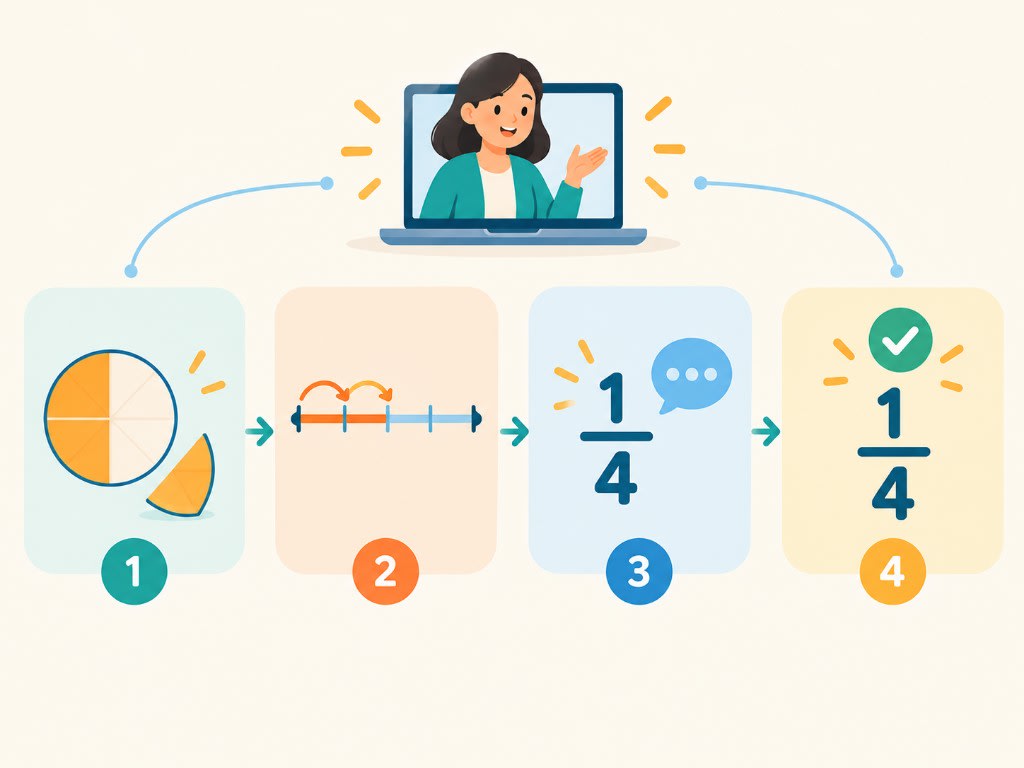
Take fractions for a child with dyslexia. Fractions are demanding processing multiple symbols, comparing numbers, holding several steps in mind at once a heavy cognitive load before the math even starts.
Instead of opening with abstract rules like "find the common denominator," an effective tutor starts with concrete, visual models: fraction circles, number lines, or something relatable like sharing a pizza. These give the concept a tangible foundation before symbols enter the picture.
Symbols are introduced gradually, with consistent layouts and short, clear instructions while the reasoning is said out loud, so the child can hear the logic, not just read it. The pace stays slower at first, with frequent chances for the child to explain or demonstrate understanding verbally rather than relying only on reading and writing. Once the visual concept is solid, the tutor connects it back to the notation and slowly removes the visual support.
Beyond Academics: Building Confidence and Reducing Anxiety
For many neurodiverse children, struggle in math and science erodes confidence fast. Fixing the teaching method matters but building self-assurance takes more than that. It starts with a space where it's genuinely safe to be wrong.
An effective tutor doesn't rush, compare, or jump in to correct mistakes immediately. Instead, mistakes get normalized as part of thinking not failure. Small, achievable wins come first, so the child can repeatedly feel "I can do this" before the challenge increases.
Language matters here too. Instead of "I'm bad at math," the reframe is "I haven't figured this out yet." Giving the child real choices which problem to try first, explaining an answer verbally instead of writing it builds autonomy and lowers anxiety. The goal isn't just better performance. It's a child who's willing to attempt hard problems, recover from setbacks, and say, "I don't know yet, but I can work it out."
Uncovering "Aha!" Moments: Identifying Specific Learning Needs

One common "aha" moment: a child solves a problem correctly with one representation, then gets completely stuck when the same idea shows up differently. A student might nail a fraction calculation using a familiar procedure, then freeze when asked to show the same fraction on a number line.
That's a signal the issue often isn't the calculation itself. It's that the underlying concept hasn't fully generalized yet.
In a 1:1 session, the tutor watches how the child approaches the problem, not just whether the answer is right. Questions like "Can you explain your thinking?" or "What if we changed the numbers or the picture?" paired with close attention to where the child hesitates help pinpoint the real hurdle: a missing foundation, a misconception, a processing difficulty, a confidence issue, or simply an explanation that hasn't clicked. From there, the method, representation, and pace adapt to that specific need, rather than slotting the child into a fixed "learning style."
Your Actionable Guide: Advocating for Individualized Learning
If your neurodiverse child keeps struggling despite consistent effort at school or home, try reframing the question. Instead of "How can we help my child practice more?" ask: "What exactly is getting in the way of learning?"
For one week, observe closely during math or science time and note three things:
- What your child can do independently celebrate it
- Exactly where they get stuck the precise moment or concept
- What happens when the explanation changes does a visual help? A verbal walkthrough? A different example?
Bring those specific observations to your child's teacher or tutor and ask: "Based on this, what do you think is causing the difficulty, and what can we change in how it's being taught?" That shifts the conversation from "more practice" to identifying the actual barrier.
How Asymptode Supports Neurodiverse Learners
Our 1:1 online tutoring is built to implement exactly this kind of tailored teaching. We focus on:
- Personalized pacing moving at your child's speed, not a fixed schedule
- Multi-sensory approaches visual, auditory, and kinesthetic methods for the same concept
- Confidence building a judgment-free space where mistakes are part of the process
- Targeted intervention addressing the specific gap or misconception, not just "more problems"
We partner with parents to understand each child's profile, adapting continuously and staying aligned with school curriculum and goals.
Key Takeaways
- Change the route, not the expectation neurodiverse learners can reach the same understanding through a different path
- Confidence needs a safe-to-fail space normalize mistakes before pushing for more
- Watch for representation gaps solving one way but not another is a real diagnostic signal
- Ask "what's in the way," not "how do we practice more" it changes the entire conversation with teachers and tutors
With the right support, every child can build genuine understanding and lasting confidence in math and science.
Explore Asymptode's 1:1 Tutoring Programs.