

Your child comes home, drops their backpack, and says it again: "I'm just bad at math." Or science. Or whatever subject has become the daily battleground. You've tried flashcards, YouTube videos, maybe even a workbook from the bookstore. Nothing sticks. And underneath the frustration is a quieter fear: what if they never catch up?
Here's what years of 1:1 tutoring sessions have shown us: it's rarely a matter of ability. It's a mismatch between how a concept is being taught and how your specific child's brain processes it. Personalized teaching strategies — especially inside a 1:1 online tutoring environment — close that gap. Below, we break down exactly what that looks like, with real examples, not just theory.
What "Personalized Teaching" Actually Means (And What It Doesn't)
"Personalized learning" gets used loosely — sometimes it just means a teacher grouping 30 students into three tiers instead of one. That's differentiation, and it has real value in a classroom. But it isn't the same as true personalization.
In 1:1 tutoring, personalization means the entire session — pacing, examples, visuals, even the order concepts are introduced — adapts to one student, in real time, every single session. There's no average student to teach to. There's just yours.
This distinction matters because it changes what you should expect from a tutoring service. If a "personalized" program still moves every student through the same fixed script, it's personalization in name only.
The Adaptive Learning Cycle: Observe, Diagnose, Adapt, Practice
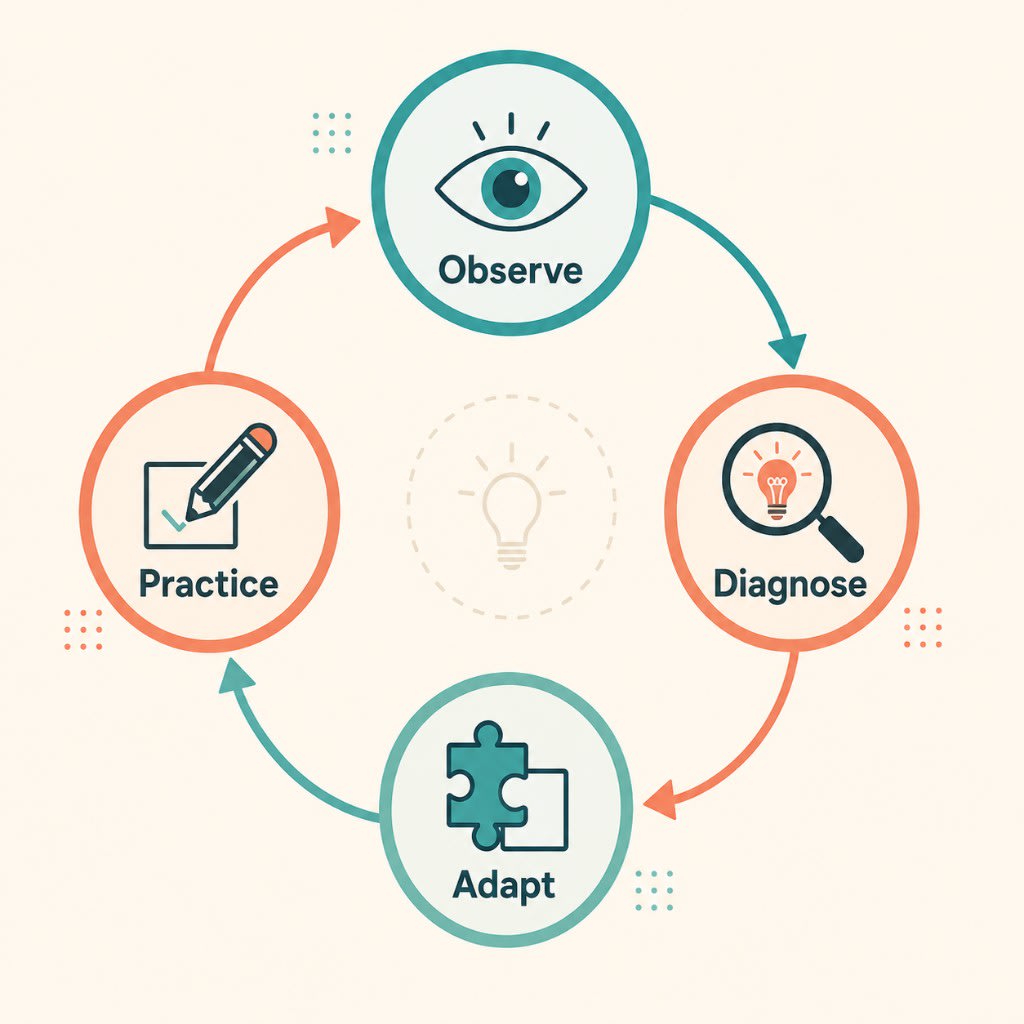
Effective 1:1 tutoring runs on a repeating loop:
- Observe — the tutor watches how a student approaches a problem, not just whether they get the right answer.
- Diagnose — is the gap conceptual, procedural, or confidence-based? Each requires a different fix.
- Adapt — the explanation changes on the spot: slower pacing, a different diagram, or a return to a missing foundational concept.
- Practice — new problems reinforce the adapted understanding, calibrated to be challenging but not overwhelming.
This cycle repeats dozens of times in a single hour. It's the mechanism behind what looks, from the outside, like a single "aha" moment — but is really the result of continuous, moment-by-moment recalibration that a 30-student classroom or even a small group setting simply can't replicate.
Real Example: From Memorized Formulas to Genuine Understanding
One recurring pattern we see: a student can recite a physics formula perfectly but freezes the moment a problem looks unfamiliar. That's a signal they've memorized a procedure without building the underlying mental model.
Instead of re-explaining the formula, a tutor might strip the problem down to a simple picture and ask guiding questions — letting the student arrive at the answer themselves. The shift isn't just academic. Students who go through this typically stop saying "I don't get it" and start asking "what happens if we change this?" That question is the tell: they've moved from memorization to genuine curiosity.
Real Example: Matching the Strategy to the Learning Style
A student struggling with electric circuits could define voltage and current, but couldn't predict how a circuit would actually behave. After observing that the student reasoned better with visuals than with equations, the approach shifted entirely: interactive circuit diagrams, animations, and predictions made before seeing the outcome.
Once the student could visualize current flow, the formulas stopped being abstract rules and started making sense as descriptions of something they could already picture. That's the core mechanic of adaptive teaching — not a fixed set of "tricks," but a continuous process of finding the explanation that matches how a specific student thinks, then building from there.
Why This Matters Beyond This Semester's Grade
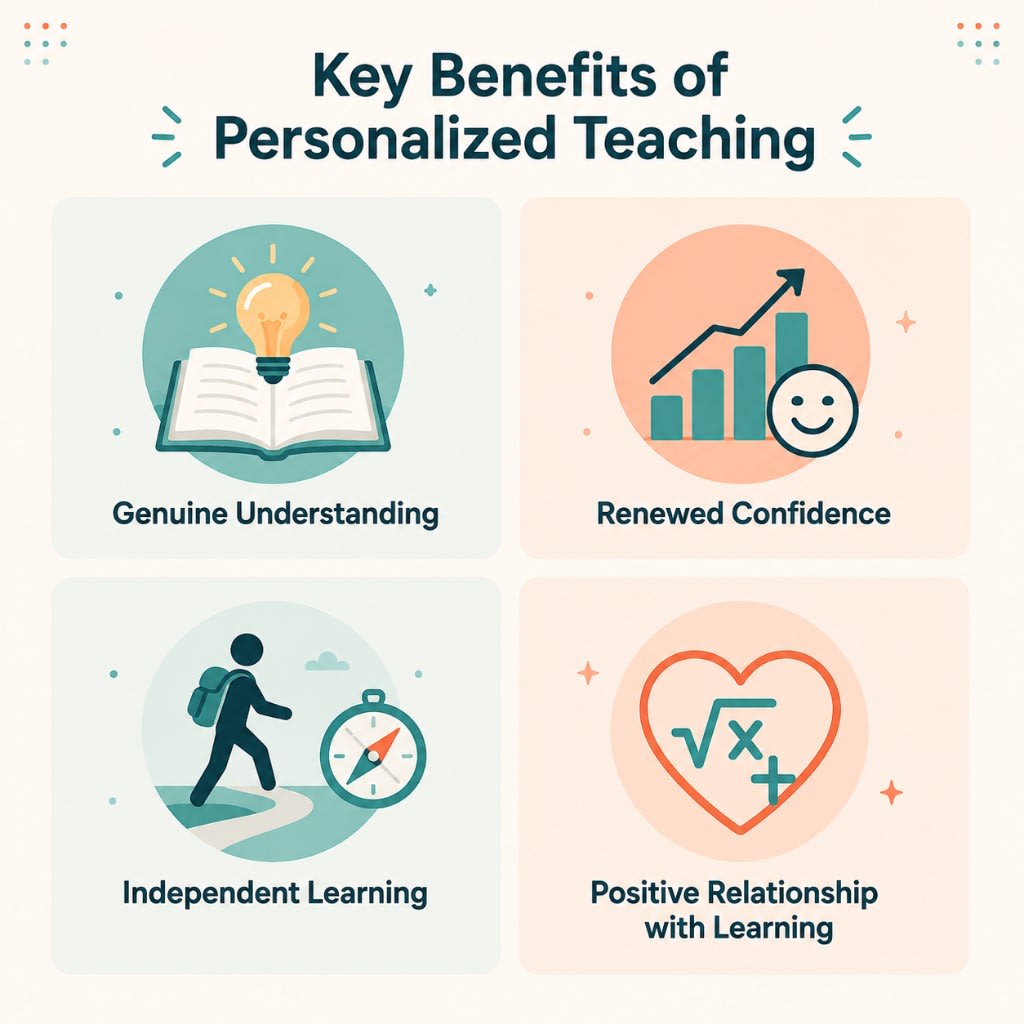
Parents searching for a tutoring center are usually solving for more than one bad test grade. Personalized strategies address the deeper, longer-term concerns:
- Genuine understanding — a foundation that holds up in next year's harder material, not just this week's quiz.
- Rebuilt confidence — the anxiety around "hard" subjects fades when a student has repeated proof they can figure things out.
- Independent problem-solving — the goal isn't a tutor who's always in the room; it's a student who no longer needs one.
- A different relationship with the subject — math and science shift from a source of dread to something they're willing to engage with on their own.
How to Evaluate a Personalized Tutoring Service
If you're comparing options, a few questions cut through the marketing language:
- Does the tutor adjust the lesson within a session, or only between sessions?
- Can you see evidence of a student's specific learning pattern being tracked over time — not just attendance and scores?
- Is the tutor trained to diagnose why a student is stuck, not just to reteach the same material more slowly?
At Asymptode, this is the standard we build our 1:1 online math and science tutoring around: every session adapts to where your child actually is, not where a curriculum assumes they should be.
Frequently Asked Questions
What's the difference between differentiated instruction and personalized tutoring? Differentiated instruction adjusts a classroom lesson for groups of students with similar needs. Personalized tutoring adapts continuously to one individual student, in real time, session by session.
How quickly will I see results? Confidence shifts are often visible within a few sessions; measurable academic gains typically take longer and depend on the size of the underlying gap.
Is personalized tutoring only for students who are behind? No. The same adaptive approach applies to advanced students — accelerating pace, introducing harder problems, or exploring topics ahead of grade level.
Ready to see the difference? Explore Asymptode's 1:1 online math and science tutoring and let us help your child build genuine understanding — not just memorize for the next test.