

Every parent wants their child to do well in math and science. But sometimes the methods designed to speed learning up quietly get in the way of real understanding. A child can look like they're keeping up, finishing worksheets and getting answers right, while gaps build underneath.
This article explains the difference between efficient teaching and rushed teaching, shows how to spot the signs of superficial learning, and explains why a child-centric, paced approach builds stronger foundations.
What Is "Brisk" Teaching, and When Does It Become "Rushed"?
The word "brisk" makes most people think of speed. But good brisk teaching should mean efficient teaching, not rushed teaching. Efficient teaching means:
- Identifying the most important learning gap
- Addressing it clearly
- Checking that the student understood
- Moving forward without wasting time on material the student already knows
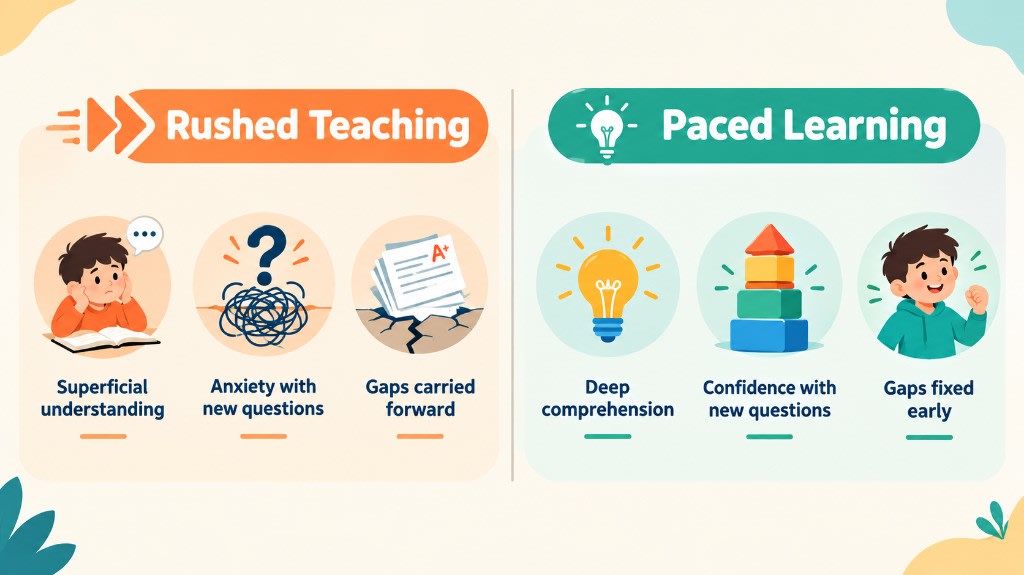
Rushed teaching skips the checking step. The risk is that students appear to keep up while quietly carrying misconceptions forward. In foundational subjects like math and science, one missed concept can create a chain of difficulties later. Students start to:
- Memorize formulas instead of understanding them
- Depend on hints
- Avoid unfamiliar problems
- Lose confidence when the question changes
The opposite extreme is just as unhelpful. Endless repetition can waste time without fixing the real issue. The right pace is the fastest pace at which genuine understanding is still being built.
Speed is not the problem. Speed without understanding is.
The Algebra Trick: A Story of Superficial Learning
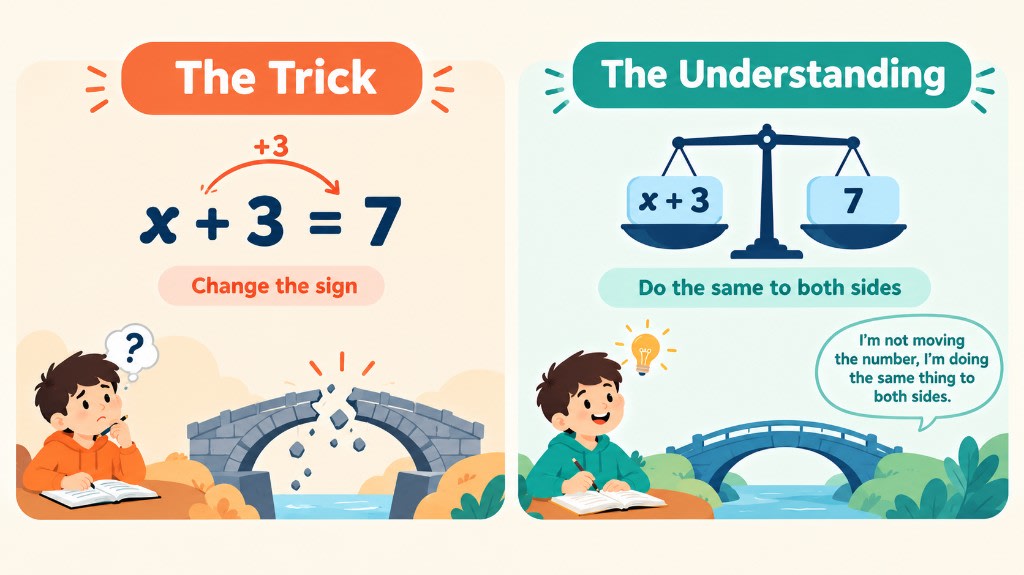
Consider a common example. A student learns a quick algebra "trick": when a number crosses the equals sign, change its sign.
At first, it works well. The student finishes simple equations quickly and looks successful. But when equations become more complex, they struggle, because they never understood why the trick works.
In a paced 1:1 session, the tutor steps back and uses a different idea: an equation is a balance, and both sides must stay equal. The student is asked to:
- Explain each step in their own words
- Predict what should happen before calculating
The "aha!" moment usually sounds like this:
"I'm not moving the number. I'm doing the same operation to both sides."
That understanding carries over to equations the student has never seen. The early method produced correct answers. The deeper method produces understanding that survives when the problem changes.
Signs Your Child May Be Learning Superficially
Many parents worry that their child is learning tricks instead of concepts. Here are the signs to look for:
- Struggles with variation. Correct answers on familiar questions, but trouble when the numbers, wording, or context change.
- Formula dependency. They often ask, "Which formula do I use?" or remember a rule but can't explain why it works.
- Repeated mistakes. Despite lots of practice, the same conceptual errors keep coming back.
- Anxiety with the unfamiliar. They get nervous or shut down when a question looks new.
A Simple Test to Try at Home
Ask your child:
- "Can you explain why this works?"
- "Can you solve it a different way?"
If they can explain the reasoning, apply the idea to a new situation, and recover from their own mistakes, the learning is likely deeper. If they can't, the pace may have outrun their understanding, and that is worth addressing early, before the gap grows.
Asymptode's Approach: Paced for Understanding, Not Speed
At Asymptode, our child-centric approach is paced for understanding, not paced for speed. Instead of rushing through a syllabus, our tutor first works out:
- What the child truly understands
- Where the specific gap is
- What pace allows the concept to become clear
If a student needs more time, we slow down. If they've mastered something, we move ahead. We then revisit concepts through explanation, unfamiliar problems, and retrieval, so understanding is retained instead of forgotten after a test.
The Lasting Advantages of Paced Learning
Students who build strong foundations gain:
- Better transfer of knowledge to new problems
- Greater independence in their studies
- Real confidence in tackling difficult math and science
We don't measure progress by how quickly a child finishes a lesson. We measure it by how confidently they can use what they learned when the lesson is over.
Worried your child is learning tricks instead of true understanding? Explore Asymptode's 1:1 online math and science tutoring at asymptode.com.
Key Takeaways
- Efficient is not the same as rushed. Efficient teaching targets gaps and checks understanding. Rushed teaching prioritizes speed over comprehension.
- Foundations are everything. Tricks without understanding lead to bigger struggles in complex topics.
- Look for understanding, not just answers. Ask your child to explain and to solve problems another way.
- Paced learning builds confidence. The right pace builds lasting understanding and independence.