

As a parent, you want more than just improved grades for your child you want genuine understanding, lasting confidence, and a strong foundation in subjects like math and science. You may have come across "Teach Like a Champion" (TLAC), a well-known framework widely used in classroom teaching. But how do those principles translate to the personalized, 1:1 online tutoring your child actually needs?
At Asymptode, we've adapted core TLAC techniques specifically for a 1:1 setting, so they deliver tangible, trackable progress rather than just classroom management. This isn't about clever tricks it's about building real understanding and the habits of a successful learner.
"No Opt Out" as a Confidence-Building Tool
Many parents associate "No Opt Out" with a teacher putting a student on the spot in front of the class. In 1:1 tutoring, we use it very differently as a confidence-building tool.
Here's what that looks like in practice. If a student says "I don't know" when asked why two algebraic expressions are equal, the tutor doesn't just hand over the answer. Instead, they might:
- Break the problem into a smaller, more manageable step.
- Use a visual model or a different representation to make the concept concrete.
- Ask a simpler, related question that gives the student's thinking somewhere to start.
The tutor keeps scaffolding this way until the student can reason their way forward on their own. Then and this is the key part the tutor returns to the original question and asks the student to explain it independently. That deliberate loop turns an initial "I don't know" into a confident "let me try," and makes sure the student actually understands the concept rather than just having heard the right answer once.
Measurable Indicators of Deep Understanding
Parents often want more than a higher score they want solid proof their child is really understanding the material. The strongest evidence of that isn't a grade; it's an observable change in how the student thinks.
Our tutors track whether a student can:
- Explain a concept in their own words true understanding goes beyond rote memorization.
- Solve an unfamiliar variation applying knowledge to a scenario they haven't seen before.
- Justify each step understanding the why behind the how.
- Self-correct an error catching and fixing their own mistakes. Complete problems with progressively fewer hints a clear, trackable path toward independence.
Take an algebra problem where a student initially needed several prompts to get through it. Over time, a tutor tracks the shift: from needing multiple prompts, to solving it independently, to explaining the quality of their own reasoning, to applying that same logic to a brand-new variation. A student might move from "I know the steps but don't know why" to independently explaining why each step preserves equality and confidently applying that reasoning to a new equation.
The key measure isn't whether the tutor guided the student to a correct answer. It's whether the student eventually returns to the original challenge and succeeds on their own. That's evidence of growing comprehension, confidence, and independence far more than any single grade can show.
Supported Independence: Our Refinement of "No Opt Out"
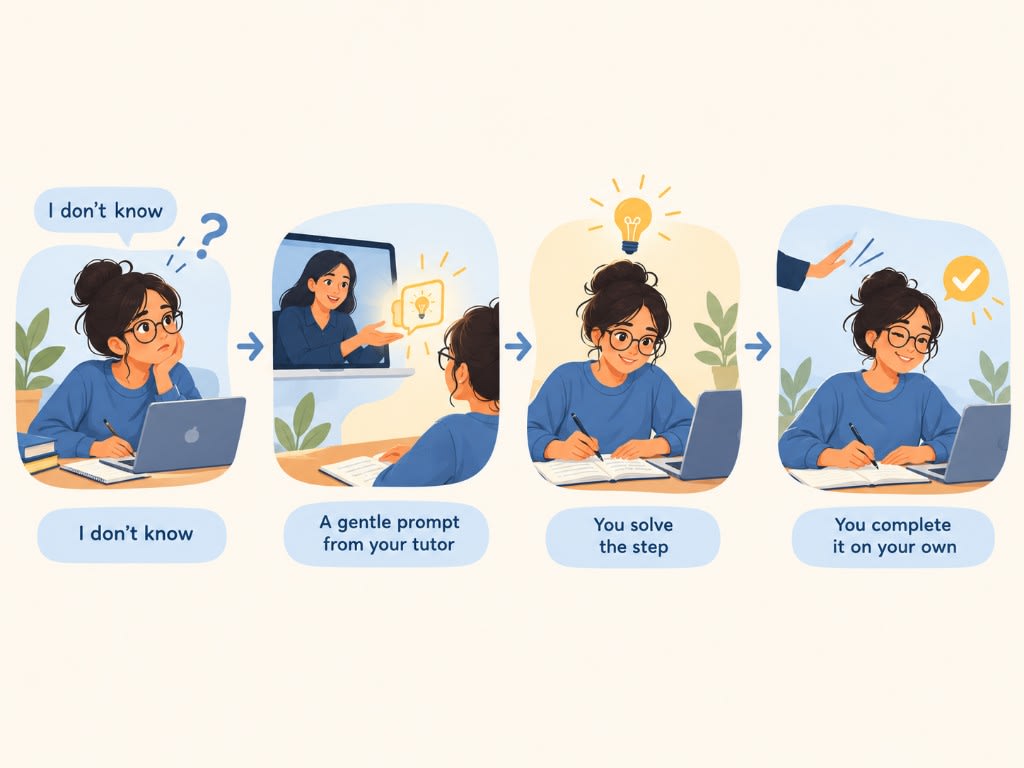
Most of what's written about "Teach Like a Champion" is aimed at classroom teachers managing a room full of students. At Asymptode, we've taken one of its core principles "No Opt Out" and reshaped it for a 1:1 context into something we call supported independence.
When a student says "I don't know," the tutor doesn't immediately step in with the answer. Instead, they:
- Diagnose the gap pinpoint exactly where understanding broke down.
- Give the smallest useful prompt just enough to unblock the student, no more.
- Change the representation if needed present the idea visually, concretely, or a different way.
- Return the student to the original problem so they finish it themselves.
Over time, those prompts are deliberately reduced. That creates a measurable shift:
"I need help to solve this" → "I can solve this with a hint" → "I can figure this out myself."
The lasting advantage here goes beyond any one math or science concept. The student develops the habit of persisting, reasoning, and recovering when they get stuck a meta-skill that matters far more than getting today's answer right, and one that carries into every future academic challenge.
From Memorization to Mastery
Parents often wonder whether their child is truly understanding the material, or just memorizing enough to get through the next test. Our adapted "No Opt Out" approach is built specifically to guard against that kind of surface-level learning.
When a student gets stuck, the tutor doesn't supply the answer. They diagnose the misconception, offer a different representation or a smaller question, and bring the student back to the original problem. That iterative process is what turns memorized steps into real understanding.
A common "aha!" moment happens when a student who's been memorizing formulas suddenly sees why one works. In physics, for example, instead of asking "which equation should I use?", the student learns to first identify what's physically happening in the problem— and only then choose the equation that represents it.
The real proof of comprehension is what happens next: the student can explain the idea in their own words, and apply it confidently to a problem they've never seen before. That's the moment memorization turns into mastery.
Key Takeaways

- Personalized TLAC: Asymptode adapts "Teach Like a Champion" for 1:1 online tutoring, tailored to each student's specific needs.
- "No Opt Out" for confidence: we use this technique to build reasoning and self-belief, not to put a child on the spot.
- Measurable progress: tutors track observable changes in thinking not just grades as real proof of comprehension.
- Supported independence: our refinement of TLAC builds persistence and problem-solving habits that last well beyond any one subject.
- Mastery over memorization: we guide students toward understanding why concepts work, leading to genuine "aha!" moments and lasting comprehension.
Ready to see your child develop genuine understanding and confidence in math and science? Explore Asymptode's personalized 1:1 online tutoring and discover the difference our "Teach Like a Champion" approach can make. Visit asymptode.com to learn more.