

If your child has ever slammed a textbook shut and said "I'm just bad at this," you know how heavy it feels. You want them to understand math and science, feel confident, and maybe even enjoy them. But once a strong aversion has set in, how do you turn it around?
It usually isn't about more content or more drilling. It's about changing your child's relationship with learning. Behind almost every "I can't" is an unmet need for understanding, connection, and safety.
The Real Root of Aversion: It's Not "I Don't Like It"
When a child is anxious about math or science, it's rarely because they dislike the subjects. More often they have a history of repeated failure, embarrassment, unfavorable comparison to peers, or a foundational gap that was never properly addressed. Over time, they protect themselves by avoiding hard questions or repeating, "I'm just bad at this."
So the first step is not more content. It's psychological safety: a space where your child can explore, make mistakes, and share their thinking without fear of judgment.
What this looks like in practice:
- Start with questions your child can answer, and let them explain their thinking in their own words.
- Treat mistakes as a normal, useful part of learning.
- Offer small, achievable challenges so they experience real success, then raise the difficulty gradually.
- Make progress visible, for example by revisiting a problem that felt impossible last month.
The goal is to replace "I can't do this" with "I don't understand this yet, but I know how to work it out."
Try at home: When your child is stuck, ask "What part makes sense so far?" before "What did you get wrong?"
Turning Abstract Concepts into Hands-On Experiences
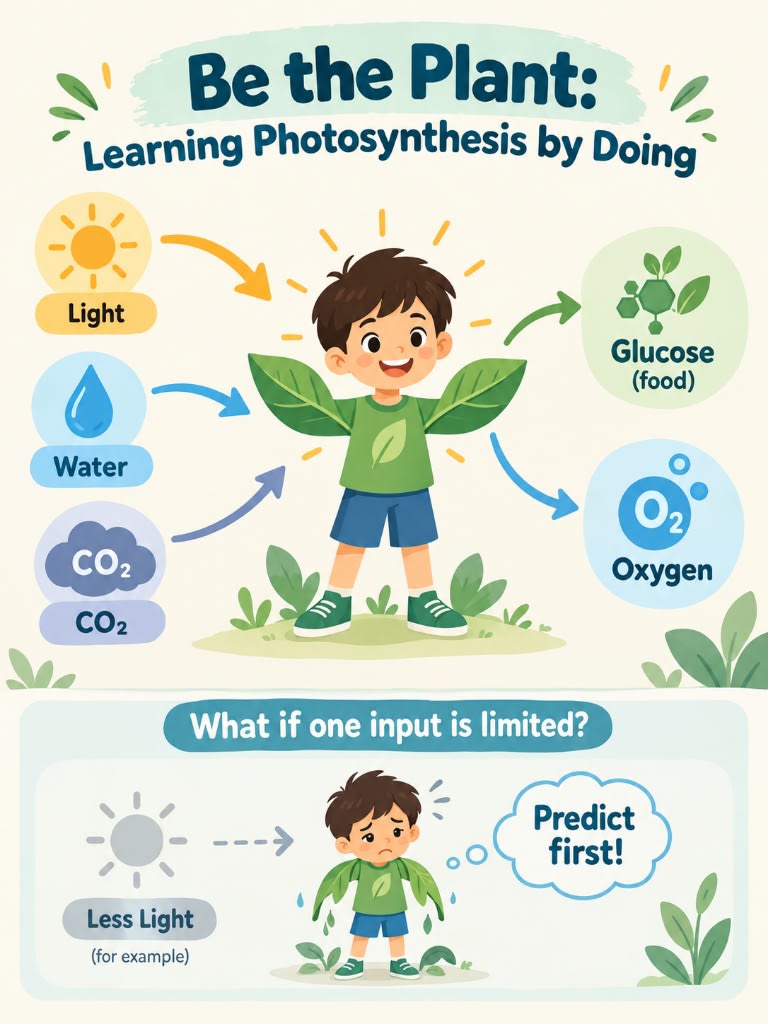
For a struggling student, a dry definition or a dense formula can feel like a wall. Creative, hands-on activities bridge the gap between abstract ideas and real understanding.
Take photosynthesis. One student found it too abstract to remember, so instead of starting with definitions, the tutor turned the student into the "plant." Light, water, and carbon dioxide became inputs, and the student had to predict what would happen when one was limited. By acting and predicting, the student built an understanding that was more memorable than any worksheet could provide.
Ideas you can borrow:
- Be the concept. Act out a process (a plant, a circuit, a water cycle) and change one variable at a time.
- Predict first. Before any experiment or calculation, ask "What do you think will happen?" Being wrong is part of the fun.
- Use the kitchen. Fractions, ratios, and states of matter are all easier to grasp while cooking.
- Draw it. A quick sketch often exposes what a child does or doesn't understand.
From "Have To" to "Want To": Building Intrinsic Motivation
Parents often worry about whether a child's willingness to learn will last, especially after months of dread. The answer is to help them experience genuine progress, not just push them to study more.
- Create small wins. "I can do this" builds self-efficacy, the belief that effort leads to results.
- Connect to their interests. Sports stats, gaming, music, or cooking can all carry math and science concepts.
- Encourage questions and offer choices. Let your child pick which problem to try first or how to approach it.
- Celebrate the right things. Praise better reasoning, the courage to attempt a hard problem, or fixing a mistake independently, not just high marks.
Over time, "I have to study" becomes "I want to see if I can figure this out," a habit that lasts without constant outside pressure.
Rethinking "Best Practices": Quality Over Quantity
Some well-intentioned advice backfires for struggling students. The classic example is more practice through repetitive worksheets. If a child holds a misconception, repeating the same type of question can reinforce the wrong thinking and deepen the feeling of "I'm just bad at this."
A better approach is fewer problems, deeper thinking:
- First, understand how your child is approaching the problem.
- Ask them to explain their reasoning, predict an outcome, or draw a diagram.
- Try a slightly unfamiliar version of the problem.
- Once the concept is clear, add targeted practice.
The goal isn't just more right answers. It's for your child to think, "I understand what I was missing, and I can figure this out."
Key Takeaways for Parents
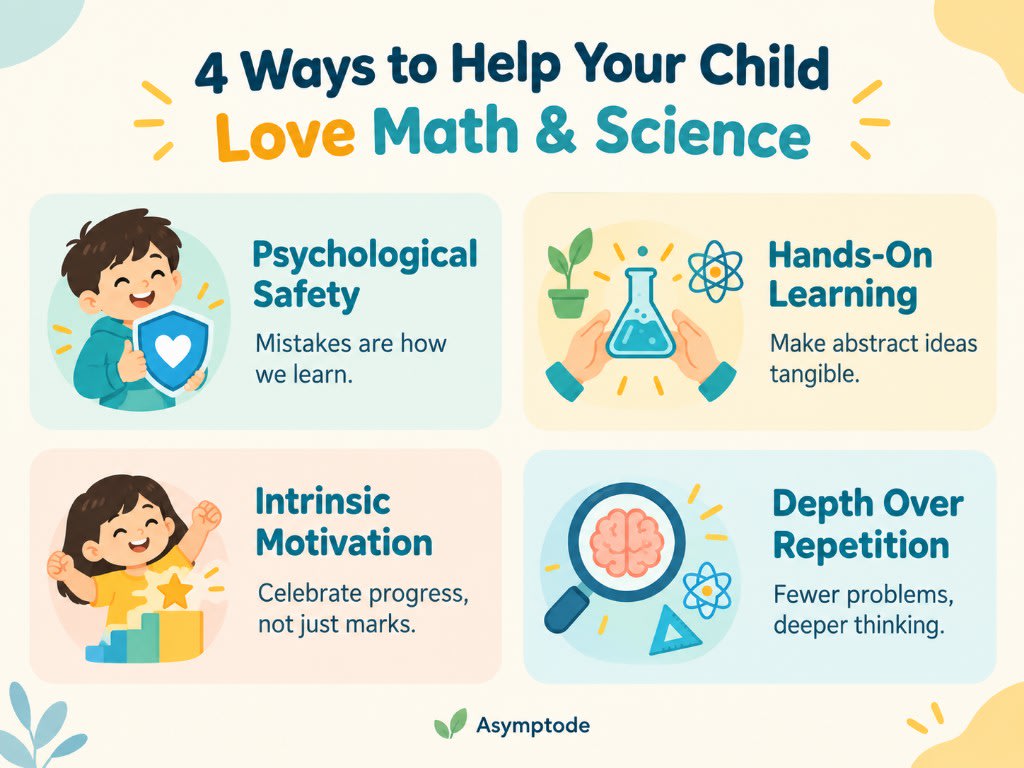
- Prioritize psychological safety. Make mistakes a safe part of learning.
- Embrace hands-on learning. Make abstract ideas tangible through role-play, prediction, and drawing.
- Foster intrinsic motivation. Celebrate progress, connect to interests, and encourage curiosity.
- Choose depth over repetition. A few thoughtful problems beat a stack of worksheets.
Ready to See Your Child Enjoy Learning Again?
At Asymptode, our 1:1 online tutoring meets your child exactly where they are, paced to their learning style and focused on real understanding and confidence. Visit Asymptode.com to learn more about our tailored approach.