

If you've ever watched your child log into a video call for tutoring and wondered whether anything real is actually happening on the other side of that screen, you're not alone. It's one of the most common doubts parents have: can a tutor sitting hundreds of miles away really understand how my child thinks or is this just a webcam version of a textbook?
That skepticism is fair. Most online tutoring content either glosses over the question or answers it with vague marketing language about "certified tutors" and "accelerated achievement." Parents deserve a real answer, grounded in how effective 1:1 teaching actually works not just a sales pitch.
Debunking the Engagement Myth: How Online Tutoring Fosters Connection
The biggest misconception is that online tutoring means a child is simply a passive listener in front of a screen. In truly effective 1:1 online tutoring, the screen becomes a shared workspace, not a broadcast. The child is drawing, solving, predicting, explaining, and thinking out loud while the tutor watches not just for the right answer, but for the hesitation, the mistake, and the reasoning behind it.
When a child gets stuck, a skilled tutor can immediately switch representations moving from a formula to a diagram, or from an abstract idea to a concrete example and gauge whether that shift actually helped. This kind of responsive, real-time adjustment is what builds genuine connection. It doesn't come from physical proximity; it comes from a tutor who is closely watching how a child thinks, communicates, and reacts to being challenged. That's what makes a child feel truly seen.
Beyond Speed: The Pedagogical Power of 1:1 Online Tutoring for Deep Understanding
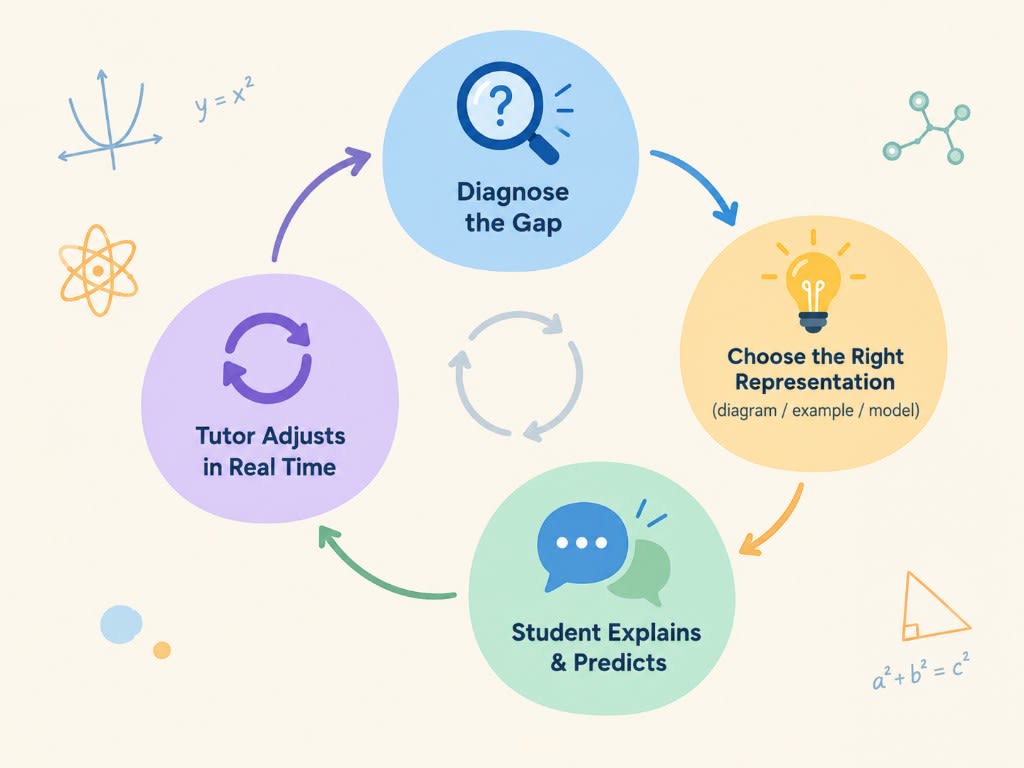
Many competitors sell online tutoring on speed "accelerated achievement," faster grades, quicker fixes. But for subjects like Maths and Science, speed isn't the real advantage. The real advantage is continuous adaptation to how an individual child thinks.
Effective tutoring starts with precisely diagnosing the actual gap in understanding, then choosing the representation most likely to close it a diagram, a physical example, a visual model, or pure mathematical reasoning before moving on to practice. Along the way, tutors lean on strategic questioning, prediction, "teach-back" (where the student explains the concept in their own words), and error analysis, so the child learns why an answer works instead of memorizing a procedure.
Because each session is one-on-one, the tutor can slow down when a foundational concept is missing, push harder when the child is ready, and gradually withdraw hints as independence grows. The advantage isn't that it's online it's that every minute of instruction can respond to exactly how that child is thinking in that moment.
From "Which Formula?" to "I Can Figure This Out": A Story of Transformed Confidence
Academic improvement is only half of what parents hope for the other half is confidence. Consider a student who used to freeze at the sight of an unfamiliar Physics problem, always asking, "Which formula should I use?" The real issue wasn't effort; it was that the student had never been taught how to read the physical situation first.
Through consistent 1:1 sessions, the tutor used diagrams, asked prediction questions, and gradually reduced hints. The turning point came when the student, faced with a new problem, said on their own: "Let me draw it first." From there, they began tackling harder problems independently and catching their own mistakes. The real shift wasn't the test scores it was the student's growing belief: I can figure this out.
What to Look For: Evaluating Online Tutoring for Lasting Impact
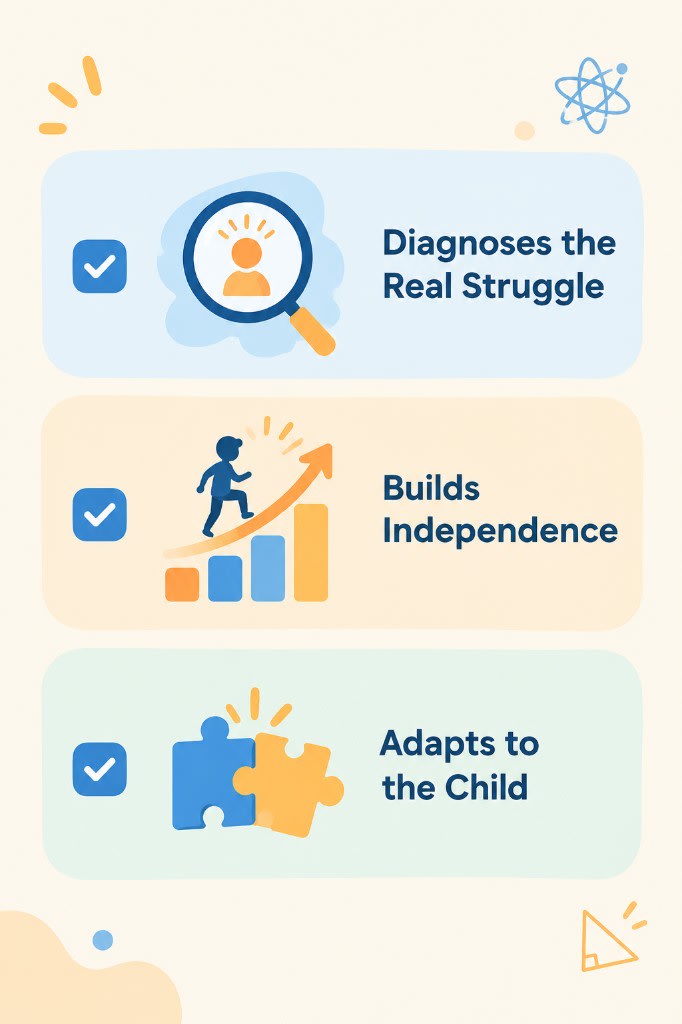
With so many options claiming to "boost grades," how can a parent tell the difference between a program that builds lasting understanding and one that offers only a short-term fix? Three practical questions cut through the noise:
Does the tutor diagnose the reason behind the struggle? If a child keeps making the same mistake, a good tutor doesn't just assign more practice they identify the specific misconception or missing foundation causing it.
Is there evidence of growing independence? Look for fewer hints needed over time, clearer explanations from your child, self-correction of errors, and the ability to handle unfamiliar problems not just higher scores on worksheets they've already seen.
Does the teaching genuinely adapt to your child? A strong tutor can explain the same concept multiple ways, adjust pace to your child's needs, and deliberately pull back support as confidence builds.
The simplest test: if the tutor disappeared tomorrow, would your child know how to figure things out on their own?
The Bottom Line
Effective online tutoring isn't a digital version of a classroom lecture it's a personalized process built on close observation, adaptive teaching, and a real understanding of how a child learns. Especially in demanding subjects like Maths and Science, that combination is what turns temporary grade bumps into lasting confidence and independent problem-solving.
Want to see this in action? Visit Asymptode.com to learn how our 1:1 online Maths and Science tutoring is built around exactly this kind of adaptive, confidence-building approach.