

As a parent, you want the best for your child's future. You worry about them falling behind in subjects like math and science, and you're constantly weighing whether tutoring is really worth the cost or whether "continuing education" is even a phrase that applies to a middle schooler, rather than an adult chasing a professional certificate.
At Asymptode, we think it applies more than most parents realize. Personalized math and science tutoring isn't just about the next test. It's a strategic investment in your child's most valuable asset: their capacity to keep learning.
Rethinking "Continuing Education" for K-12 Students
When people hear "continuing education," they usually picture adult career certifications a defined skill, learned for a defined professional purpose. For a K-12 student, we'd define it differently: continuing education is the continuous development of a child's ability to learn, not just their progress through the next unit or grade.
In math and science especially, every new concept builds on the last one. Strengthening today's foundation doesn't just help this week's homework it shapes how easily your child grasps harder ideas years from now, from algebra to calculus, from basic chemistry to advanced physics. A strong foundation keeps paying off as a child moves from middle school to high school, college, and into fields that don't even exist yet.
So the real investment isn't in this semester's grade. It's in your child's growing capacity to figure things out independently.
The Long-Term Value: Keeping Future Options Open
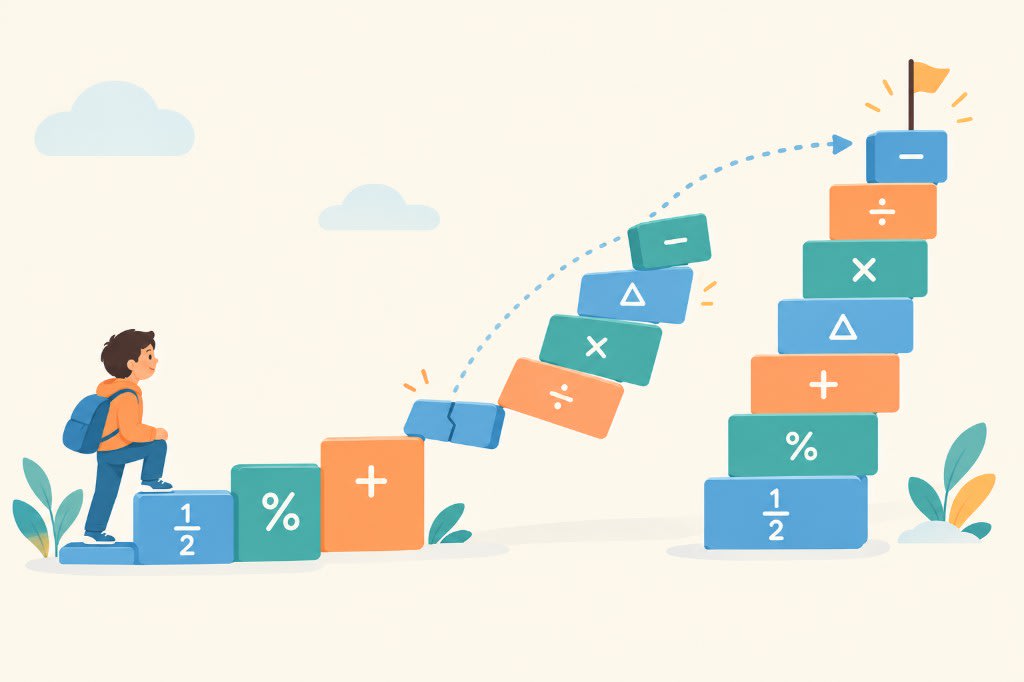
The most common hesitation we hear from parents isn't "does tutoring work" it's "is it worth what it costs, long-term?" In our experience, the biggest long-term payoff is optionality: keeping doors open rather than letting them close quietly.
Consider a hypothetical example. A seventh-grader we'll call him Maya's classmate is doing fine in school but starts to struggle the moment fractions turn into ratios and proportional reasoning. Nothing dramatic happens; he just gets a little slower, a little less confident, and starts avoiding word problems. Left alone, that small gap tends to compound: proportional reasoning underlies percentages, unit rates, slope, and eventually algebra itself. Two years later, without intervention, "a bit behind in fractions" can look like "struggling with algebra," which can quietly rule out advanced math, physics, or engineering as realistic options in high school not because he isn't capable, but because an early gap was never repaired.
That's the real cost of waiting. And it's why the value of 1:1 tutoring isn't measured in this year's grade it's measured in bottlenecks avoided and doors kept open.
Asymptode's Approach: Continuous Development, Not Content Consumption
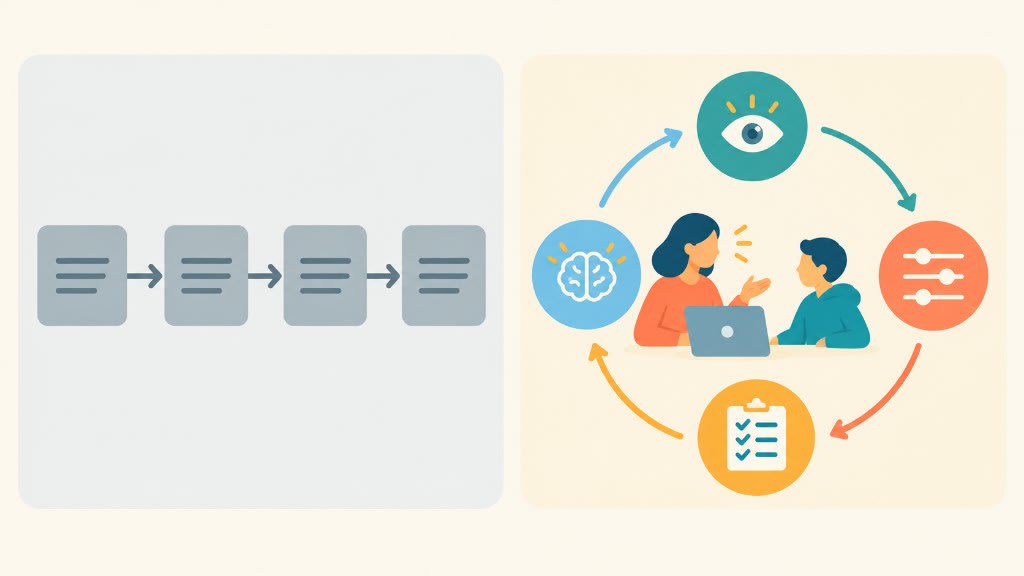
Most online "continuing education" is built for adults: self-paced, generalized, and designed to move a motivated learner through a fixed curriculum on their own. That model doesn't fit a child who's still building the confidence to ask for help.
Asymptode's 1:1 tutoring works differently. We start with the child what they understand, where they get stuck, what foundational piece is missing, and what explanation will actually make it click. If there's a misconception, we slow down and rebuild it properly. If a concept is already solid, we don't waste time re-teaching it. Tutors use diagrams, guided questioning, real-world examples, and teach-back to make students actively reason through problems rather than passively watch someone else solve them and we test understanding with unfamiliar problems, so the learning actually transfers instead of staying tied to one worksheet.
For a child, "continuing education" should mean continually becoming a stronger learner not just finishing more assignments.
Addressing the "Are We Just Paying for Grades?" Worry
Many parents quietly wonder: are we spending all this money just to get a better grade or worse, does needing a tutor mean my child isn't capable?
Neither is true, and it's worth saying plainly. The goal of tutoring isn't to create dependence on extra help or to patch tonight's homework. It's to strengthen the foundation that makes every future lesson easier. If a student is struggling with algebra, we don't just get them through today's assignment we find the underlying gap, rebuild it, and deliberately pull back support as the student becomes more independent. Success looks like a kid who starts approaching hard problems with curiosity instead of avoidance.
You're not paying to fix a weakness. You're investing in a capability one that outlasts any single class.
The Bottom Line
Personalized math and science tutoring with Asymptode isn't a short-term fix for a rough report card. It's a long-term investment in your child's ability to think, reason, and learn independently the kind of foundation that keeps options open for whatever they decide to pursue next.
Ready to see where your child's foundation could use reinforcing? Book a free consultation with Asymptode.