

As parents, we all want our children to thrive not just in school, but in life. We dream of them genuinely understanding concepts, feeling confident, and having a wide range of opportunities open to them. When we hear terms like "student enrichment services," it's natural to wonder what that truly means for our K-12 child, and whether it's a worthwhile investment.
This article redefines student enrichment services from a K-12 parent's perspective, focusing specifically on the profound, long-term impact of early math and science mastery.
What Is K-12 Student Enrichment (and What It Isn't)
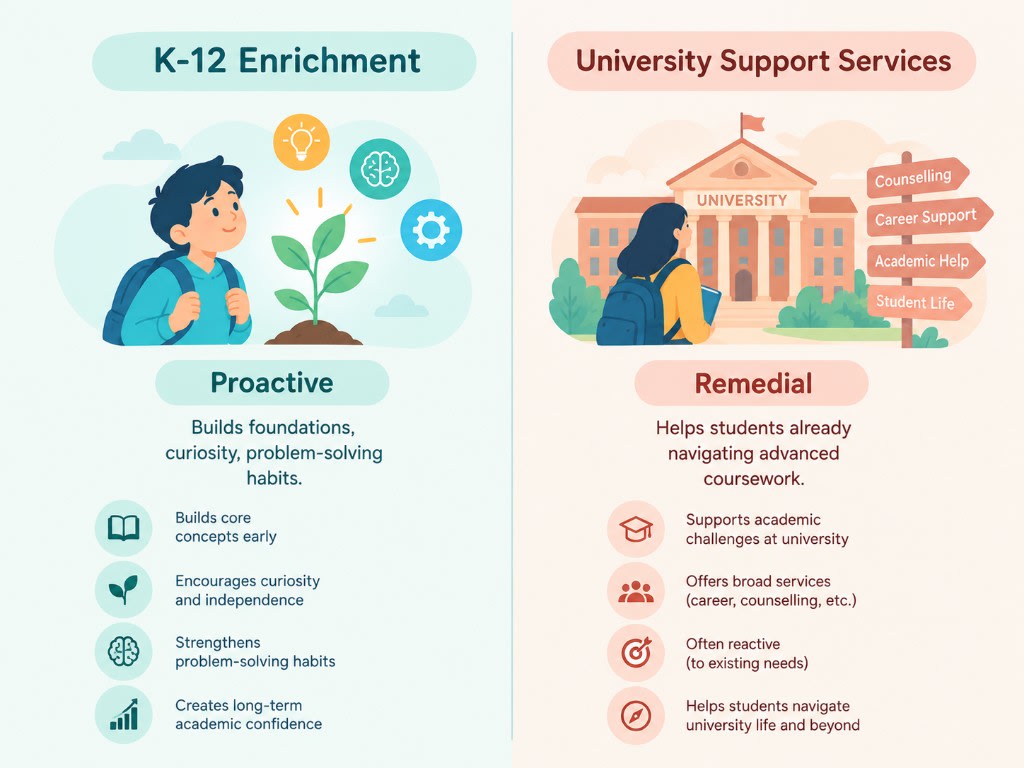
When you search for "student enrichment services," you'll often find resources from universities detailing programs designed to support enrolled college students with academic coaching, financial literacy, or career services. These are vital for students navigating higher education, but they are fundamentally different from what K-12 enrichment offers.
K-12 math and science enrichment is proactive, not remedial. Its core purpose is to build strong mathematical and scientific foundations early, cultivate genuine curiosity, and develop robust problem-solving habits. It challenges students beyond simply completing the school syllabus, encouraging them to think deeply and ask insightful questions.
While university enrichment programs support students already in an advanced academic environment helping them navigate courses or specific challenges K-12 enrichment shapes the very foundation a child carries into that environment. A child who learns to reason deeply, ask good questions, and tackle unfamiliar problems early is better prepared to learn harder concepts later. The long-term value isn't just getting ahead for one grade it's building intellectual habits that make future learning easier, deeper, and more independent.
Beyond Grades: The Unseen Returns of Early Math & Science Enrichment
Parents make a significant financial and time investment in enrichment, and naturally, they look for tangible results. While improved grades are a welcome immediate outcome, the deepest returns are often less obvious, yet far more impactful.
One of the most profound benefits is a child learning to sit with confusion and work through it, instead of freezing or guessing. This is what a good mentor models every session: breaking problems down, checking their own reasoning, and persevering. This invaluable habit transfers far beyond math class, into any unfamiliar challenge a child faces later in life.
There's also a quiet but powerful confidence shift. Students who are guided back to the real root cause of a learning gap stop believing they're "bad at math." This internalized belief is often the actual barrier keeping capable kids away from advanced STEM tracks. We've seen this directly translate into students opting into harder coursework and competitions they'd otherwise have avoided, because the fear of not understanding has been replaced with a working method for getting unstuck.
The Cumulative Trap: Why Delaying Foundational Mastery Costs More Later
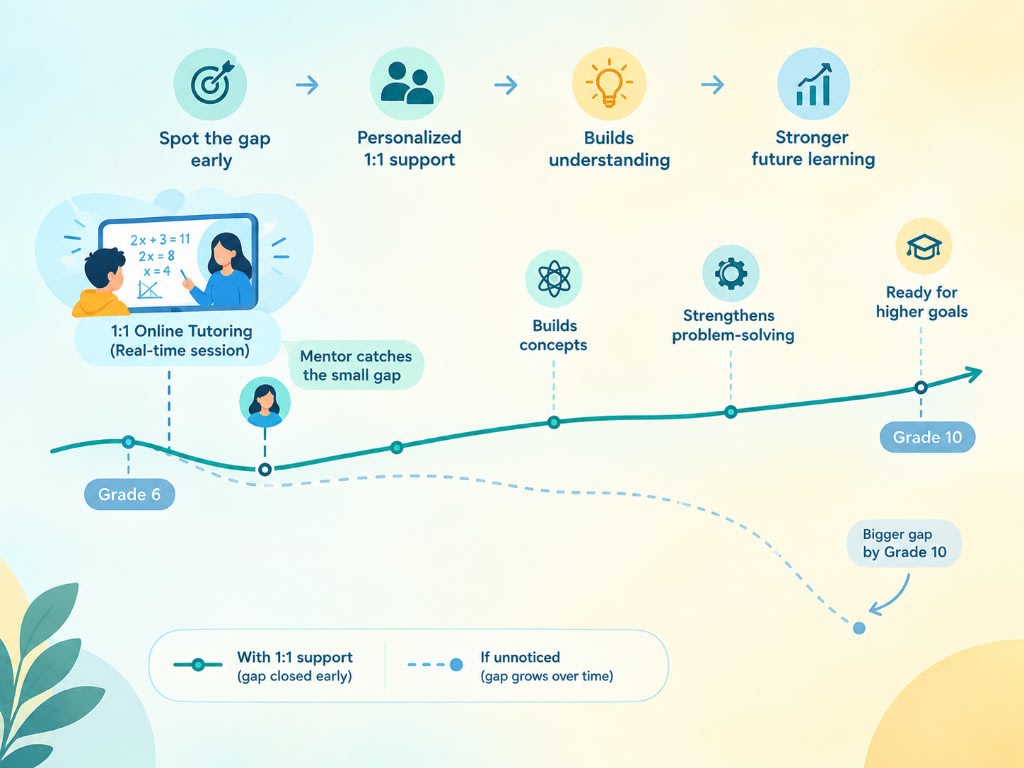
It's tempting to prioritize other activities or believe a child can "catch up" later. However, math and science are unusually unforgiving subjects because they are cumulative. A gap in understanding fractions doesn't stay contained to fractions it quietly resurfaces as "trouble with algebra," then "trouble with functions," each time looking like a new problem rather than the same unresolved one.
By the time a struggling grade becomes visible in 9th or 10th grade, it's often actually a 5th or 6th-grade gap that has been compounding silently for years. "Catching up" now means relearning several years of foundation simultaneously, under more pressure, with less time. This has real, concrete consequences beyond a report card.
Advanced coursework think AP Calculus, AP Physics, or competitive math programs has hard prerequisite chains. A student can't opt into them last-minute, no matter how motivated they suddenly become, because foundational gaps make the next layer incomprehensible, not just difficult. Even more critically, early struggle often gets internalized as "I'm not a math person." Many capable students self-select out of STEM tracks entirely, well before they'd ever hit an actual ability ceiling. This closes doors to engineering, medicine, and research paths not because they couldn't do the work, but because nobody caught and closed the gap early enough for them to believe they could.
Asymptode's Approach: Proactive, Personalized, and Paced for Lasting Success
At Asymptode, our 1:1 online math and science tutoring is built directly against this cumulative trap. Our model prioritizes continuity, meaning a dedicated mentor notices a small gap in real time perhaps in 6th grade rather than parents discovering a "sudden" struggle in 10th grade, because by then, it was never sudden at all. We pace learning to your child's individual stage, ensuring genuine understanding, not just memorization.
We believe in nurturing intellectual habits that make future learning easier, deeper, and more independent. Our goal is to empower your child to reason deeply, ask good questions, and tackle unfamiliar problems with confidence setting them on a path toward lasting academic and career success.
Key Takeaways
- K-12 enrichment is proactive: It builds strong foundations and intellectual habits, unlike university support programs.
- Long-term benefits extend beyond grades: Students gain resilience, problem-solving skills, and quiet confidence.
- Early intervention is crucial: Math and science are cumulative; delaying mastery creates compounding gaps that limit future options.
- Personalized learning makes a difference: A dedicated mentor can identify and address gaps in real time, fostering a belief in one's own capability.
Investing in early, targeted math and science enrichment is an investment in your child's future opening doors to wider academic and career opportunities and instilling a lifelong love of learning. Explore how Asymptode can support your child's journey to lasting understanding and confidence today at asymptode.com.