

As a parent, watching your child struggle with math or science can be incredibly frustrating and even heartbreaking. You see the low grades, the homework battles, and the dwindling confidence. But often, the biggest question isn't if your child is struggling, but why.
Many parents feel overwhelmed trying to understand the root cause of these academic hurdles. Is it a lack of effort? A difficult teacher? Or something deeper — a specific learning gap that's holding them back? At Asymptode, we understand these concerns, and our approach to 1:1 online math and science tutoring is built around precisely identifying and addressing these unique challenges.
Uncovering the Hidden Signs of Learning Gaps
It's easy to spot when a child gets an answer wrong, but understanding why they got it wrong requires a more nuanced approach. Standard tests often only reveal the outcome, not the underlying issue.
One subtle sign is when a student can solve familiar questions but struggles as soon as the wording or numbers change. That often means they've memorized a method without fully understanding the concept behind it. Other signs include repeatedly making the same type of mistake, taking unusually long to start a problem, asking "Which formula should I use?" for every question, or being unable to explain why their answer makes sense.
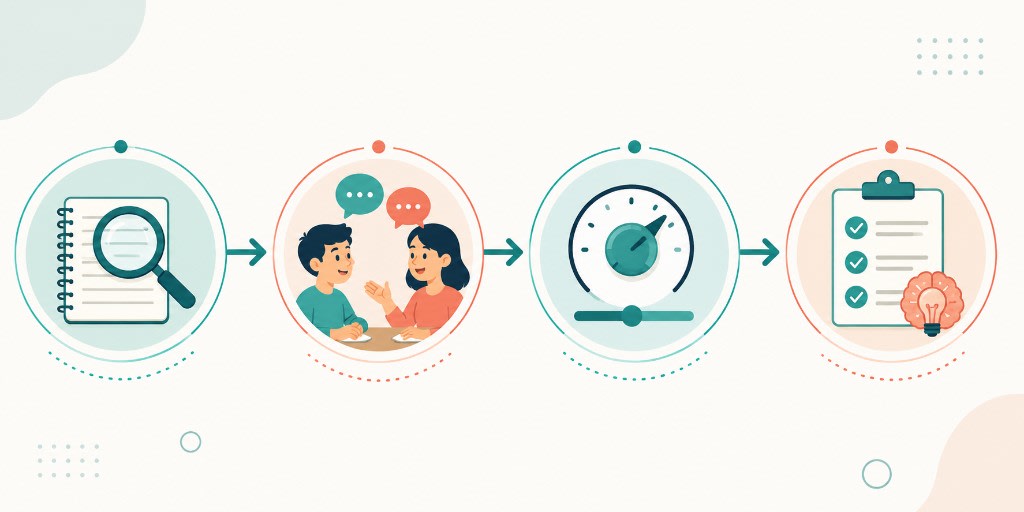
In a 1:1 assessment, we go beyond a standard test. We ask the student to think aloud, explain their reasoning, draw diagrams, make predictions, and solve slightly unfamiliar problems. We also change the explanation or difficulty in real time and observe how they respond. This helps us separate a knowledge gap from a reasoning gap, a prerequisite gap, or a confidence issue. A classroom test usually tells us what the student got wrong; 1:1 assessment helps us understand why they got it wrong. That diagnosis is the starting point for truly personalized teaching.
The Power of Truly Tailored 1:1 Strategies
Many educational resources offer general "teaching strategies," but these often fall short when addressing a child's unique learning gaps.
One student came to us struggling with algebraic equations. Their answers were often wrong, but the real issue wasn't calculation — it was that they didn't understand what the equals sign actually represented. They were treating an equation like a sequence of steps rather than a relationship between two sides.
Instead of giving them more worksheets, the tutor used balance diagrams and simple visual examples. We first worked with physical "balance" situations, then connected those ideas to algebraic expressions. The student was asked to explain each step in their own words and predict what should happen before doing the calculation — a very different approach from simply teaching the standard procedure of "move this to the other side and change the sign."
The breakthrough came when the student could solve an unfamiliar equation and explain why each step preserved the equality, rather than just following a memorized rule. They also began catching their own mistakes before the tutor pointed them out. That was the evidence the strategy was working: the student wasn't just getting more answers right — they had developed a mental model that let them reason through new problems independently.
1:1 Tutoring vs. Classroom: A Different Impact
The biggest difference with 1:1 tutoring is that the teaching can change the moment the student needs it to. In a classroom, the teacher has to follow the pace of the group. In 1:1, if a student is confused, the tutor can stop, identify the exact gap, change the explanation, and immediately check whether the new approach worked.
For example, a student may be getting algebra questions wrong because of a foundational misunderstanding, not because they need more practice. The tutor can identify that during the session, address the foundation, and then return to the original problem with the newly established understanding.
Building Trust Through Transparent Progress

We also believe parents should understand why a particular strategy is being used. Rather than simply saying "your child is improving," we share what we observed, what gap we identified, what we changed, and what evidence shows the student is now understanding more independently.
Progress is measured through more than marks on a test:
- Fewer repeated mistakes — a real drop in recurring errors
- Better explanations — the ability to articulate concepts clearly, in their own words
- Willingness to attempt unfamiliar problems — confidence to tackle new challenges without immediate fear
- Reduced dependence on hints — solving problems with less prompting from the tutor
For parents, this transparency matters. Struggling with a child's learning can be emotionally difficult, and you want reassurance that your child isn't incapable and that the investment is truly making a difference. Showing the learning process — not just the final score — is what builds that trust.
Key Takeaways
Identifying and addressing learning gaps requires more than standard tests; it demands a personalized, adaptive approach. Subtle signs often reveal deeper conceptual misunderstandings that 1:1 tutoring is uniquely equipped to diagnose and resolve. By focusing on tailored strategies and transparent progress, Asymptode helps your child build true understanding, overcome academic hurdles, and regain their confidence in math and science.
Ready to see how personalized 1:1 tutoring can transform your child's learning journey? Explore Asymptode's tailored math and science programs today at asymptode.com.