

As a parent, you want more than just good grades for your child in math and science. You dream of genuine understanding, a lasting foundation, and the confidence to tackle any challenge. You worry about them falling behind, losing confidence, or simply memorizing facts without truly grasping the underlying concepts. This is where the idea of a "gold standard" in teaching strategies becomes crucial.
When we talk about the 'gold standard' in teaching strategies for K-12 math and science, we're not referring to a specific early childhood assessment product like 'Teaching Strategies GOLD.' Instead, we mean the pinnacle of educational approaches—methods that consistently lead to deep, enduring comprehension and empower students for future success. It's about transforming learning from a chore into an engaging journey of discovery.
What is the "Gold Standard" in K-12 Math & Science?
For K-12 Math and Science, "gold standard" means helping a student achieve mastery that lasts beyond the next test. It goes far beyond simply completing worksheets or memorizing formulas. We want students to truly understand concepts, connect ideas across different topics, explain their reasoning clearly, and confidently apply their knowledge to unfamiliar problems.
A truly strong strategy also involves identifying foundational gaps early on, using mistakes as valuable feedback for growth, and gradually guiding the student from supported practice to independent problem-solving. For older students, this excellence means developing critical thinking, robust mathematical reasoning, keen scientific thinking, and the unwavering confidence to tackle difficult problems independently.
This approach stands in stark contrast to early-childhood assessment systems, where the primary focus may be on developmental milestones and basic skill acquisition. Our focus is on building a robust intellectual framework that supports lifelong learning.
Beyond One-Size-Fits-All: The Personalized Path to Mastery

Parents are rightly wary of 'one-size-fits-all' approaches, knowing that every child learns differently. A strong way to avoid this pitfall and ensure personalized, deep learning is our diagnose → teach → adapt philosophy.
We begin by truly understanding how the student is thinking—where their confusions lie, what they already know, and what specific hurdles are holding them back. Only then do we change the explanation, examples, pace, and level of challenge to perfectly suit that individual student. This ensures the learning experience is always relevant and engaging.
Instead of just memorizing formulas, students are actively asked to explain why something works, represent it visually to deepen their understanding, and apply it to unfamiliar problems. As they improve and gain confidence, the tutor gradually removes support, empowering the student to reason and solve problems independently.
The gold standard is not giving every student the same path—it is helping each student reach the same depth of understanding through the unique path that works best for them. This personalized approach fosters genuine understanding that lasts.
Measuring True Understanding: Explain, Retain, Apply
How do you know if these 'gold standard' strategies are truly building a lasting foundation rather than just leading to short-term gains? We look beyond immediate grades and ask whether the student can explain, retain, and apply a concept independently.
A strong indicator of lasting mastery is when a student can solve a new problem with different wording or combine ideas from different topics to reach a solution. We also look for fewer repeated mistakes, the ability to ask more insightful questions, stronger reasoning skills, and less dependence on hints from the tutor.
Over time, students should be able to revisit an older concept and still explain why it works, not just remember a formula. Most importantly, we track whether their confidence and willingness to attempt difficult problems are consistently growing. The real measure of success is when a student can say, "I haven't seen this before, but I know how to figure it out."
The Pitfall of "More Practice = More Learning" (and a Better Way)
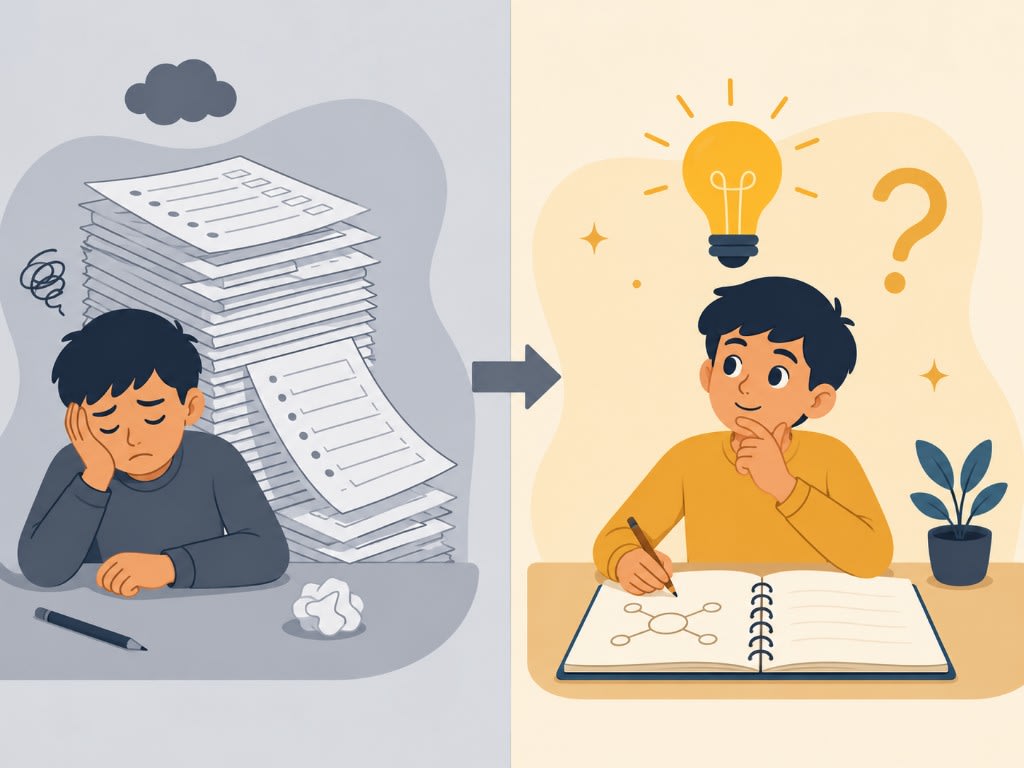
Many traditional math and science classrooms still rely on methods that can lead to surface-level understanding. A common practice that often falls short of the 'gold standard' is the belief that "more practice = more learning"—giving students many similar questions after they make a mistake.
The problem with this approach is that repetition can inadvertently reinforce the wrong mental model rather than fixing the underlying misconception. It can lead to rote application without genuine understanding.
Our alternative is "fewer problems, deeper thinking": we ask students to predict outcomes, explain why a method works, compare different approaches, and tackle unfamiliar variations of problems. For example, in Physics, instead of repeatedly applying a formula, we first ask, "What is physically happening here, and why does this principle apply?" This crucial step exposes how the student is truly thinking and allows the tutor to address the actual conceptual gap.
The gold standard is not measured by how many questions a student completes—it is whether they can think through a problem they have never seen before.
Why Asymptode Embodies the Gold Standard
At Asymptode, our 1:1 online math and science tutoring is built upon these very 'gold standard' principles. We understand your desire for your child to genuinely understand concepts, build a lasting foundation, and regain their confidence.
Our expert tutors are dedicated to providing personalized attention, diagnosing individual needs, and adapting their teaching to ensure deep, lasting mastery. We move beyond memorization, fostering critical thinking and problem-solving skills that empower students to excel not just in tests, but in their academic journey and beyond.
We believe every child deserves a learning experience that truly adapts to their unique style and pace, ensuring they develop the skills and confidence to thrive in math and science.
Key Takeaways
- The 'gold standard' in K-12 math and science teaching focuses on lasting mastery, deep conceptual understanding, and critical thinking, not just memorization.
- Personalized learning paths are essential, adapting to each student's unique needs through a 'diagnose → teach → adapt' philosophy.
- True success is measured by a student's ability to explain, retain, and apply concepts independently, demonstrating growing confidence.
- Moving beyond 'more practice = more learning' to 'fewer problems, deeper thinking' addresses misconceptions and builds genuine problem-solving skills.
Ready to see your child rediscover the joy of learning and achieve lasting mastery in math and science? Explore Asymptode's personalized 1:1 online tutoring today.
Visit asymptode.com to learn more about how our gold standard teaching strategies can benefit your child.