

Your child got the homework right last night. Then today's test asked the same idea in a slightly different way, and they froze. If that sounds familiar, you're not imagining it. Many children learn to perform math and science without really understanding it. They memorize steps, formulas, and definitions that work until the question changes.
If you've felt helpless watching this happen, or worried that your child is learning "tricks" instead of real knowledge, this guide is for you. Most content about teaching strategies is written for classroom teachers and university faculty. This one is written for parents of K-12 children who are struggling in math and science. It covers how to recognize memorization, which strategies build genuine understanding, and what to look for in the help your child gets.
Why Do So Many Kids Memorize Instead of Understand?
Memorization feels efficient. A formula gets the answer, a definition gets the mark, and a familiar worksheet gets finished. For a child who is already behind, memorizing can feel like the only way to keep up.
The problem is that memorized steps are fragile. They work only when the question looks exactly like the one your child practiced. Once a problem is worded differently, combined with another idea, or set in a new context, the memorized method falls apart. The child then concludes, "I'm bad at this."
The goal of good teaching strategies is to move a child from knowing how to solve a problem to understanding why the solution works. That shift is what makes learning last.
How Can You Tell If Your Child Is Memorizing or Truly Understanding?
You don't need to be a math or science expert to spot the difference. Watch how your child approaches problems, not just whether they get them right.
Signs of rote memorization
- They solve familiar questions but struggle with new ones. They know the steps, but get stuck when the question is worded differently.
- They rely heavily on formulas. They can recall a formula but can't explain why or when to use it.
- They memorize definitions without examples. They can repeat a science definition but struggle to connect it to real-life situations.
- They need constant hints. They ask, "Which formula should I use?" instead of working out what the problem is asking.
Signs of true conceptual understanding
- They explain their reasoning. They can describe why they chose a method, not just how they got the answer.
- They apply knowledge to unfamiliar problems. They can use the same concept in a different situation.
- They make connections. They relate new concepts to something they've learned before.
- They recognize and correct mistakes. They can see where their reasoning went wrong and explain how to fix it.
Simple questions parents can ask
Try these during homework time. Keep your tone curious, not like a quiz:
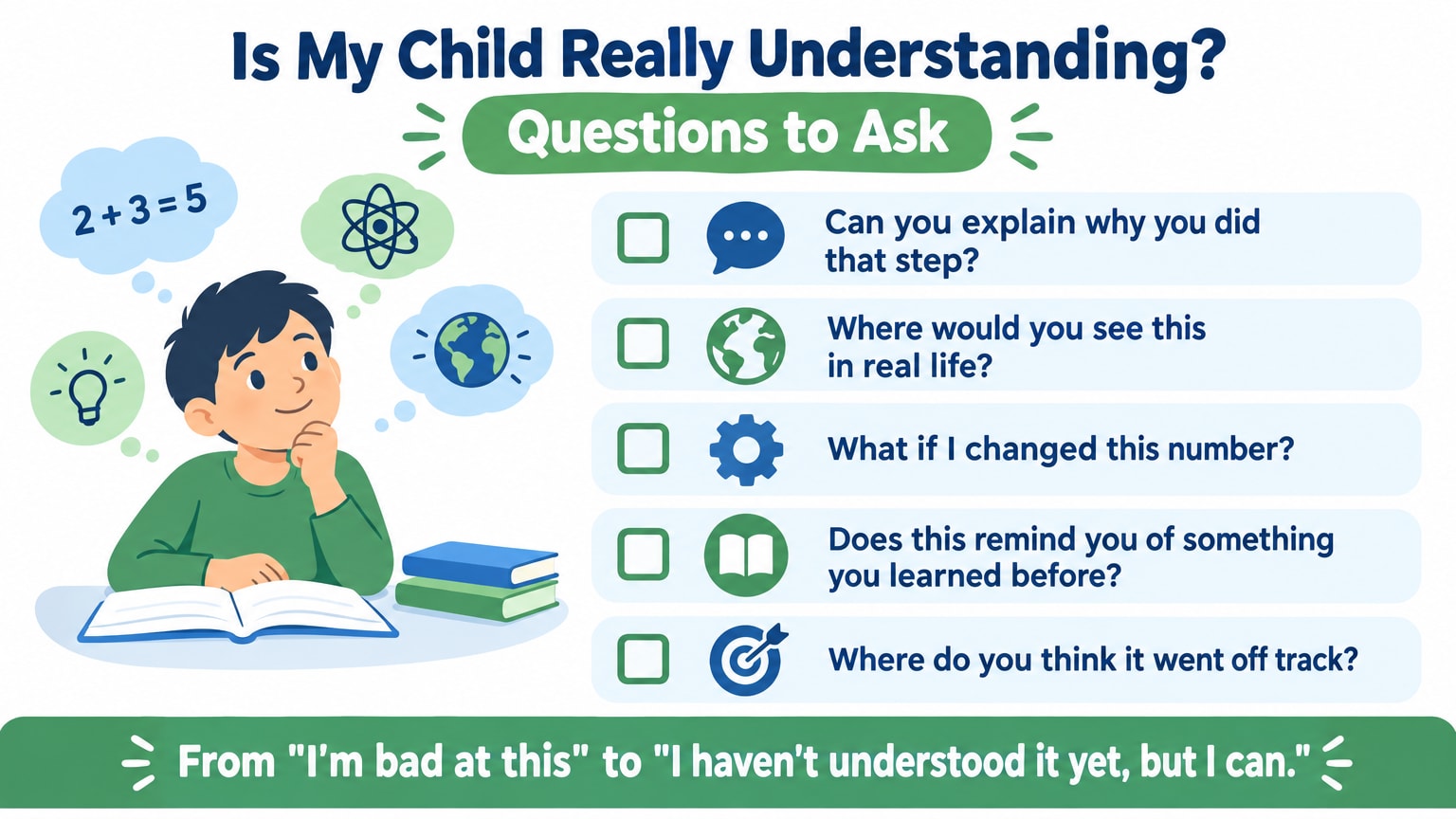
- "Can you explain why you did that step?"
- "Where would you see this in real life?"
- "What if I changed this number? What would happen to the answer?"
- "Does this remind you of anything you learned before?"
- "If you got it wrong, where do you think things went off track?"
If your child can't answer these yet, don't worry. That simply shows where the learning needs to go next.
Which Teaching Strategies Build True Understanding in Math and Science?
Piling on more practice rarely fixes a misunderstanding. If a child is practicing the wrong mental model, repetition can make it stronger. These strategies focus on the why.
1. Start with a safe, judgment-free space
For a child who has become anxious or disengaged, the most important first step is rebuilding confidence. Pushing more practice or correcting every mistake can make an anxious child feel even more discouraged. A good tutor first tries to understand what the child finds confusing and where their confidence started to break down. Here, curiosity matters more than getting the right answer immediately.
2. Use visuals before numbers
Visualization combined with real-life analogies helps children see the logic behind a concept instead of memorizing rules.
Example: fractions. Instead of assigning more fraction problems, a tutor can use a pizza or a chocolate bar divided into equal parts. By seeing that two halves make a whole, or that one-half is bigger than one-third, the child begins to understand fractions rather than just follow rules. Only then does the tutor move gradually to numerical problems, checking that the child can explain their reasoning on their own.
3. Begin with real-life questions, not formulas
Science feels intimidating when it starts with equations. It feels approachable when it starts with something your child has already seen.
Example: physics. A tutor might ask, "Why does a ball slow down when you roll it across the floor?" Your child can think, observe, and share ideas without worrying about formulas or wrong answers. From there, the tutor connects those observations to the scientific concepts behind them, so understanding develops naturally.
4. Ask "why" more than "what"
When a child explains their reasoning out loud, two things happen. They strengthen their own understanding, and the teacher can hear exactly where the thinking breaks down. A wrong answer with a clear explanation is often more useful than a right answer that was guessed or memorized.
5. Change the problem to test understanding
Once a concept seems clear, a strong teacher deliberately changes the wording, numbers, or context. If the child can still solve it, the understanding is real. If not, they go back to the concept, not to another round of identical drills.
6. Treat mistakes as information
Mistakes show how a child is thinking. When they're treated as chances to learn rather than failures, children stop hiding their confusion and start working through it.
How Do These Strategies Move a Child from Concrete to Abstract?
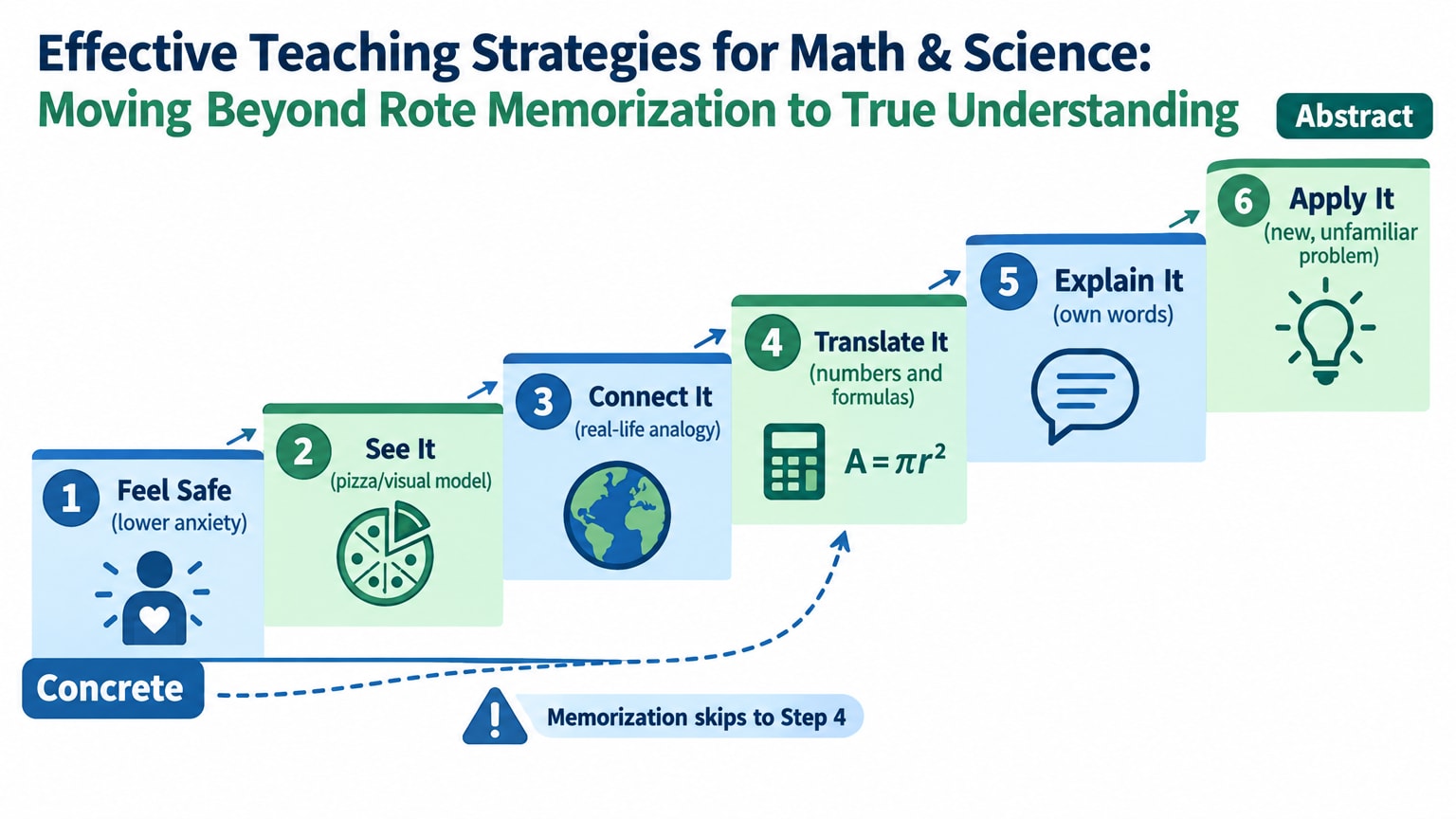
The strategies above build on each other in order. Each stage gives the child a firmer footing before the next step up:
- Feel safe: Lower the anxiety so the child is willing to try.
- See it: Use a visual or physical model, like the pizza or the rolling ball.
- Connect it: Link the model to a real-life analogy or a concept the child already knows.
- Translate it: Move gradually to numbers, symbols, and formulas.
- Explain it: The child describes the reasoning in their own words.
- Apply it: The child solves an unfamiliar version of the problem on their own.
This order matters. Children who memorize usually skip straight to step 4, the formula, without the foundation underneath. Strong teaching strategies build that foundation first, so the formula makes sense when it arrives.
Why Does Deep Understanding Matter for Your Child's Future?
What your child learns now gets reused later in harder forms. A child who understands the fundamentals of algebra will find it easier to approach functions, more complex equations, and physics, where the same ideas come back. A child who memorized algebra tricks often has to start from scratch each time.
For students who have struggled before, prioritizing understanding over quick tricks brings lasting benefits:
- Stronger foundations: They connect new concepts to what they already understand instead of starting over.
- Better problem-solving: They approach unfamiliar questions logically instead of hunting for a memorized step.
- Academic resilience: When topics get hard, they're more likely to break problems down and try different approaches instead of giving up.
- Real confidence: Understanding how and why something works builds confidence that holds up even on new questions, not just familiar ones.
- Independence: Over time, they learn and apply concepts without needing constant hints.
This is how a struggling learner can go from catching up to keeping up, and eventually to tackling advanced math and science without fear.
What Can Parents Do at Home Starting This Week?
You don't need to reteach the curriculum to make a difference. Small changes in how you talk about homework can help:
- Swap "Is it right?" for "How did you figure that out?" This rewards thinking, not just answers.
- Point out math and science in daily life. Splitting a pizza, measuring for a recipe, or noticing why a bike slows down on grass all reinforce concepts.
- Normalize "not yet." When your child says "I'm bad at this," gently reframe it: "You haven't understood it yet, and that's okay."
- Celebrate small breakthroughs. A clear explanation or a self-corrected mistake is real progress, even if the grade hasn't moved yet.
- Notice the patterns. If your child keeps asking "Which formula?" or freezes on reworded questions, that's a sign a concept underneath needs rebuilding. More practice won't fix that.
Why Do These Teaching Strategies Work Best in 1:1 Tutoring?
If your child has been in group classes and still feels lost, there's a reason. These strategies depend on seeing how a child thinks, and that's hard to do with a whole class.
In 1:1 tutoring, the tutor can:
- Observe your child's thinking in real time and spot the exact misconception behind a mistake.
- Adjust the explanation on the spot, switching from a diagram to an analogy to a real-life example until it clicks.
- Set the pace to your child's stage, slowing down to rebuild a foundation or speeding up once a concept is secure.
- Encourage questions without embarrassment, which matters a lot for anxious learners.
- Celebrate small wins that help turn "I'm bad at this subject" into "I haven't understood it yet, but I can."
This is how we approach tutoring at Asymptode. Our 1:1 online math and science tutoring is paced to your child's stage, and it focuses on understanding why, not memorizing how.
Key Takeaways
- Memorization is fragile. It works on familiar questions and breaks down when anything changes.
- Watch for the signs. Reliance on formulas, constant hints, and freezing on reworded questions all point to memorization. Explaining reasoning, making connections, and self-correcting point to real understanding.
- Effective teaching strategies build from concrete to abstract. Start with safety, then visuals and real-life examples, then numbers, then explanation and new problems.
- Confidence comes before practice. For anxious learners, a judgment-free space is the first step.
- Deep understanding pays off later. It makes advanced topics like functions and physics easier to approach, and it builds resilience and independence.
- 1:1 support helps these strategies work because a tutor can see and respond to how your child thinks.
If your child is stuck in a cycle of memorizing, forgetting, and losing confidence, it doesn't have to stay that way. Learn how Asymptode's personalized 1:1 online math and science tutoring helps children build real understanding at asymptode.com.
FAQ
How can I tell if my child is memorizing instead of understanding math?
Change the wording of a familiar problem and see what happens. If your child freezes, keeps asking which formula to use, or can't explain why a method works, they're probably relying on memorized steps. A child who understands can explain their reasoning, apply the idea to a new problem, and spot their own mistakes.
What is one effective teaching strategy for a child struggling with fractions?
Start with something they can see, like a pizza or chocolate bar cut into equal parts. That shows why two halves make a whole or why one-half is bigger than one-third. Once your child can explain the idea from the visual, move gradually to numerical problems.
My child is anxious about math or science. Where should we start?
Start by rebuilding confidence, not by adding more practice. Create a judgment-free space where curiosity matters more than getting the answer right straight away. Begin with simple real-life questions, and treat mistakes as chances to learn.
Why do these teaching strategies work well in 1:1 tutoring?
In 1:1 tutoring, the tutor can watch how the child thinks, spot misconceptions as they happen, and adjust the explanation and pace right away. That's very hard to do in a group class.