

As parents, we all want our children to succeed in school and beyond. In subjects like math and science, that usually means hoping for more than good grades — we want our kids to genuinely understand what they're learning, not just memorize enough to pass the next test.
Yet real understanding can feel hard to pin down. You may have come across the word "didactic" in conversations about education, and if so, it probably didn't sound like a compliment. Most of what's written about "didactic meaning" online is dictionary definitions and linguistic trivia — the Greek roots, the negative connotations, the comparisons to "pedantic." Almost none of it asks the question that actually matters to a parent: what does didactic teaching look like for my child, and how does it lead to real understanding?
Reclaiming "Didactic": Teaching with Purpose, Not Just Telling
Here's the misunderstanding: many people hear "didactic" and picture a teacher simply telling children what to learn. In STEM, that kind of instruction produces memorization without understanding — students who can recite a formula but freeze the moment a problem looks unfamiliar.
The true didactic meaning is something different. It's intentional, expert-led teaching — a teacher or tutor who knows precisely which concept matters, why it matters, and how to make it click for that particular child.
A good tutor doesn't just hand over the answer. They make the thinking visible: asking the right questions, challenging misconceptions, and connecting new ideas to what the child already knows. The child is still doing the thinking — the tutor is providing the structure and direction that helps that thinking go deeper. The goal is for that guided understanding to eventually become the child's own independent way of reasoning. That's didactic teaching done right: not talking at a child, but teaching with purpose.
From Memorization to Mastery: A Physics Example
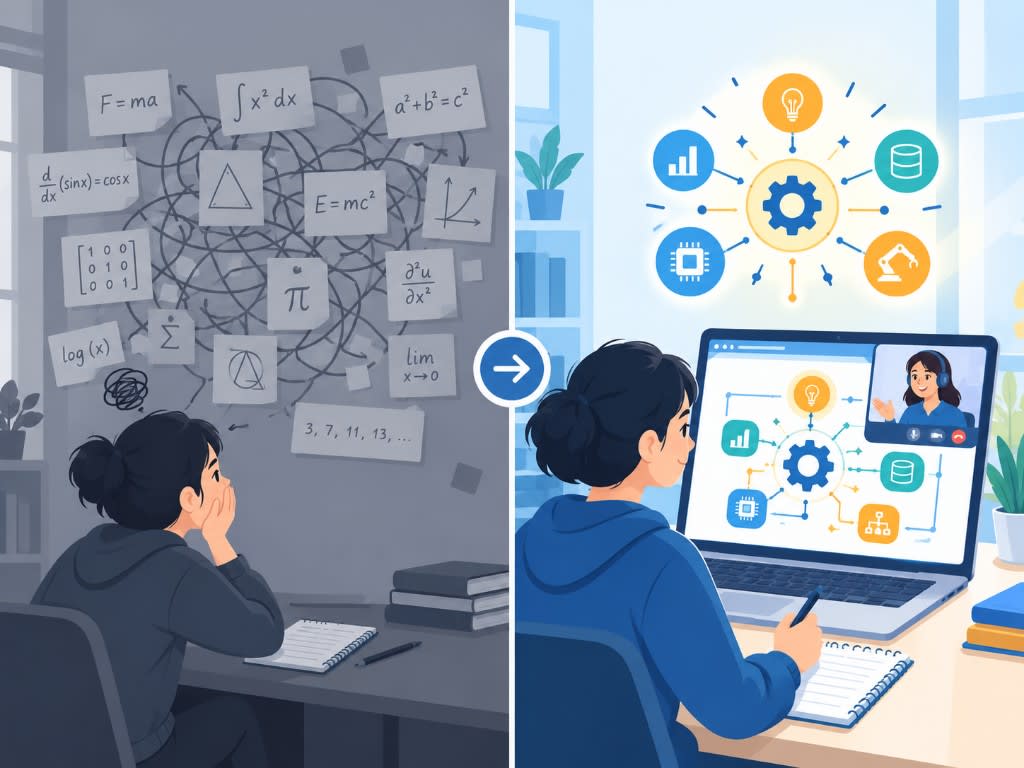
Consider a physics student who could recite every equation for electric circuits — but froze the moment a circuit diagram looked different from the one in the textbook. They knew what to do with the formulas, but not why those formulas worked.
Instead of assigning more formula-based practice, a didactic tutor took a different approach. They explained the underlying principle, sketched the circuit, and asked the student to predict what would happen before solving anything. Then they pushed on the reasoning: "Why do you think the current changes here?" — rather than simply marking the answer right or wrong.
That question exposed the real gap: the student could define current and voltage, but had never built a mental model of how the two actually relate. Once that model existed, the student could reason through an unfamiliar circuit before reaching for a formula at all.
That's the transformation didactic teaching is after — moving a child from "I remember what to do" to "I understand why it works, and I know what to do when the problem changes."
How to Spot Genuinely Didactic Teaching
For a parent trying to tell the difference between real understanding and surface-level teaching, a few questions go a long way:
- Does the tutor ask the child to explain why an answer is correct, rather than just correcting mistakes?
- Do they adjust the explanation, pace, or examples when the child is confused, instead of repeating the same approach louder?
- Are students given unfamiliar problems that test whether they can apply a concept — not just repeat a memorized method?
It also helps to ask a prospective tutor or program directly: "How do you identify the reason behind a repeated mistake?" and "How do you know my child truly understands a concept?"
The right answer isn't just "higher test scores." A strong STEM learning environment shows progress through better reasoning, clearer explanations, fewer repeated misconceptions, sharper questions from the student, and growing independence. The goal is a child who moves from "I know the formula" to "I understand why it works — and when to use it."
Beyond Grades: Building Critical Thinkers for a Changing World
A genuinely didactic approach gives children something grades alone can't measure: the ability to think when the answer isn't obvious. When a student understands the reasoning behind a concept, they can transfer that understanding to unfamiliar problems, connect ideas across subjects, and adapt as the context shifts.
A student who truly grasps the principles behind energy conservation or mathematical modeling can apply that thinking to a piece of technology or a problem they've never encountered before. That's what builds the ability to question assumptions, test ideas, learn from mistakes, and develop new solutions.
In a world that keeps changing faster than any curriculum can keep up with, the most valuable STEM skill isn't knowing every answer — it's having the confidence and reasoning ability to figure out what to do next.
How Asymptode Embodies Didactic Teaching

At Asymptode, our 1:1 online math and science tutoring is paced precisely to each child's stage, so the experience stays genuinely personalized — and genuinely didactic. We focus on intentional, expert-led teaching that prioritizes deep, lasting comprehension over rote memorization.
Our tutors are trained to make thinking visible, guide students through difficult concepts rather than around them, and foster the kind of independent thinking that's the real hallmark of understanding. We believe every child deserves the chance to actually grasp STEM — not just survive it — and that understanding is what opens doors to their future.
Key Takeaways
- Didactic teaching means intentional, expert-led guidance — not just telling.
- It works by making thinking visible and challenging misconceptions, not by handing over answers.
- Real understanding shows up when a child can apply a concept to a problem they've never seen before.
- This approach builds critical thinking and problem-solving skills that outlast any single test.
- Asymptode's 1:1 tutoring model is built to deliver exactly this kind of lasting understanding in STEM.
Ready to see your child move beyond memorization to genuine understanding in math and science? Explore Asymptode's personalized 1:1 online tutoring at asymptode.com and discover what didactic learning can do for your child.