

As a parent, you want nothing more than to see your child succeed, especially in subjects as fundamental as math and science. When your child struggles, the search for effective help often leads to online math courses programs that promise "mastery," "guaranteed success," or "catching up quickly." But for many parents of struggling learners, the reality falls short, leaving both you and your child feeling frustrated and further behind.
At Asymptode, we understand that frustration. You want your child to genuinely understand math, not just memorize for tests. You want them building a strong foundation, feeling confident, and enjoying learning again. This guide is here to help you navigate the crowded landscape of online math courses and reveal what actually makes a program effective for real progress and lasting understanding.
The "Mastery" Myth: Red Flags in Online Math Programs
Many online math courses define "mastery" in ways that don't serve a struggling learner. The biggest red flag: mastery measured by completion rates or test scores rather than whether your child can actually explain and apply the concept. That leads to a cycle of memorization without real comprehension.
Be cautious of programs that lean heavily on:
- Passive learning endless videos with little interactive engagement or application.
- Automated hints and repetitive worksheets these can become crutches that prevent genuine problem-solving.
- Fixed sequences a rigid curriculum that doesn't first diagnose why your child is struggling, pushing them through material they aren't ready for or skipping foundational gaps.
Another common misconception: a prestigious name automatically means a program is right for your child. Resources tied to institutions like Harvard or MIT are academically excellent, but they aren't necessarily built around the individual diagnosis, remediation, pacing, and confidence-building a struggling K-12 learner needs. They're often designed for advanced students or adult learners, not children grappling with core concepts.
The question every parent should ask: "If my child keeps getting the same type of question wrong, who identifies the misconception, and what changes in the teaching?" If the answer is simply "more practice," that's a warning sign. Real mastery starts with understanding the learner, not just delivering more content.
Beyond the Syllabus: Non-Negotiable Elements for Lasting Understanding
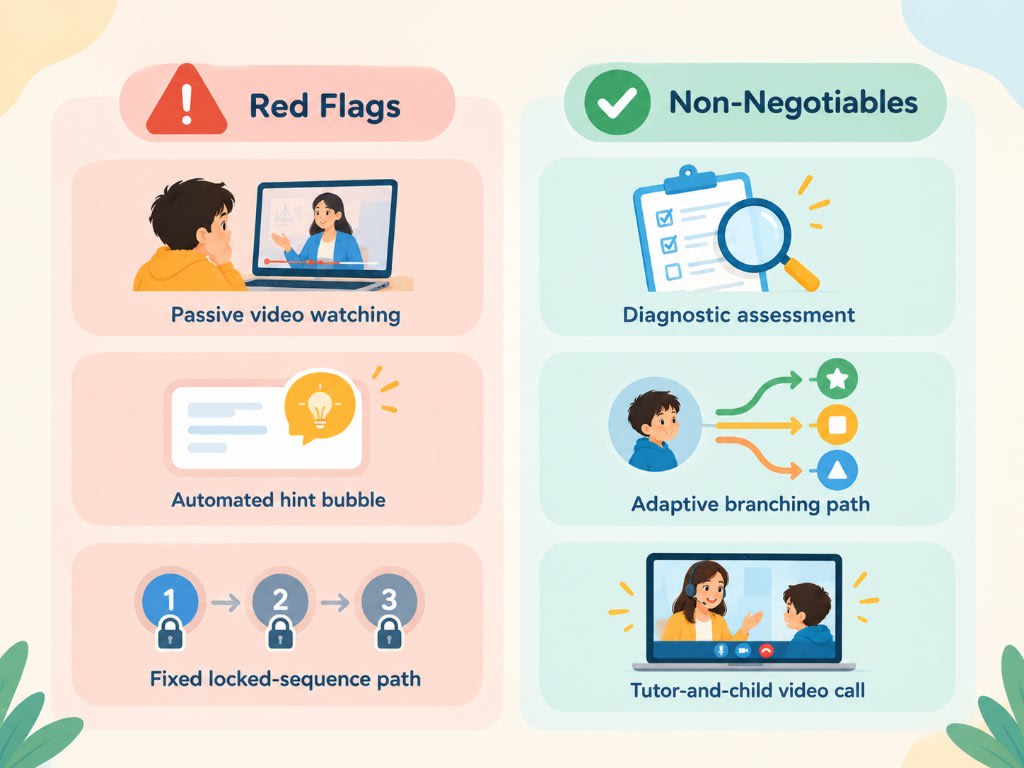
A good online math course needs more than a strong syllabus or topic list. For a struggling student, certain elements are non-negotiable:
- Diagnostic assessment a real initial assessment that identifies prerequisite gaps and root causes, not just surface-level errors.
- Adaptive learning path a curriculum that changes based on those gaps and your child's ongoing progress, not a fixed track.
- Frequent, explanatory feedback feedback that explains why an answer is wrong, not just that it's wrong.
- Checks for retention and transfer deliberate ways to confirm your child can explain the concept later and apply it to unfamiliar problems.
For deeper, more persistent gaps, human intervention matters. That means a qualified tutor who can observe a student's reasoning in real time, change explanations on the fly, adjust pace to the child, and revisit foundations without judgment.
A self-paced course can deliver content efficiently but it can't reliably diagnose the individual reason a child is struggling. A course catalog tells you what will be taught; a real learning system shows you how it discovers, fixes, and verifies what your child hasn't understood.
The "Aha!" Moment: Fixing Foundational Gaps with Personalized Learning
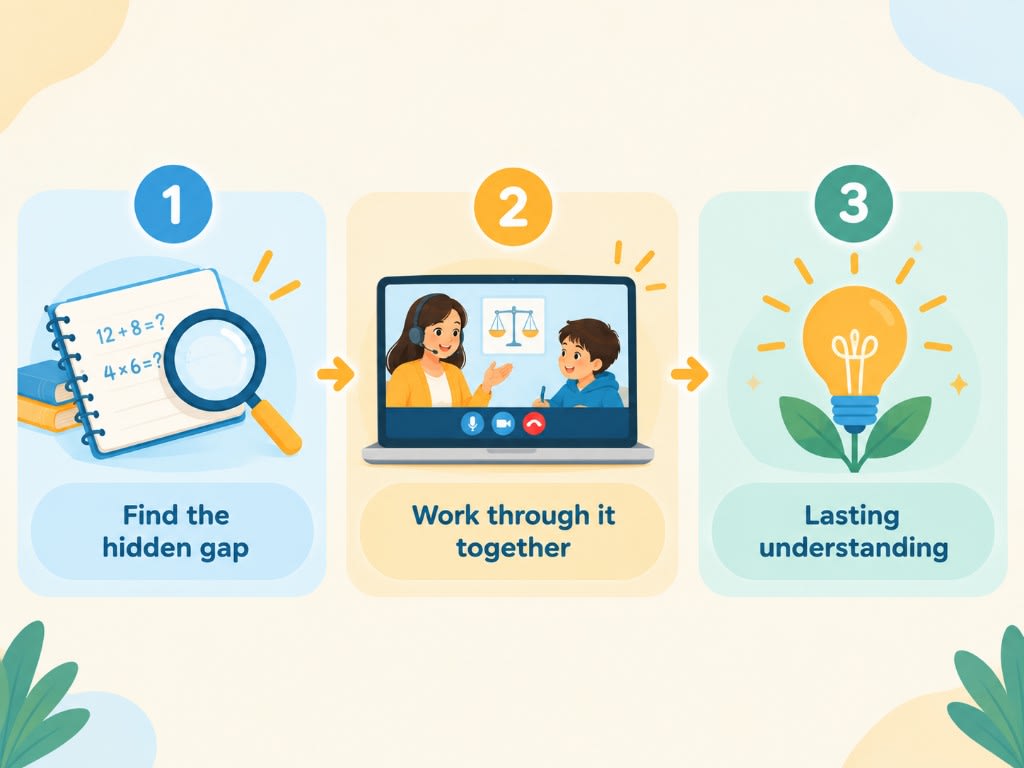
Generic online courses often miss the specific, hidden gaps a struggling student carries. Here's what that looks like in practice.
An algebra student could follow procedures but kept making mistakes with equations. At first, it looked like they just needed more practice. But 1:1 tutoring uncovered a deeper gap: the student saw the equals sign as "now calculate the answer" rather than a statement that both sides are equal. That misunderstanding was the real barrier not a lack of practice.
Working one-on-one, the tutor slowed down, used a balance-style visual, and asked the student to predict what would happen if the same operation were done to both sides. The breakthrough came when the student said, "Oh, I'm not moving numbers I'm keeping both sides equal." From there, the tutor tested the idea on unfamiliar equations and gradually removed the prompts, until the new understanding held on its own.
The change wasn't just more correct answers the student could finally explain the reasoning and transfer it to new problems. That's the power of personalized learning: find the hidden gap behind the mistake, fix the foundation, then build forward.
What Does "Lasting Understanding" Really Look Like?
Many platforms optimize for completing modules or passing tests. For a struggling student, real success looks different your child can:
- Explain a concept in their own words, not just recite a definition.
- Apply it to unfamiliar problems, showing real flexibility, not rote pattern-matching.
- Still use it weeks later without needing a reminder.
You'll see real proof of lasting understanding when your child solves new questions independently, catches and corrects their own errors, or calmly teaches the idea back to someone else. That's deep, internalized knowledge not temporary memorization for a test.
Choosing the Right Path for Your Child's Success
Navigating online math courses for a struggling child can feel overwhelming. But once you know what to look for, you can make an informed choice look past flashy promises and prestigious names toward programs built around genuine diagnosis, adaptive learning, human intervention, and a clear path to lasting understanding.
Your child deserves a dedicated mentor who understands their unique pace and learning style, and helps them work through hurdles without judgment. At Asymptode, we offer 1:1 online math & science tutoring, paced to your child's stage, built to restore a strong foundation and real confidence. Discover how personalized learning can lead to real progress and a renewed love for math and science.
Key Takeaways
- Red flags: mastery measured by completion, heavy reliance on automated hints, fixed sequences with no diagnosis.
- Non-negotiables: diagnostic assessment, adaptive learning path, explanatory feedback, human tutor intervention.
- True progress: programs that find and fix foundational gaps, leading to real "aha!" moments.
- Lasting understanding: your child can explain, apply, and retain concepts independently not just pass a test.
Ready to choose a path built around real progress? Explore Asymptode's personalized 1:1 online math and science tutoring at asymptode.com.