

When you hear "completely science," you might picture a research lab, or even an unblocked games site. But if you're a parent worried about your child's science learning, it points to something more personal: a foundation strong enough that the next few years of school don't feel like a struggle.
What Does a "Complete" Science Foundation Mean?
We define a complete science foundation not as knowing a large number of facts, but as understanding how scientific ideas connect and how to use them to make sense of the world. A strong K-12 foundation combines conceptual knowledge, scientific reasoning, mathematical thinking, evidence-based problem solving, and curiosity.
In Physics, for example, a student shouldn't only memorize the equation for force. They should understand what force represents, predict what might happen in a new situation, interpret a diagram or graph, explain their reasoning, and then use the equation to test that explanation. The same principle applies across Biology, Chemistry, and Earth Science: understand the idea → connect it to evidence → apply it in a new context → explain why it makes sense.
So the goal isn't simply to make a child "good at science" for the next test. It's to develop a student who naturally asks "Why?", "How do we know?", and "What would happen if…?" and has enough conceptual foundation to investigate those questions. That is a much broader definition of science learning than content coverage or memorization.
What Does It Look Like at Different Ages?
- Elementary: Observes, describes, and asks why. Can say what they think will happen before an experiment and explain what changed afterward.
- Middle school: Comfortable with ratios, simple graphs, and basic equations. Can explain a result in their own words, not just recite a definition.
- High school: Moves between equation, graph, diagram, and verbal explanation. Can adapt a method to an unfamiliar problem.
The Bottleneck Effect: How Early Gaps Affect Later Learning
A common pattern is that a small science gap doesn't cause an immediate crisis. It becomes a bottleneck later, because concepts build on one another.
Imagine a student who reaches high school Physics without a strong understanding of proportional reasoning, graphs, and basic algebra. They may manage simple formula-based questions at first. But as Physics becomes more conceptual, they struggle to translate a physical situation into equations or interpret graphs.
The student may then conclude, "I'm just not a Physics person," and avoid more advanced science courses. But the underlying issue wasn't lack of potential. It was a foundation that was never repaired. If a tutor identifies the gap early, rebuilds those fundamentals, and reconnects them to current Physics, the student can regain access to more advanced work.
To be fair, one early gap doesn't determine a student's career path. But foundational gaps can narrow a student's confidence and willingness to pursue increasingly quantitative subjects if they remain unaddressed. That's why the goal of K-12 science tutoring should be more than fixing the next test. It should keep future academic choices open by making sure today's foundations are strong enough to support tomorrow's learning.
Beyond Grades: Red Flags Parents Can Spot Early
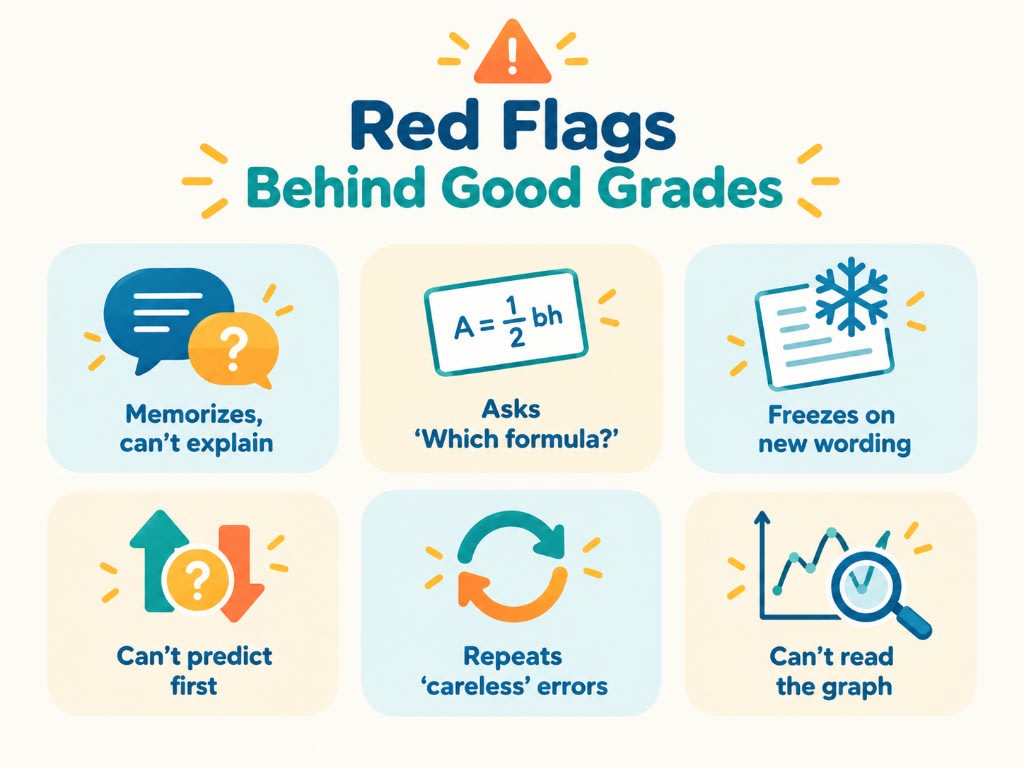
Some of the strongest warning signs show up while grades still look acceptable. Look for patterns in how your child thinks about science:
- They can memorize but can't explain. They can state a formula or definition but struggle to say what it means in their own words.
- They ask "Which formula?" immediately. This can mean they haven't learned to identify the underlying principle before choosing a method.
- They succeed only when questions look familiar. Change the diagram, wording, or context and they freeze.
- They can't predict before calculating. If they can't say whether an answer should increase, decrease, or stay similar, they may be relying on procedure rather than understanding.
- They repeat the same "careless" mistake. A recurring error is worth investigating rather than dismissing.
- They struggle to connect representations. They can calculate from an equation but can't interpret the matching graph or diagram.
- They avoid explaining their reasoning. "I just know" or "That's the formula" can signal that the mental model isn't developed yet.
- They need increasingly frequent hints. Finishing homework with heavy prompting can hide a growing independence gap.
A Simple Parent Check
Ask: "Can you explain why this answer makes sense without looking at your notes?" Then change one part of the problem and see whether your child can adapt.
If they can't, don't simply assign more practice. Ask, "What concept is missing underneath this?" and address that foundation before the gap compounds. The aim is to catch the difference between "I can complete this" and "I actually understand this" before it becomes a major academic problem.
Why 1:1 Foundational Tutoring Works
1:1 foundational tutoring doesn't start with "What topic should we cover next?" It starts with "What is preventing this student from understanding the topic?" More classroom work or videos can provide more explanations and practice, but they may not reveal the specific misconception or missing prerequisite underneath a student's struggle.
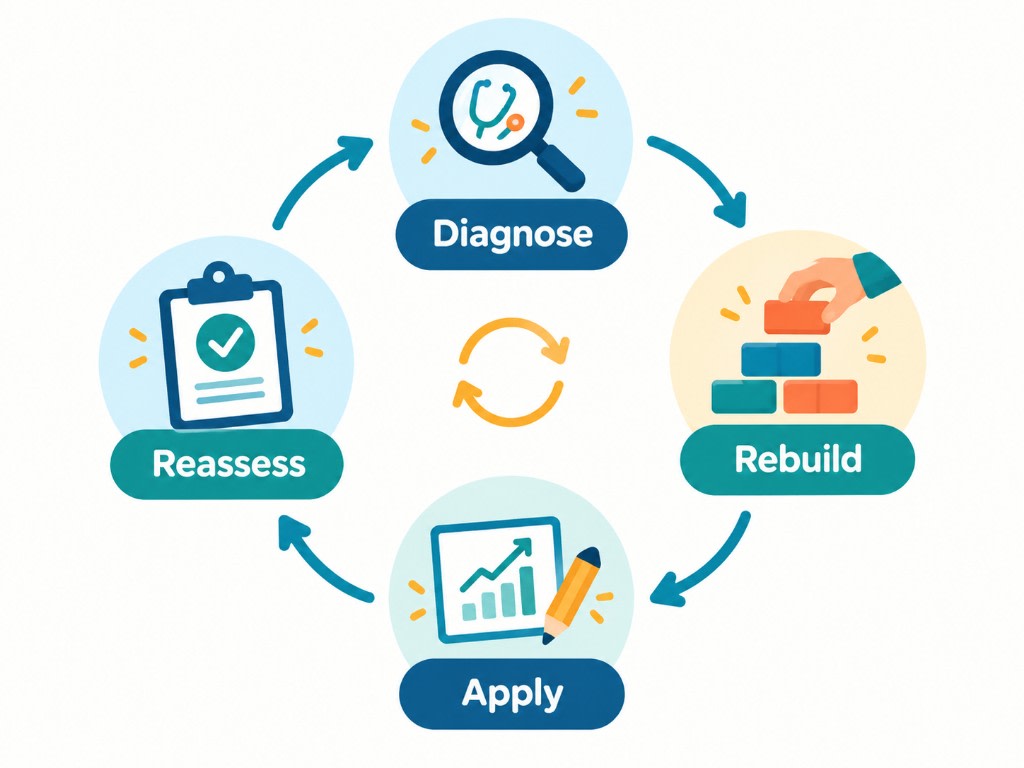
At Asymptode, the process is diagnose → rebuild → apply → reassess.
- Diagnose: The tutor listens to how the student explains an idea and identifies whether the problem is conceptual, mathematical, procedural, or foundational.
- Rebuild: They step back to the missing building block, using a diagram, physical example, analogy, equation, or guided questions until the idea makes sense.
- Apply: The idea is reconnected to what the student is learning in class right now.
- Reassess: The tutor deliberately changes the problem or representation to check that the understanding transfers, and gradually removes their own support.
For example, a student who struggles with Physics formulas may actually have difficulty interpreting graphs or proportional relationships. More Physics worksheets won't necessarily fix that. Rebuilding the underlying concept and reconnecting it to Physics will.
That's what makes the approach comprehensive: we aren't just helping a student get through today's science work, we're strengthening the foundations that make future science easier to understand independently.
Key Takeaways
- A complete science foundation means understanding, reasoning, and curiosity, not memorized facts.
- Small gaps compound because science concepts build on each other.
- Red flags often appear before grades drop. Watch how your child explains, predicts, and adapts.
- Asking "What's missing underneath?" beats assigning more of the same practice.
- 1:1 tutoring finds and repairs the root cause, then checks that it holds.
Ready to help your child build a strong, lasting foundation in science? Explore Asymptode's personalized 1:1 online math and science tutoring at Asymptode.com.