
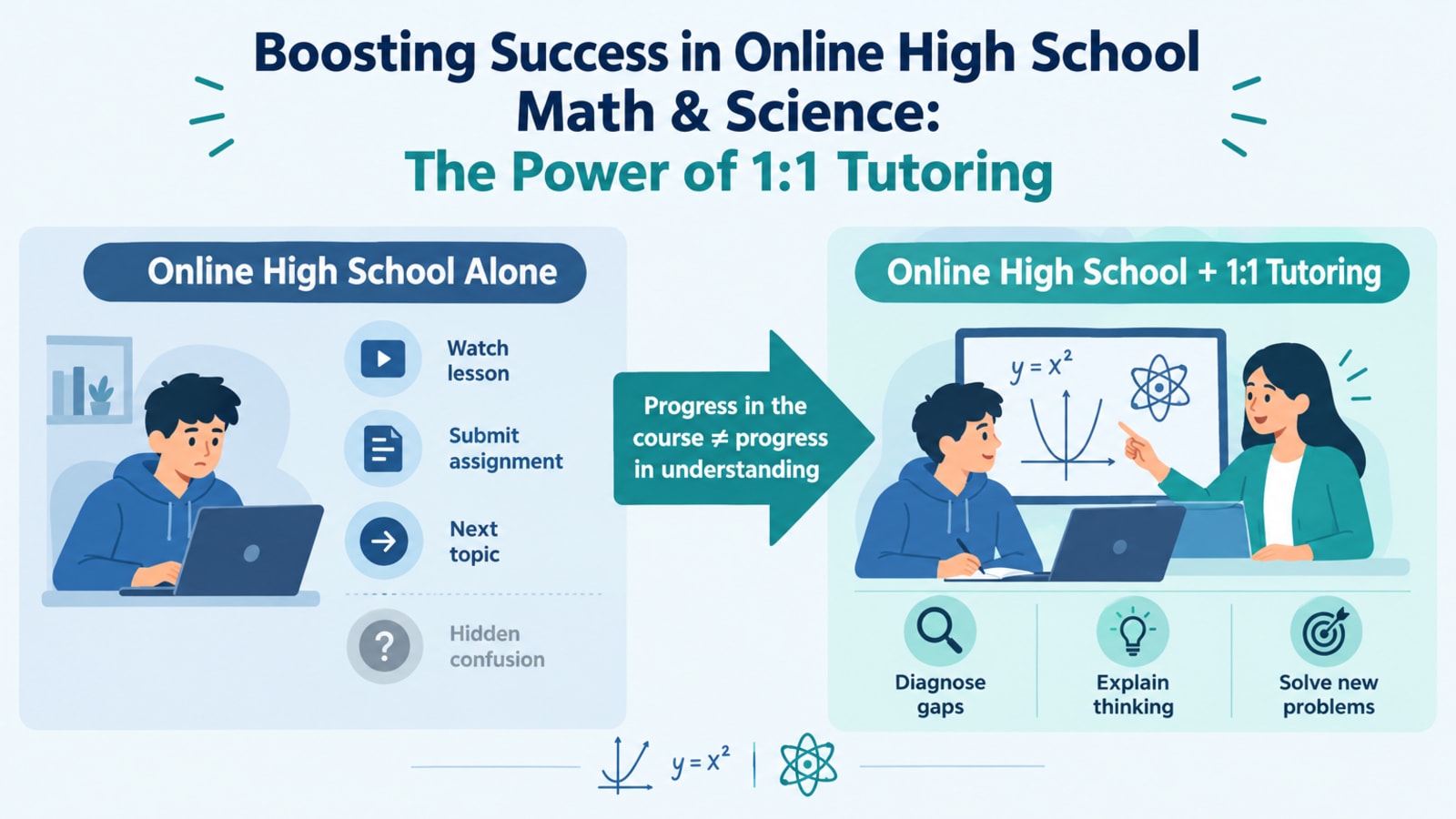
Your teen logs in, watches the lesson, submits the assignment and moves on. The dashboard says they're on track. Then a quiz comes back with a low score, or you see them staring at a Physics problem for twenty minutes without writing anything. Something isn't adding up, and you're not sure what.
If you're the parent of a student in an online high school program, you may already be asking yourself whether online learning can really work for a child who struggles with focus, or who needs someone to guide them directly. It's a fair question. Most online high school websites talk about accreditation, flexibility and self-paced courses. Very few talk honestly about what happens when a student starts quietly falling behind in math or science.
In this post, I'll explain where online math and science courses tend to go wrong for students who are struggling, why 1:1 tutoring can fill that gap, and how you can work out whether your child needs that support and how to fit it alongside their current online course.
Is Online High School Effective for Students Who Struggle With Math and Science?
Online high school can be a great fit for many students. Programs such as Excel High School and K12 emphasize flexible schedules, self-paced coursework and access to teachers. For a student who's motivated and confident, that freedom can be a real advantage.
For a student who's struggling, the same flexibility can work against them, because it can hide confusion. In an online course, a student can watch a lesson, finish an assignment and move on without really understanding what came before.
In math and science, that matters a lot, because each concept builds on the last. A small gap in algebra, graphs or scientific reasoning can grow into a much bigger problem a few units later. A student can fall behind without anyone noticing, since moving through the course doesn't always mean understanding it.
So the honest answer is that online high school can work, but for a student who struggles, it rarely works alone. What usually makes the difference is how much personal support they get.
Why Do Students Lose Focus in Online High School Math and Science?
Even with general teacher support, I see a few problems come up again and again for students who struggle in online math and science courses.
- Real-time diagnosis is limited. Teachers can answer questions, but a struggling student often doesn't know what to ask, or can't explain where their thinking goes wrong.
- Learning becomes passive. Watching videos and following worked examples can feel like understanding, until the student has to solve a new problem on their own and freezes.
- Screens bring distraction and fatigue. Notifications, extra tabs and long hours in front of a screen make it hard to concentrate, especially when the material already feels difficult.
- Self-pacing happens without a clear plan. Students may spend too long on easy topics, avoid the hard ones, or rush through lessons to catch up.
- Some students are afraid to ask for help. They stay quiet in online classes because they don't want to look behind their classmates, so their misunderstandings stick around.
- Practice repeats without progress. A student may finish worksheet after worksheet and still make the same mistakes, because no one has found the gap underneath.
If some of these sound familiar, your child isn't lazy and you haven't failed as a parent. These are predictable problems in a learning setup that relies on students working out for themselves what they don't understand.
More screen time or a stricter schedule won't fix them. What helps is active, personal support that makes the student's thinking visible.
How Does 1:1 Tutoring Help Online High School Students Regain Focus?
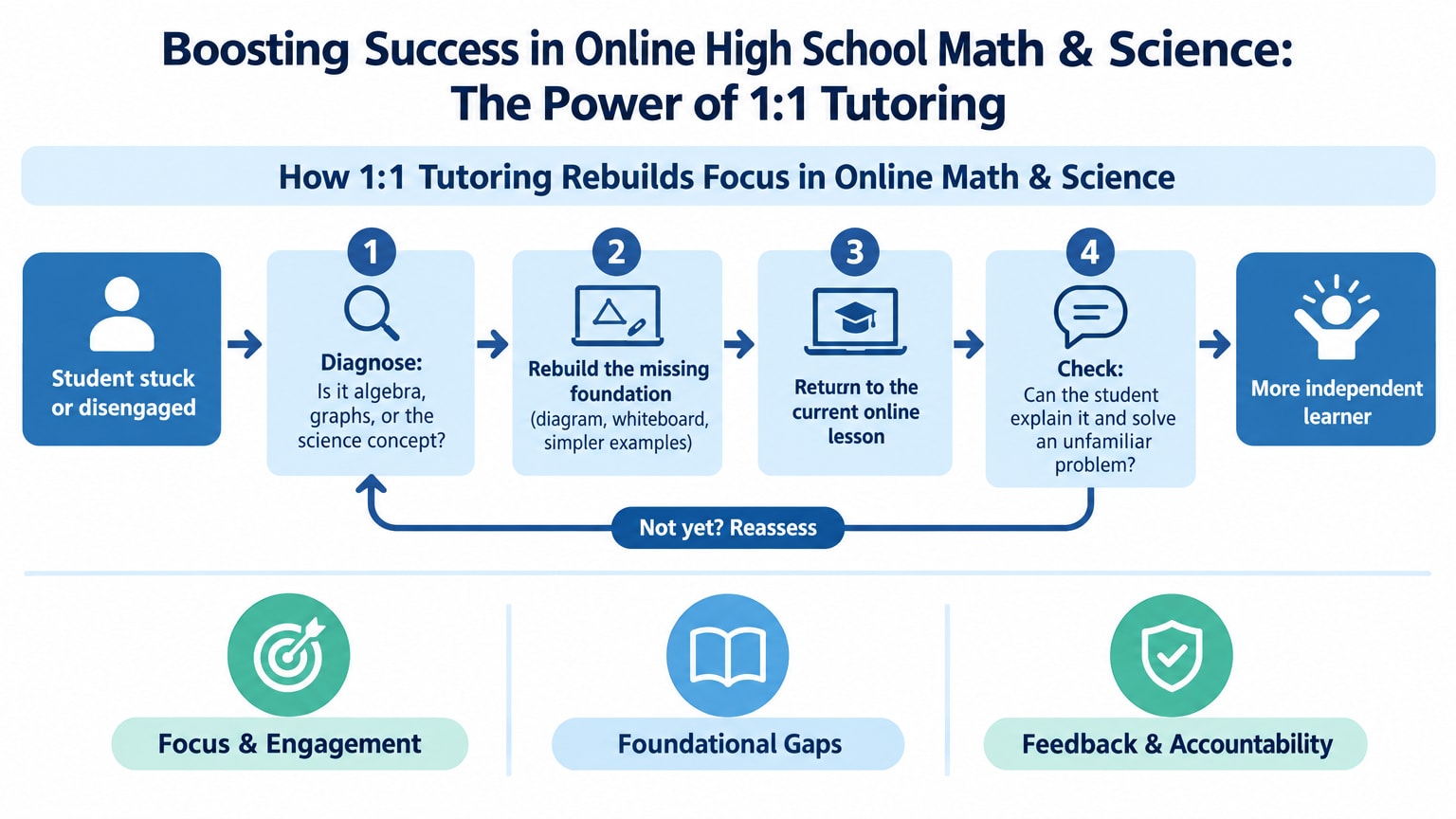
The biggest advantage of personalized 1:1 tutoring is that the tutor responds to the student's thinking as it happens, instead of just helping them move through the course. When a student loses focus because the material feels confusing or overwhelming, the tutor can break the problem into smaller steps, try a different explanation, sketch a diagram on a digital whiteboard and pull the student back into solving the problem.
That helps in three main ways.
1. Focus and engagement
In a good 1:1 session, the student does the work: explaining, predicting, solving and asking questions. The tutor adjusts the pace and difficulty so the work stays manageable but still meaningful. That's very different from sitting through a pre-recorded video at the end of a long day of screen time.
2. Foundational gaps
When a student gets stuck on a high school Physics problem, the cause may lie somewhere else. A tutor can work out whether the real obstacle is algebra, reading graphs or the scientific principle itself, then rebuild that missing piece before going back to the current lesson. Self-paced modules generally can't make that kind of diagnosis.
3. Feedback and accountability
A 1:1 tutor spots misunderstandings as they happen, gives specific feedback and sets clear goals for the next session. Finished assignments count, but progress is mainly measured by whether the student can explain a concept and solve unfamiliar problems with less help.
Take a student who keeps getting stuck on Physics equations. At first, they might look disengaged. A tutor might find that the real problem is turning a word problem into a diagram. Once that specific skill is addressed, the lesson can start to feel manageable again, and the student becomes willing to take part.
Keeping up with the online course matters, but the larger goal is to help the student take back control of their learning, fill the gaps holding them back, and become more and more independent.
What Does 1:1 Tutoring Look Like in an Online Physics Course?
Here's a representative scenario. It illustrates how this kind of support works; it isn't a verified case study of one specific student.
Picture a high school student in an online Physics course. They can follow the video lessons and memorize the equations, but motion problems presented in an unfamiliar way trip them up every time. When someone tells them which formula to use, they can plug in the numbers. On their own, they don't know how to choose the right equation. Their confidence drops, and they start putting off assignments.
In 1:1 sessions, the tutor stops assigning more equation practice and focuses on how the student thinks through a problem. They ask the student to:
- Describe what's physically happening in the problem.
- Identify the known and unknown quantities.
- Sketch the situation.
- Predict what should happen before calculating anything.
It soon becomes clear that the main difficulty is turning word problems into diagrams. So the tutor practises that skill with simpler examples first, then gradually works back up to the harder course questions.
The real change is that the student starts explaining their reasoning before choosing an equation, and needs fewer prompts on unfamiliar problems. What helped was learning how to decide which formula makes sense, and why. Memorizing more formulas, or simply finishing more online lessons, might never have solved that.
How Can You Tell If Your Child Needs 1:1 Tutoring?
Before paying for tutoring, it helps to understand what's actually going on. Here are two practical steps I'd recommend.
Step 1: Look beyond grades and identify the pattern
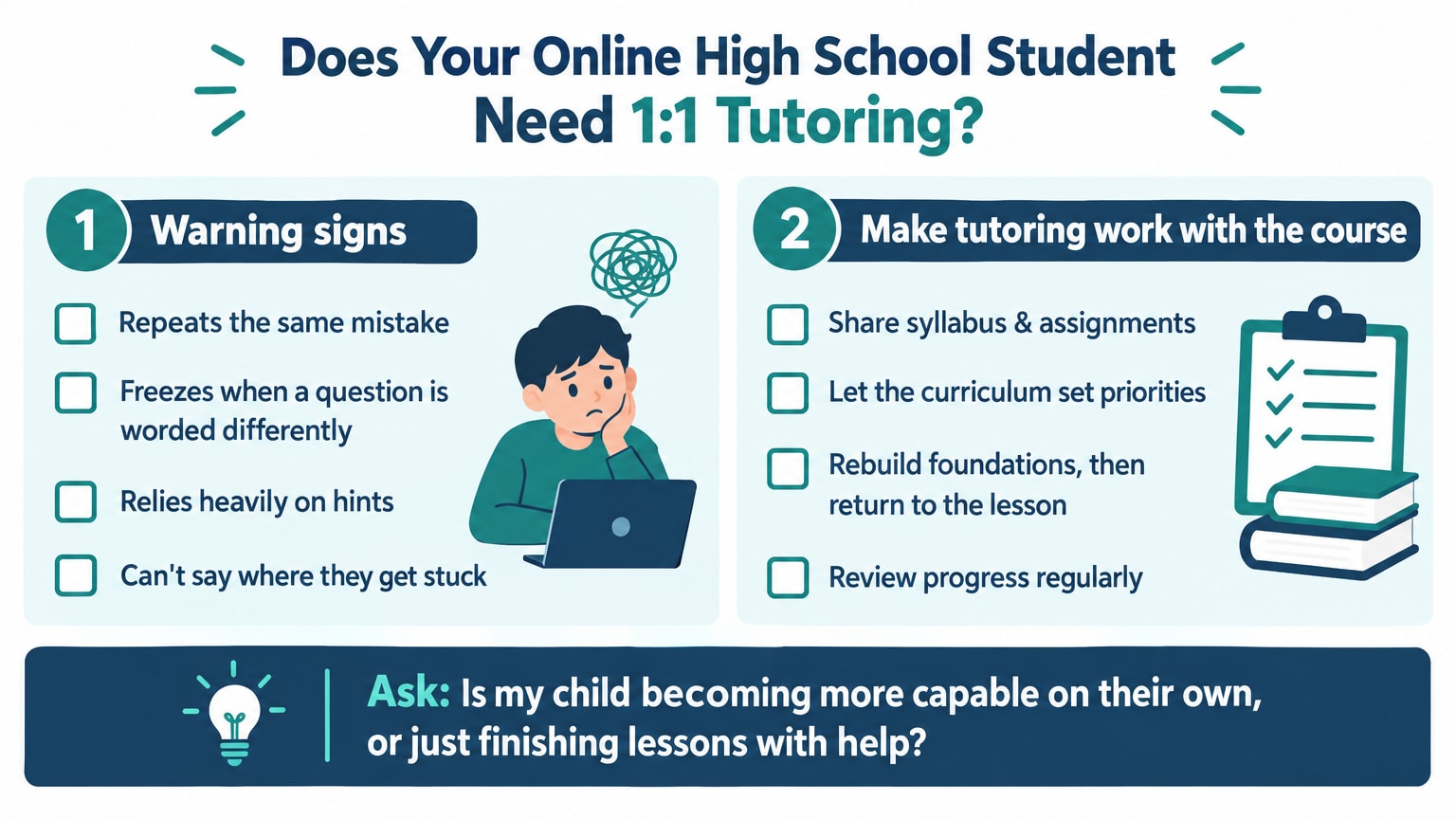
Ask your child to explain a recent math or science problem in their own words. Can they explain why a method works, or can they only follow an example? Watch for signs like these:
- They make the same mistake over and over.
- They freeze when a question is worded differently.
- They rely heavily on hints or worked examples.
These signs often point to a gap in the basics rather than a need for more practice.
Step 2: Ask what happens when they get stuck
Try questions like:
- "Which part makes sense, and where do you lose the thread?"
- "If we changed the numbers or the diagram, would you know how to approach it?"
If your child can't say where the difficulty is, or if extra videos and worksheets aren't helping, that's a strong sign a 1:1 tutor could help. A tutor can dig into their reasoning and find the underlying problem.
How Do You Combine 1:1 Tutoring With an Online High School Curriculum?
Many parents worry that a tutor will add a second curriculum that clashes with the one their child already has. Done well, tutoring supports the online program instead of competing with it.
Here's how to fit the two together:
- Share the materials. Give the tutor the course syllabus, upcoming assignments, quizzes and practice-test results.
- Let the curriculum set the priorities. Use the course to decide what needs attention, then let tutoring focus on the specific gaps holding your child back.
- Rebuild the basics, then return to the lesson. If a Physics assignment covers forces but your child struggles with algebra or reading graphs, the tutor can briefly rebuild that skill before going back to the current lesson.
- Review and adjust regularly. As the course moves on, check progress and shift priorities.
The online course provides structure and covers the material, while 1:1 tutoring provides diagnosis, tailored explanations and targeted practice.
How Should You Judge Whether Tutoring Is Working?
I'd encourage every parent to come back to one question:
"Is my child getting better at solving problems on their own, or just getting better at finishing lessons with help?"
That difference is often the clearest sign of whether the support is working. Good signs include:
- Your child can explain the concept in their own words.
- They can apply it to an unfamiliar problem.
- They need less help as time goes on.
- They're more willing to try hard assignments instead of avoiding them.
These signs show real understanding building up, and that understanding is what protects your child from falling behind again in the next unit or the next grade.
Key Takeaways
- Online high school can hide confusion. Moving through a self-paced course doesn't always mean understanding it, especially in math and science.
- The common problems are predictable. Limited real-time diagnosis, passive learning, digital distractions, unplanned self-pacing, fear of asking for help and repetitive practice can all quietly push a student behind.
- 1:1 tutoring makes thinking visible. A tutor can spot hesitation, trace mistakes back to missing basics and change the explanation on the spot.
- The breakthrough is often a skill. In Physics, for example, learning to turn a word problem into a diagram can unlock much more than memorizing equations.
- Diagnose before you decide. Look at the pattern behind your child's mistakes, and ask what happens when they get stuck.
- Tutoring should support the course. Share the syllabus and assignments so the tutoring stays focused.
- Measure independence as well as completion. The real test is whether your child solves problems with less help over time.
If your teen is enrolled in an online high school and math or science has turned into a daily struggle, you don't have to wait for things to get worse. At Asymptode, we offer 1:1 online math and science tutoring paced to your child's stage, focused on finding the real gaps and building understanding that lasts. Learn more at asymptode.com.
FAQ
Can online tutoring work for a teen who struggles to focus online?
It can, as long as the sessions are active. In a 1:1 session, the student explains, predicts, solves problems and asks questions instead of watching videos. The tutor can also adjust the pace and difficulty as they go, which makes it easier to stay focused than in a self-paced module.
Will 1:1 tutoring clash with my child's online high school curriculum?
It shouldn't. Tutoring should support the online course, not compete with it. Share the syllabus, upcoming assignments, quizzes and test results with the tutor. The course covers the material, and tutoring works on the specific gaps that are holding your child back.
How do I know if my child needs a tutor or just more practice?
Ask your child to explain a recent problem in their own words, then change the numbers or wording. If they can only follow examples, make the same mistake over and over, or freeze when a question looks different, there's probably a gap in the basics. More practice alone usually won't fix that.
How can I tell if tutoring is actually working?
Ask yourself one question: is my child getting better at solving problems on their own, or just getting better at finishing lessons with help? Signs of real progress are explaining their reasoning, handling unfamiliar problems and needing fewer prompts over time.
References
- Excel High School: Flexible, Accredited Online Programs
- K12: Flexible Online High School Programs
- Acellus Academy: Online High School