

If the same kinds of errors keep coming back, the problem usually isn't effort. It's what the mistakes are really telling you.
You've watched your child work through SAT practice questions, check the answers, and read the explanations. A week later, a similar mistake shows up again. It's frustrating, and it's easy to wonder whether your child is truly understanding the material or just getting lost.
Most practice resources show the correct answer and a short explanation. If your child is still stuck, it's a sign that reviewing the right answer isn't enough. What matters is understanding how your child was thinking when the mistake happened.
The misconception: "learning from mistakes" means knowing the right answer
A common belief is that learning from a mistake means understanding the correct answer afterward. Your child reads the explanation, says "Oh, I get it," and it feels solved. But if the same mistake, or a close variation, appears in a different question a week later, the underlying issue was never addressed.
The fix is to go one level deeper and diagnose the thinking. Instead of explaining the answer, try asking:
- "What did you notice first?"
- "What were you trying to find?"
- "Why did you choose that approach?"
- "Where did you start to feel unsure?"
The answers often show that the real problem isn't the question at all. It might be a missing algebra foundation, trouble translating words into equations, misreading the question, or picking a method before understanding the situation.
For example, if a student keeps choosing the wrong formula, reviewing the formula again won't help. We need to understand why they thought it applied, rebuild the underlying concept, and then test it on a differently worded problem.
The shift for parents is from "My child got this wrong" to "What does this mistake tell us about how my child is thinking?" That's the difference between correcting an answer and improving your child's ability to handle the next unfamiliar question.
Sort mistakes by the thinking behind them
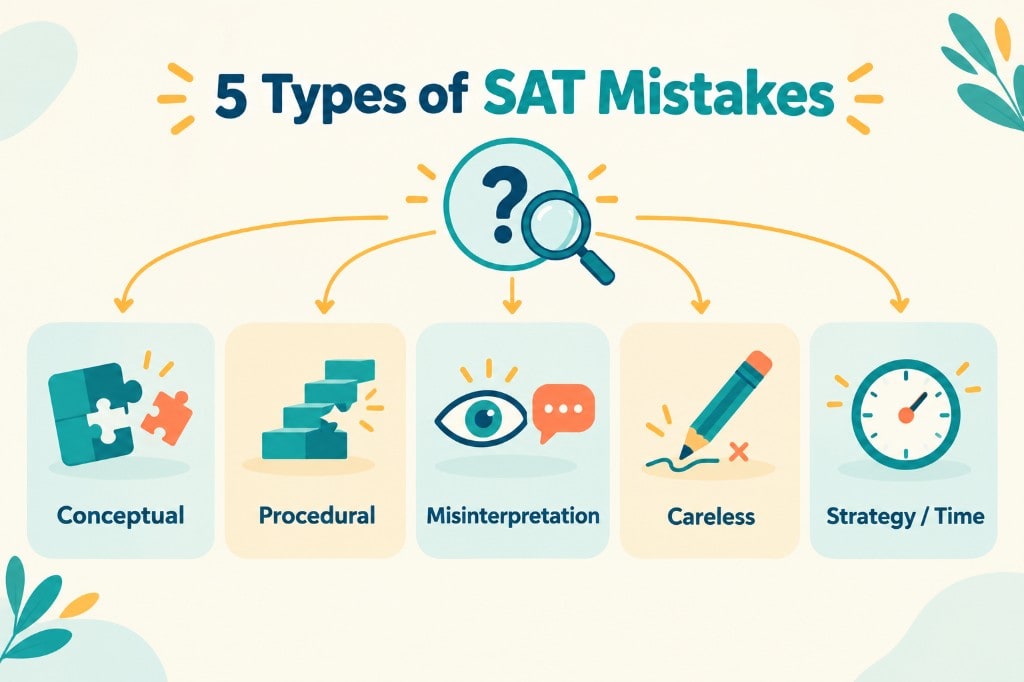
Labeling every error "Math," "Reading," or "Writing" tells you where the mistake happened, not why. A more useful approach is to sort mistakes into five types:
| Type | What it means | A question to ask |
|---|---|---|
| Conceptual | They don't understand the underlying idea | "Can you explain what this concept means in your own words?" |
| Procedural | They know the idea but apply the method wrong | "Show me each step. Where did it go off track?" |
| Misinterpretation | They misunderstood what was being asked | "What was the question asking you to find?" |
| Execution / careless | The reasoning is sound, but there's an arithmetic or notation slip | "Can you spot the slip? What would help you catch it next time?" |
| Strategy / time | They spent too long, guessed too early, or chose an inefficient approach | "What made you choose that approach? How much time did it take?" |
Once you know the type, you can choose the right response instead of just handing over more practice questions.
An example: when "careless" isn't careless
Suppose your child works out 3/4 × 8 and gets 8. It looks like a simple calculation slip. But try this: ask them to explain what 3/4 represents, and to estimate the answer before calculating.
If they can't say why multiplying by 3/4 should give something smaller than 8, the problem isn't arithmetic. It points to a deeper gap in how they understand fractions as quantities. The right response isn't a correction. It's rebuilding that concept, then testing it with different numbers and contexts.
The question to ask yourself: Was this a knowledge problem, a reasoning problem, a reading problem, an execution problem, or a strategy problem?
How to talk about mistakes without turning it into a fight
A great opening question is: "Can you walk me through what you were thinking when you chose that answer?" It works because it doesn't start with "Why did you get this wrong?" The goal is to understand their reasoning before correcting it.
Here's what that can sound like. (An illustrative example, not a transcript of a real session.)
Parent: "Let's not worry about the answer yet. Can you show me how you approached the question?"
Student: "I thought I was supposed to use this equation."
Parent: "Got it. What in the question made you choose that equation?"
Student: "Because it had these two numbers."
Parent: "That makes sense. Now, what was the question actually asking us to find? And what do you think those numbers represent?"
Student: "Oh… I think I used the equation because I recognized the numbers, but I didn't really think about what they meant."
Parent: "Exactly. Let's try a similar question with different numbers. Before calculating anything, tell me what you notice and what you're trying to find."
Notice what happened. The conversation moved from "you got it wrong" to "let's understand your thinking," and the student discovered the gap themselves.
You don't need to know the SAT content to do this. Your role is to help your child make their reasoning visible. Once they can see where their thinking went off track, a tutor can address the underlying concept or strategy instead of just supplying the answer.
The most useful habit is to be curious before being corrective. That small change can turn a mistake into a real conversation about how your child thinks.
Key takeaways
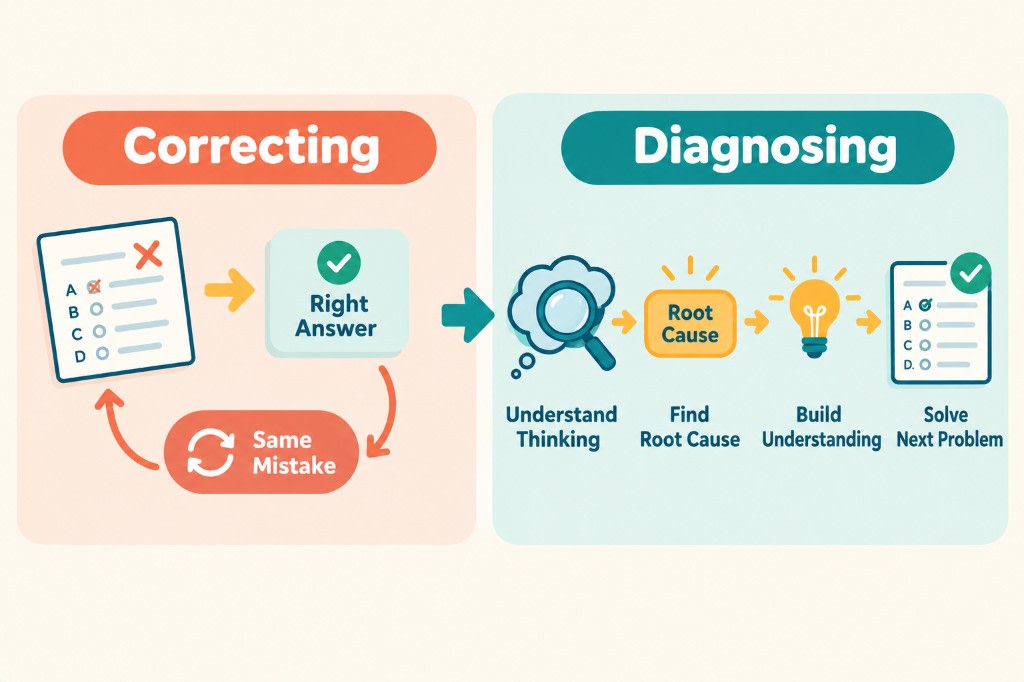
- Knowing the right answer isn't the same as fixing the mistake. If it comes back, the cause wasn't addressed.
- Sort errors by the thinking behind them: conceptual, procedural, misinterpretation, careless, or strategy/time.
- Ask to understand first: "Walk me through what you were thinking."
- Test the fix on a differently worded problem before moving on.
If you'd like help uncovering what your child's mistakes are really saying, book a free consultation with Asymptode. Our 1:1 online math and science tutors diagnose the deeper conceptual gaps, adapt to your child's learning style, and build understanding that lasts well beyond test day.