

As a parent, you want your child to truly grasp math and science, not just memorize facts for a test. You worry about them falling behind, frustrated by group classes where their specific struggles get lost. You dream of a solution that adapts to their unique learning style, building confidence and a strong foundation for the future.
At Asymptode, we understand these concerns. Our 1:1 online math and science tutoring is designed to move "beyond the login," focusing on personalized teaching strategies that unlock deep learning and genuine understanding for your child. We don't just teach subjects; we cultivate a love for learning and problem-solving.
Uncovering Your Child's Unique Learning Hurdles
One of the biggest frustrations for parents in traditional group settings is the feeling that their child's specific difficulties are overlooked. How can a teacher address 30 different learning gaps simultaneously? In a 1:1 environment, our approach is fundamentally different.
We usually don't begin by treating the first session like a formal test. Instead, our tutors spend time getting your child comfortable, often starting with a topic they enjoy or are interested in. This relaxed atmosphere helps build rapport and reduces anxiety. Once we've worked through something together, we engage your child with questions about what was just covered, listening carefully to how they think through the answers. This isn't about right or wrong; it's about understanding their thought process.
This gives us a much clearer picture of where the student actually stands. For example, if we're working on fractions, we're not simply interested in whether they can answer one fraction question correctly. We want to understand which parts they already know comfortably and where their understanding starts to break down. From there, the tutor can continue from the student's actual level rather than unnecessarily starting from the beginning or jumping too far ahead.
For a completely new topic, such as trigonometry, we first look at whether the foundational knowledge needed for that topic is in place. In science, real-life examples can be incredibly useful because they often reveal whether a student genuinely understands an idea or is just remembering a definition. The important part is that we keep reassessing as we go. Our team pays attention to each student's progress and adjusts the learning plan based on what the child needs, even beyond the individual lesson.
Personalized Strategies for 'Aha!' Moments
Many parents seek tutoring because general explanations aren't clicking for their child. Our tutors excel at creating those 'aha!' moments through truly personalized instruction. A simple example would be fractions. Two students in the same grade can both be "studying fractions" while needing completely different things.
One student may already understand what fractions represent but struggle when adding fractions with different denominators. Another may still be unsure why one-half and two-fourths represent the same amount. Giving both students the same explanation would not really be personalized or effective.
So, the tutor starts by asking a few questions and working through examples with the student to find their current level of understanding. If the foundations are already clear, we move forward from there instead of repeating everything they already know. If a gap appears, we slow down and address that specific gap first. This ensures every minute of the session is productive and tailored.
The same adaptive approach works with new topics too. Before moving into something more advanced, we check whether the knowledge needed to understand it is actually in place. The goal isn't to rush through a chapter because that's what the textbook says should happen next. It's to help the student build enough understanding to take the next step confidently, fostering genuine mastery.
Engaging Diverse Learning Styles for Tangible Concepts
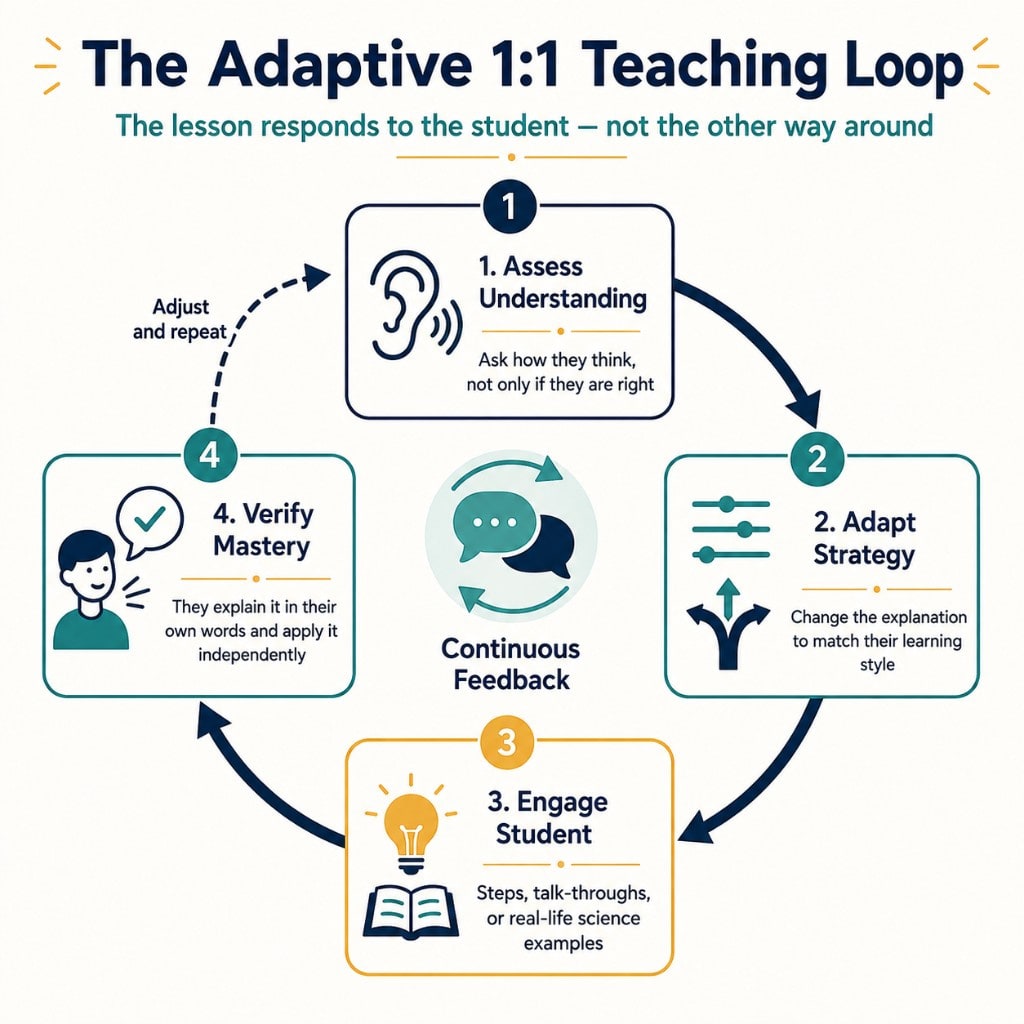
Beyond just explaining concepts, our tutors actively engage students with different learning styles to make abstract math or science concepts tangible and memorable. In a 1:1 session, the tutor can actually pay attention to how the individual student is responding instead of continuing with one fixed explanation for an entire group.
Some students understand something much faster when they can see it worked out step by step. Others need to talk through the reasoning and ask questions along the way. Sometimes a practical or real-life example makes an abstract science concept much easier to understand, connecting theory to their world. If the initial approach isn't clicking, we change it. The advantage of 1:1 tutoring is that the lesson can respond to the student rather than expecting the student to keep up with a fixed teaching pace.
We also don't assume that a student has understood something just because they nodded while the tutor was explaining it. We ask questions, let the student explain things back in their own words, and see how independently they can apply what they've learned. This active recall and application solidify their understanding, moving beyond passive listening.
Prioritizing Deep Conceptual Understanding for Long-Term Success
Many educational approaches focus on getting the right answer quickly. While getting the right answer matters, we don't see it as the end of the learning process. A student can sometimes arrive at the correct answer by remembering a method without really understanding why that method works. This can lead to future struggles when problems vary slightly or become more complex.
We would rather know whether the student can explain their thinking, handle a slightly different version of the question, and work independently when the tutor is no longer guiding every step. This cultivates true critical thinking and problem-solving skills.
That can sometimes mean slowing down. If a student is rushing through a topic but a basic gap becomes visible, it's usually better to deal with that gap before moving ahead. It may feel slower in that particular lesson, but it can prevent the student from repeatedly getting stuck later when the subject becomes more difficult. This investment in foundational understanding pays dividends in the long run.
Over time, that deeper understanding is what helps students become less dependent on memorizing steps or waiting for someone to tell them what to do next. They develop the confidence and capability to tackle new challenges independently. Of course, progress also works best when the student puts in some effort outside the lesson as well, including completing homework or practice when needed, reinforcing what they've learned.
Key Takeaways
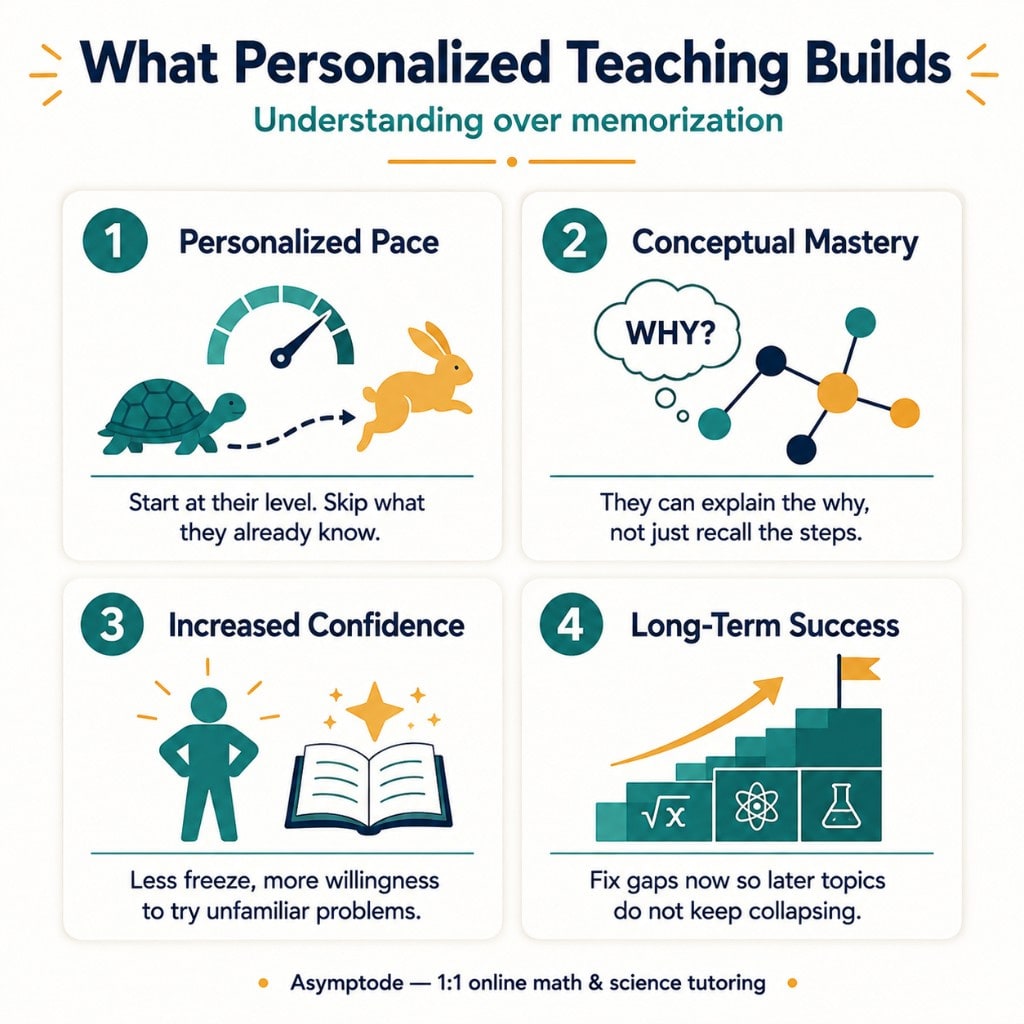
At Asymptode, our teaching strategies are built around your child's individual needs. We prioritize understanding over memorization, adapt to their unique learning style, and continuously assess their progress to ensure genuine comprehension. This personalized, flexible approach helps children build confidence, master challenging concepts, and develop a lasting love for learning math and science.
If you're ready to see your child thrive with a tutoring solution that truly understands and adapts to them, explore Asymptode's 1:1 online math and science tutoring today. Visit Asymptode.com to learn more and give your child the foundation they deserve.