

If you've searched "progress learning" hoping to understand how your child is really doing in math and science, you've probably landed on results for a K-12 software platform of the same name login pages, district dashboards, test-score portals. That's not what this article is about.
This is about a different kind of progress learning: the everyday, human signals that tell you whether your child is actually building understanding not just checking boxes on a worksheet or a quiz.
Why Grades Don't Tell the Whole Story
Report cards feel objective. A number or a letter grade seems like solid proof of where your child stands. But grades measure performance on familiar questions at a single point in time they don't tell you why a score changed, or whether your child could apply that same concept to something they've never seen before.
If you've ever felt like a tutoring update was just a tally of "hours completed" or "worksheets finished," you're not imagining the gap. Many services report activity, not learning. Parents are left knowing that something happened, without ever finding out what actually changed in their child's thinking.
What True Progress Actually Looks Like

Genuine progress in math and science is a shift from rote memorization to real comprehension from "I was told how to do this" to "I understand why this works." Here's what that shift tends to look like in practice:
- They can explain it in their own words. Not repeating a formula, but describing the idea as if teaching a friend.
- They attempt unfamiliar problems instead of freezing or asking for the formula first.
- They catch and correct their own mistakes, often before you point them out.
- They connect ideas across topics noticing, for example, that a pattern from algebra shows up again in geometry.
- They ask better questions "why" and "what if," not just "what's the answer."
- They need fewer hints and less reassurance over time.
The clearest signal of all might be a simple change in language: from "I don't know how to do this" to "Let me try and figure it out." That shift in mindset tends to matter more for long-term learning than a short-term bump in marks.
Three Questions Every Parent Can Ask
You don't need a dashboard to start tracking this. A short conversation with your child's tutor or a few minutes watching them work at home can reveal a lot.
"Can my child explain this concept in their own words, without your help?" This is one of the fastest ways to tell the difference between memorization and real understanding. If they can put it simply in their own language, they've likely internalized it.
"What happens when you give them a problem they've never seen before?" A child who's genuinely learning will reason through something unfamiliar, even without landing on the right answer immediately. That reasoning process is the skill not the final number.
"What has changed in how they approach mistakes?" Watch at home: Do they give up right away? Ask for the answer? Or try a different approach and talk through their thinking? Kids who are progressing tend to get more independent, more curious, and more willing to sit with a problem that doesn't have an obvious answer yet.
How We Think About Progress Learning at Asymptode
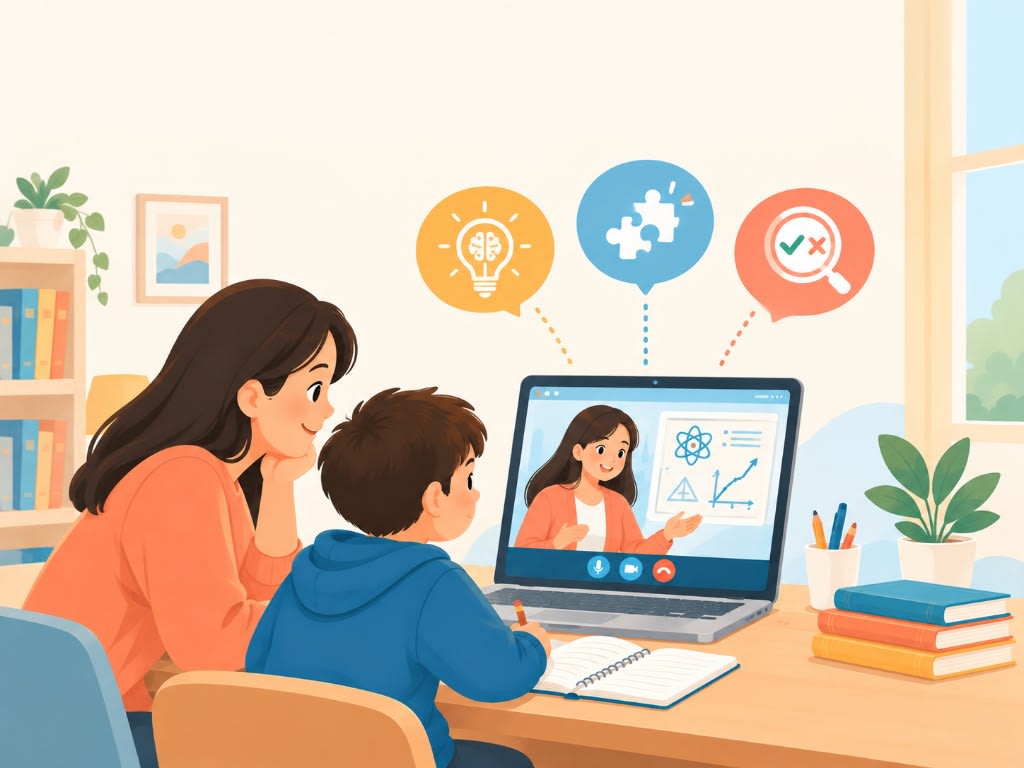
We built our tutoring approach around a simple idea: parents deserve a learning story, not just a scoreboard. That means for every child, we're tracking:
- The core gap the specific misconception or foundational hole we identified
- The adjustment how the tutor changed their teaching approach to address it
- Independent understanding whether the child can now explain the concept on their own
- Applied skill whether they can use it on a problem they haven't seen before
Alongside that, we watch for the same signals covered above: fewer repeated mistakes, fewer hints needed, sharper questions, and a growing willingness to attempt harder work.
None of this shows up as a single metric on a platform. It's a picture one that changes week to week of how your child is actually learning, not just what they've completed.
The Bottom Line
Understanding your child's true progress means looking past the letter grade and toward the underlying shift: are they thinking more independently? Reasoning through the unfamiliar? Catching their own errors? Those are the signs that stick, long after a single test score fades.
If you're ready for tutoring that reports on learning, not just activity, explore Asymptode's 1:1 online math and science tutoring paced to your child's stage, and built to make real progress visible. Visit asymptode.com to learn more.