

As a parent, watching your child struggle with math and science can be incredibly frustrating — even heartbreaking. You want them to genuinely understand, to build a strong foundation, and to feel confident, not just memorize for tests. You've likely already explored several online math programs, hoping to find the one that helps your child catch up and get ahead.
But with so many options promising quick results or endless practice, how do you tell a program offering a short-term fix from one that actually builds foundational understanding? This guide will help you navigate the landscape of online math programs and focus on what truly matters for a struggling learner.
Beyond the Buzzwords: Understanding "Long-Term Success"
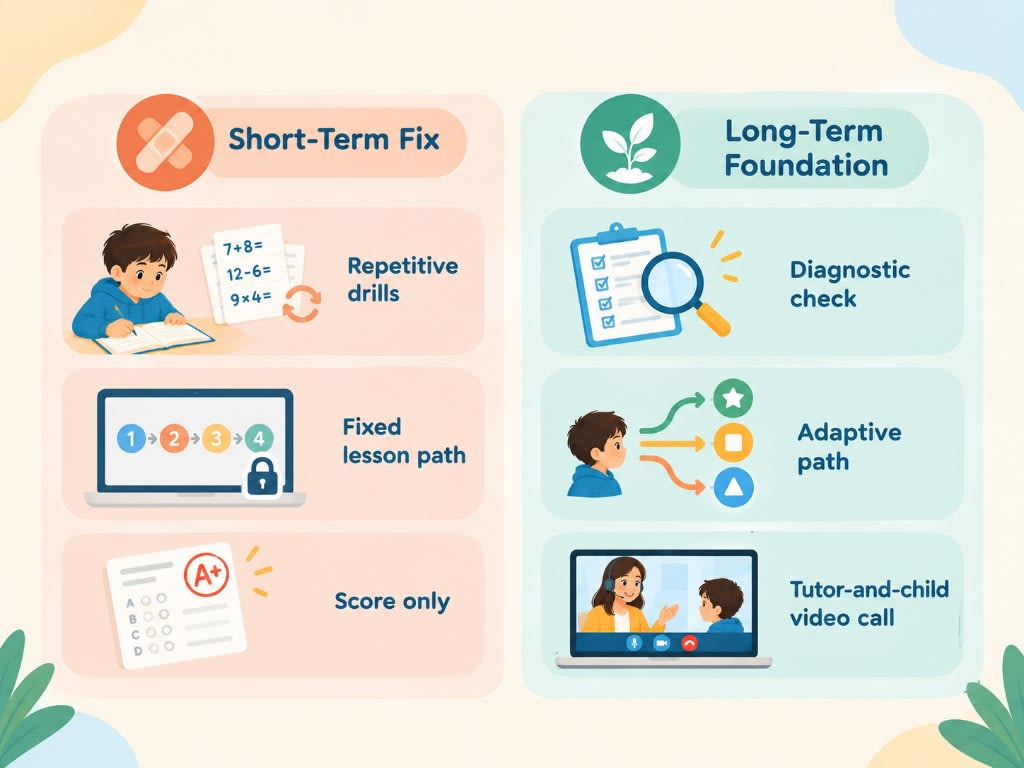
Many programs boast about completion rates or quick score improvements. But the real difference between a short-term fix and a program building lasting understanding is simple: does it measure how well a child understands — not just how much they complete.
A short-term program often relies on repetitive practice, fixed lessons, and teaching students "which method to use" for a given problem type. That might produce a temporary bump in scores, but it rarely touches the root cause of the struggle — like patching a leaky roof instead of fixing the structure underneath.
A deeper, more effective program does three things differently: it first diagnoses the underlying gap in understanding, then adapts the teaching and pace to your child's needs, and gives feedback on their reasoning — not just whether the final answer was right. Crucially, it checks whether your child can explain and apply the concept in unfamiliar situations, and revisits key concepts later to confirm real retention, instead of assuming one correct answer means mastery.
A question worth asking any program: "What happens when my child keeps getting the same type of question wrong?" If the answer is simply "more practice," that's a sign of a short-term fix. The real difference isn't how fast a program can move a score — it's whether your child becomes capable of learning and solving problems independently when the questions get harder and the context changes. That's what long-term success actually looks like.
The Pitfall of "More Practice": Identifying True Foundational Learning
When a child is genuinely struggling and falling behind, the instinct — for programs and parents alike — is often to hand them more worksheets or drills. But the real turning point comes from finding the gap before pushing the student forward. A struggling student usually doesn't need more content; they need someone to identify the missing foundation or misconception making the current topic hard.
This is where personalized, 1:1 support makes a real difference. A tutor can slow the pace down, rebuild the missing foundation with conceptual explanations and visual models, and give immediate feedback based on the student's actual reasoning — with the learning path adapting as the student improves and needs progressively less support.
For example, a student struggling with algebra might look like they just need more practice, but the real issue could be a misunderstanding of what the equals sign means. Fixing that one underlying concept can unlock several later topics at once. The real turning point is when a child stops thinking "I'm behind" and starts thinking, "I understand what I was missing — and I can figure this out."
Building Confidence, Not Just Scores: Nurturing a Love for Learning
Beyond academic progress, parents rightly worry about their child's emotional relationship with math. A good program should treat confidence as part of learning, not a separate issue. A child who struggles repeatedly can quickly start believing "I'm just bad at math" — so a program should create a safe environment where mistakes are expected, progress is visible, and challenges are matched to where the child actually is.
Instead of tracking only scores, look for programs that pay attention to behaviors like:
- Willingness to attempt a hard problem
- Ability to explain their reasoning
- Fewer requests for reassurance
- Growing independence
Small, achievable breakthroughs before increasing difficulty help shift how a child experiences struggle over time — "I don't know yet" gradually replaces "I can't do this." That shift, from fear of being wrong to curiosity about figuring things out, is what turns math from a source of anxiety into something a child can genuinely enjoy.
Choosing Wisely: Your Actionable Checklist for Online Math Programs
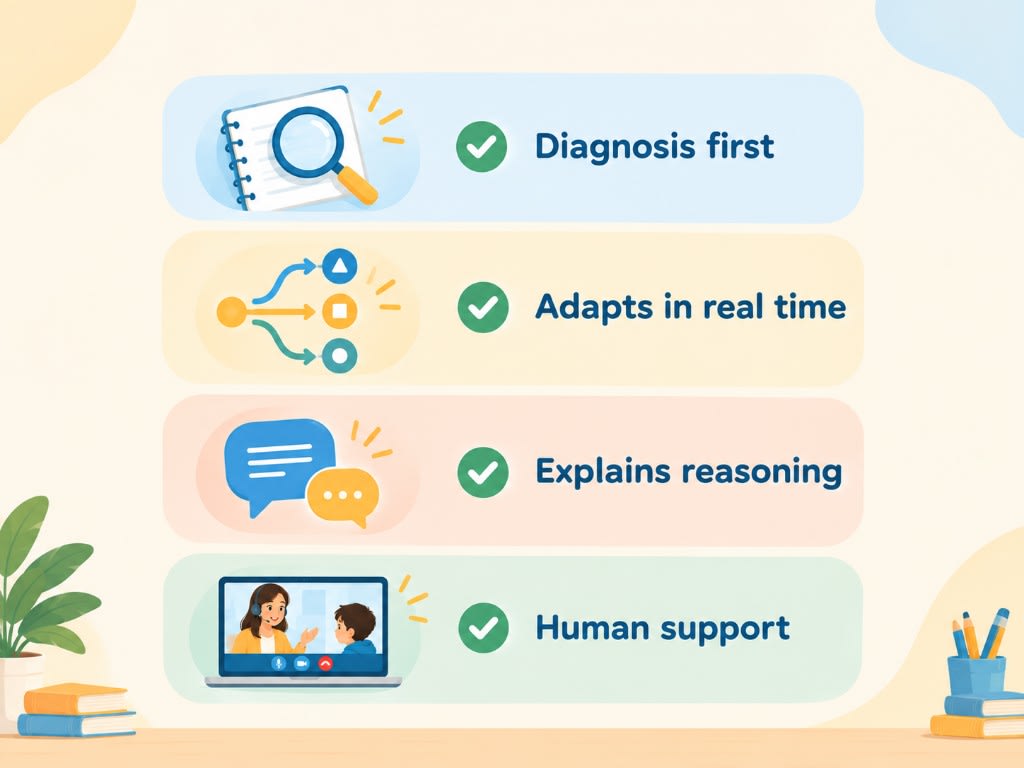
A common mistake parents make is choosing a program based on gamification, speed, price, or how many topics it covers — rather than whether it can actually fix the child's foundation. A struggling student usually doesn't need more content; they need someone to identify why they're struggling.
When evaluating a program, look for:
- Diagnosis first — does it thoroughly identify your child's specific learning gaps before prescribing a curriculum?
- Adaptive teaching — can the approach and pace adjust in real time to your child's progress and struggles?
- Conceptual explanations — does it prioritize real understanding over rote memorization and procedural steps?
- Personalized feedback — does your child get specific feedback on their reasoning and mistakes, not just "right" or "wrong"?
- Retention checks — does it revisit important concepts to confirm long-term retention, not just short-term recall?
- Human support — is there access to qualified, empathetic 1:1 help when your child gets stuck?
- Independent application — does it help your child apply concepts in new, unfamiliar situations?
Choose the program that builds your child's ability to think — not just the one that makes learning look faster or more engaging.
Key Takeaways
Finding the right online math program for a struggling child means looking past surface-level features and focusing on core pedagogical principles. Prioritize programs that:
- Measure understanding, not just completion — look for evidence of real conceptual learning.
- Diagnose and adapt — the program should identify specific gaps and tailor the learning path around them.
- Provide personalized support — 1:1 guidance is often essential for rebuilding foundations.
- Foster confidence — a safe environment where mistakes become opportunities to grow.
- Build independent thinking — the real goal is a child who can solve problems confidently on their own.
By focusing on these elements, you can choose an online math program that doesn't just help your child catch up — it builds a genuine, lasting love for learning math and science. Explore how personalized 1:1 online tutoring can make a difference for your child at asymptode.com.