

If you've hired a tutor before, you've probably lived through the black box. Session after session goes by. Homework gets done. Maybe a report card shows a small bump, maybe it doesn't. When you ask how it's going, you get "doing better" or "needs more practice." You're paying for progress, but you have no real way to see it, understand it, or trust it.
That black box more than any specific subject or skill gap is often what makes parents anxious about tutoring. Not knowing why a child is struggling. Not knowing what's actually being done about it. Not knowing whether the plan is working until the next test arrives.
A quick note before we go further: if you searched "progress learning" and expected a K-12 school platform with logins and district dashboards that's a different product. This is about something else: what progress actually looks like when a child gets personalized, 1:1 attention, and how a parent can see it happening in real time.
Progress isn't a score. It's a learning story.
At Asymptode, progress learning means making the journey visible not just the result. A test score tells you where a child landed. It doesn't tell you what got them there, or what's still shaky underneath.
Real progress includes things a mark can't capture on its own:
- Can the child explain the idea in their own words, or just repeat steps?
- Can they handle a problem that looks unfamiliar, or only ones they've drilled?
- Do they catch and fix their own mistakes?
- Do they need fewer hints than they used to?
- Do earlier concepts stick, or fade once the test is over?
When these things are tracked, progress stops being a vague feeling and becomes a visible chain:
Gap → what changed → evidence of change → next goal
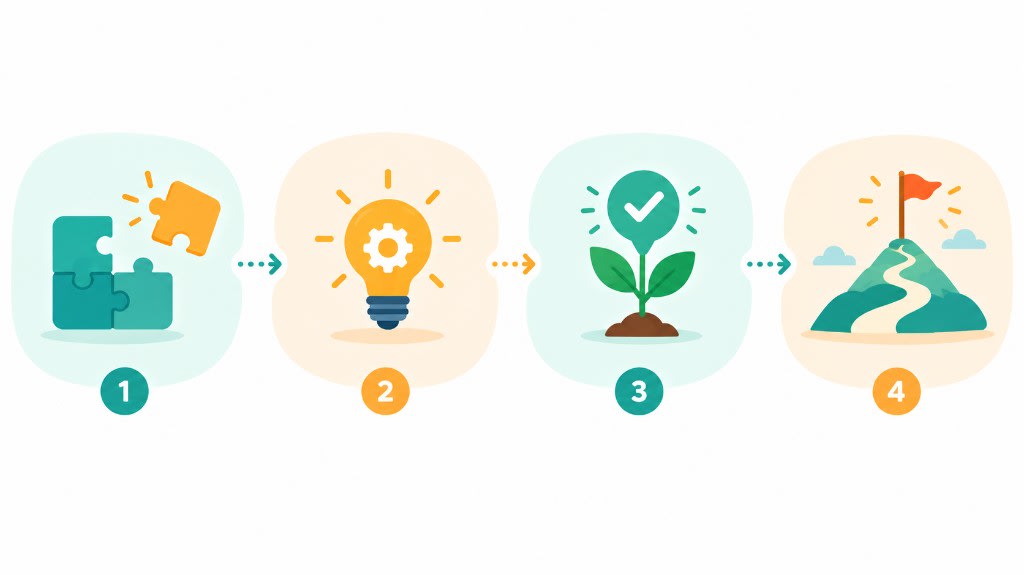
That's a very different promise than "your child is improving." It's specific, it's checkable, and it's something you can actually follow along with.
How it actually gets tracked
The mechanism behind this is simple: track learning evidence, not activity. Worksheets completed and hours logged don't tell you much. What matters is a living picture of:
- Concepts the child has genuinely mastered
- Foundational gaps sitting underneath the current topic
- Misconceptions that keep resurfacing
- How independently the child can work
- How much prompting they still need to get there
In a 1:1 setting, a tutor can actually maintain this because they're watching one child closely, not managing a classroom of thirty.
That picture then gets translated into two things parents actually see:

- An after-session note what was learned, what was hard, what the tutor changed in their approach, evidence of progress, and what's next.
- A periodic progress report trends across concepts over time, not a single test number.
Here's what that looks like in practice:
"Fractions: adds with common denominators independently; still needs support when denominators differ; next visual modelling and application problems."
No dashboard required. No jargon to decode. Just a clear, honest snapshot of where things stand and what's coming next.
A closer look: the Grade 7 fractions example
Here's a hypothetical example of how this plays out.
A Grade 7 student had inconsistent Maths marks good on some tests, poor on others. The natural assumption, for most parents, would be "they just need more practice." More worksheets, more repetition, hope for the best.
But in the first few 1:1 sessions, a different pattern emerged. The student could handle familiar procedures without trouble but the moment a problem was framed even slightly differently, they got stuck. That's not a practice problem. That's a gap problem. Digging deeper, the tutor traced it back to fractions and proportional reasoning a foundation that had never fully solidified, quietly undermining everything built on top of it.
So instead of piling on more of the same worksheets, the tutor rebuilt that foundation directly: visual models, and problems deliberately varied so the student had to think, not just pattern-match. Over the following weeks, something shifted. The student went from needing frequent prompting to solving similar problems independently and explaining their reasoning without being asked to.
The part that actually changed things for the parents wasn't the improved marks. It was the update they received. Not "your child is improving" but:
"Here was the original gap. Here's what we changed. Here's what they can now do on their own."
That reframe mattered. The parents had assumed their child simply "wasn't a Maths person." What they learned instead was that their child had been building on a foundation that wasn't secure a fixable, understandable problem, not a fixed trait. Anxiety turned into a clear plan.
Why this matters more than the mechanics
None of this is really about tracking systems or reporting formats. It's about what a parent gets to feel at the end of it: peace of mind that comes from actually understanding how and why their child is progressing not just being told that they are.
And for the child, it matters just as much. Visible progress being able to point to a gap that's closed, a problem they can now solve alone builds a kind of confidence that a test score alone rarely does.
That's the real difference personalized 1:1 tutoring can offer: progress you don't have to take on faith, because you can actually see it the gap, the change, the evidence, and what's next.
Ready to replace the black box with a clear learning story? Explore Asymptode's personalized 1:1 online math and science tutoring at asymptode.com.