

As a parent, watching your child struggle with math or science homework can be incredibly frustrating. You want to help, but complex concepts often leave you feeling ill-equipped, resorting to simply re-explaining the textbook or giving the answers. You worry they're falling behind, losing confidence, and dreading subjects that are crucial for their future.
You're not alone. Many parents face this challenge. But what if you could adopt teaching strategies that go beyond just 'telling' and truly foster a deep, resilient understanding? What if you could empower your child to reason, question, and solve problems independently, much like an expert 1:1 tutor would?
This guide will reveal five proven teaching strategies, inspired by effective tutoring approaches, that you can implement right at home. These aren't just general pedagogical tips; they're specifically tailored for the unique demands of math and science, helping your child build a strong foundation and regain their confidence.
1. Shift from 'Telling' to 'Questioning': The Socratic Method at Home
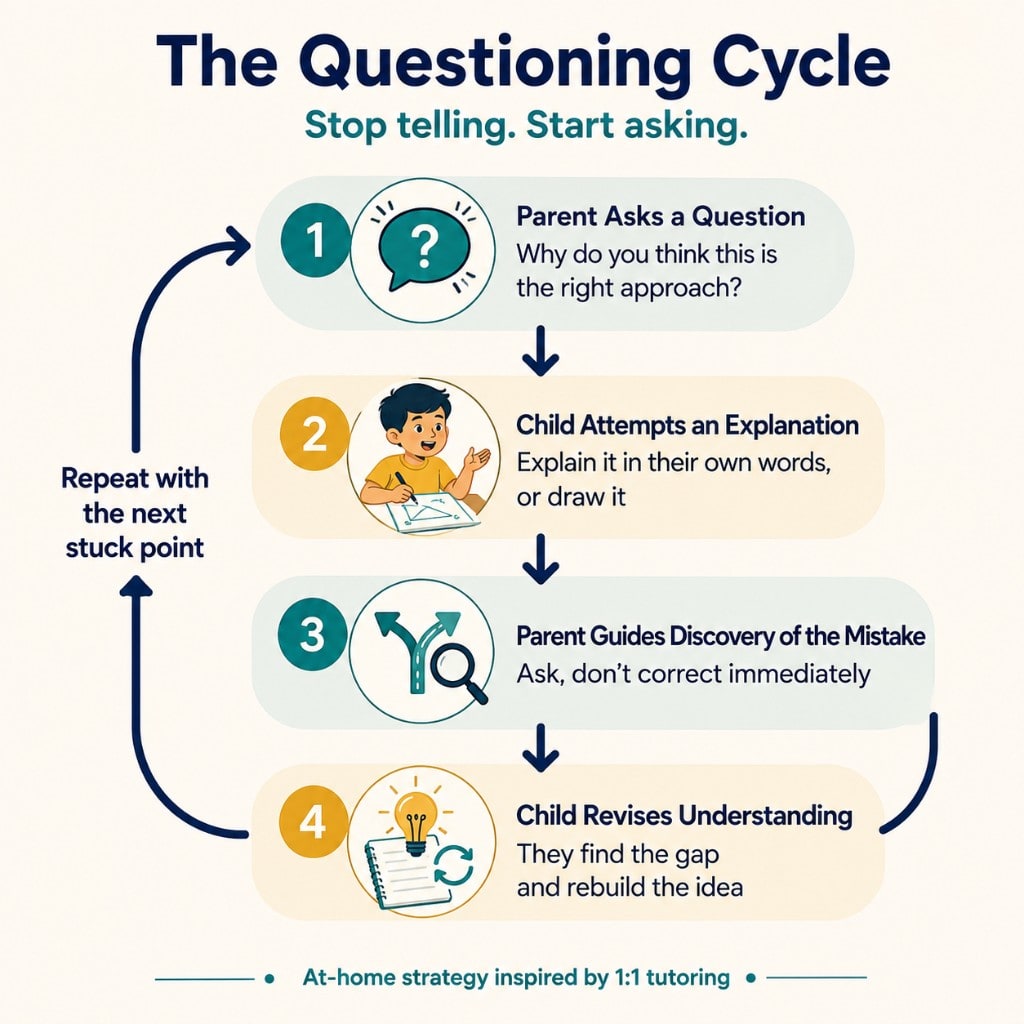
One of the most fundamental shifts you can make, mirroring expert 1:1 tutoring, is to stop giving the answer immediately and start asking questions instead. Instead of re-explaining homework, engage your child with questions like, "Why do you think this is the right approach?" or "Can you explain this concept in your own words?"
Encourage them to draw a picture, try a simple example, or even explain the problem to you. If they make a mistake, resist the urge to correct it right away. Instead, ask guiding questions that help them discover where their thinking went wrong. This approach transforms your child from a passive recipient of information into an active problem-solver, fostering genuine understanding rather than rote memorization.
2. Focus on Reasoning, Not Just Remembering
Math and science demand more than general teaching advice; students must learn to reason, not just remember. A child might know a formula but still not understand when or why to use it. This is where parents have a unique opportunity at home.
Focus on the underlying concepts, the 'why' behind the 'what.' Connect abstract ideas to simple, real-life examples, everyday observations, or even small, safe home experiments. Use diagrams to visualize complex processes. The goal is to help your child build strong conceptual foundations and confidence, rather than simply finish their homework. By observing closely, you can notice exactly where your child gets stuck and use targeted questions to guide them through the reasoning process.
3. Beyond 'Drill and Kill': Emphasize Understanding First
Many well-intentioned parents fall into the trap of "drill and kill" — giving children lots of similar questions, believing more practice automatically leads to better understanding. This often backfires because a child may learn the steps without truly grasping the concept behind them.
A more effective, Asymptode-inspired alternative is to prioritize understanding first. Before extensive practice, ask, "Why does this work?" and "Can you explain it in your own words?" For example, instead of solving twenty similar Physics problems, work through a few different types, discussing the thinking and principles behind each one. At Asymptode, we focus on understanding first, then use practice to strengthen that understanding. The goal isn't more questions; it's better thinking.
4. Embrace Mistakes as Powerful Learning Opportunities
Traditional methods often penalize mistakes, leading children to fear them. At Asymptode, we view mistakes as invaluable learning opportunities. To equip children with a deeper, more resilient understanding, encourage them to explain their thinking, question assumptions, and even try to solve problems in different ways.
Introduce unfamiliar problems that require applying concepts rather than memorizing fixed steps. When a mistake occurs, treat it not as a failure, but as a clue to a misconception. By helping your child understand and correct these misconceptions, you build stronger critical thinking and problem-solving skills. This approach fosters long-term retention, allowing your child to use what they've learned in new situations, even weeks or months later.
5. Cultivate a Growth Mindset and Intrinsic Motivation
Beyond specific techniques, fostering a growth mindset is paramount. Help your child understand that intelligence isn't fixed; it grows with effort and effective strategies. Praise their effort and process, not just the correct answer. Celebrate their perseverance through challenging problems.
Encourage curiosity by exploring topics beyond the curriculum. Watch documentaries, visit science museums virtually, or simply discuss how math and science apply to everyday life. When children see the relevance and joy in learning, their intrinsic motivation blossoms, transforming their attitude towards challenging subjects.
How Asymptode Elevates These Strategies
While these strategies empower you at home, expert 1:1 tutoring at Asymptode takes them to the next level. Our tutors are trained to implement these very methods, adapting them precisely to your child's unique learning style and pace. We provide the consistent, structured routine that makes learning less of a fight and more productive, ensuring your child receives the personalized attention they need to thrive.
We focus on helping students understand why an answer is correct, not just how to get it. We encourage questioning, critical thinking, and treating mistakes as stepping stones to mastery. This builds not just better grades, but a lasting love for learning math and science.
Key Takeaways
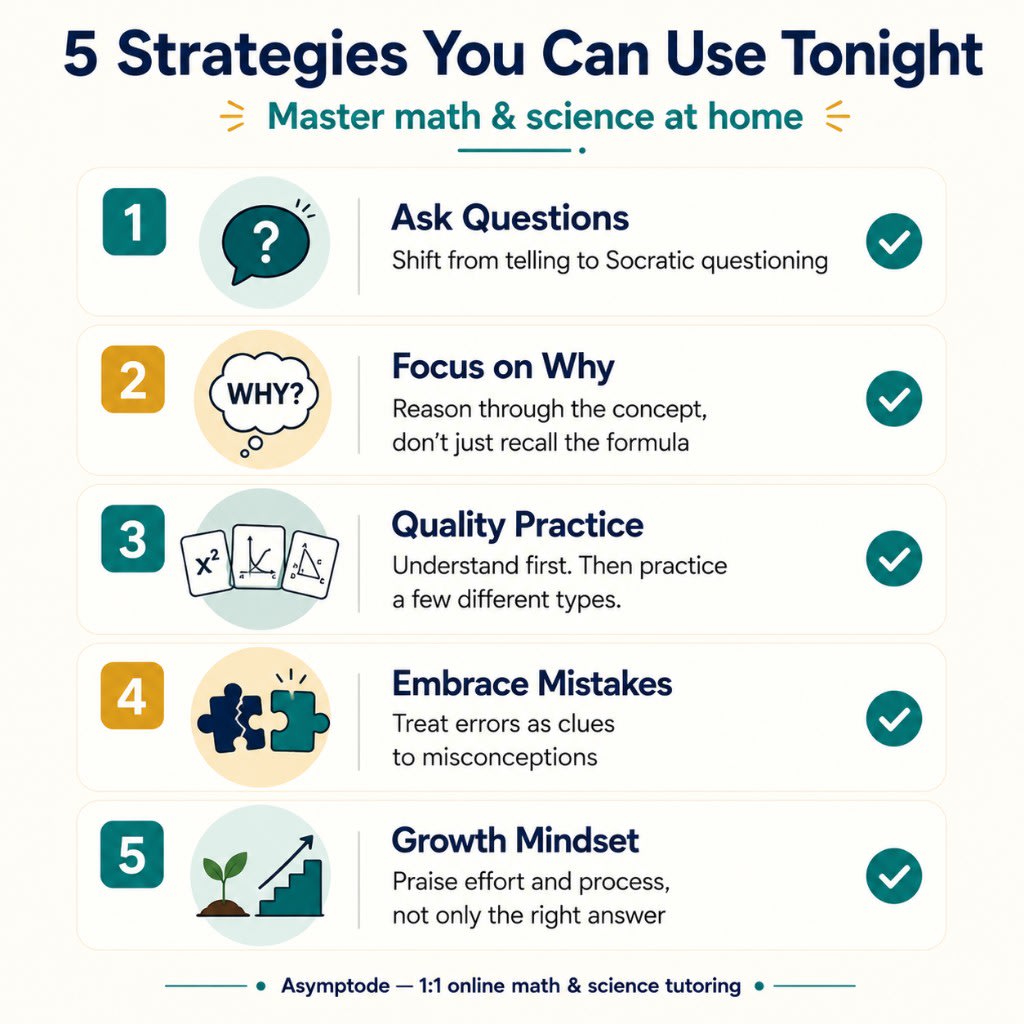
Empowering your child in math and science doesn't require you to be a subject expert, but rather an expert facilitator. By shifting to a questioning approach, prioritizing conceptual understanding over rote memorization, embracing mistakes, and fostering a growth mindset, you can significantly impact your child's academic journey.
These strategies, inspired by the best practices in 1:1 tutoring, help your child develop genuine comprehension, critical thinking skills, and the confidence to tackle any challenge. Imagine your child not just passing tests, but truly mastering concepts and approaching new problems with excitement rather than dread. That's the power of effective teaching strategies, applied right in your home.
Ready to see the difference personalized, expert-led learning can make? Explore Asymptode's 1:1 online math and science tutoring today and give your child the foundation they need for future success.